
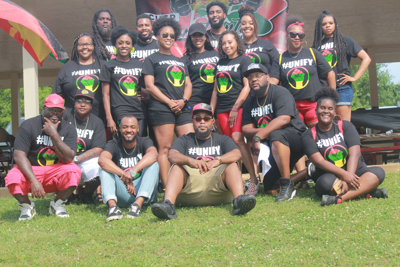


Juneteenth celebration in Winchester, Tenn.
Gina Johnson remembers vividly the night in 1966 that her dad came home bruised and bloodied. There were scratches covering his arms, and his bruised knuckles were turning purple. Four years old at the time, Johnson climbed into his lap and gently touched his busted lip. He winced slightly under her touch.
“Daddy, what happened?” she whispered.
His shoulders fell as he sighed.
Her father was the first Black man hired at Arnold Engineering Development Complex in Tennessee’s Coffee County. He’d been out organizing in the area, registering people to vote — that’s something he did regularly, but he’d never before come home looking like this.
“I started getting angry,” Johnson tells the Scene. “I didn’t want him to keep going out there, but he told me, ‘If everybody decided to stay at home because they were afraid, we would not be any better off than we were.’ That, ‘Sometimes you have to be willing to take a beating or to be called an ugly name to make sure that other people who are more frightened than you have a chance.’ There were the usual threats, the ‘if you know what’s good for you’ kind of things, but he continued to do what he did.”
Johnson says that in the late ’60s, that was normal — the way racism presented itself across the country, even in small towns like Winchester, Tenn., where she’s lived all her life. Her family roots in the area run deep — she’s traced them back to 1808 — as do, she says, the roots of racism in America.
Johnson says in small towns, most folks are outwardly neighborly, and for the most part, if an issue doesn’t affect you, you don’t see evidence of it. But racism’s face is familiar, and it can be seen in small grocery stores, along the boulevard on Saturday nights, behind the mayor’s desk or at the judge’s bench, and even in the pulpit.
“These things happen in every city in the country, but when I was growing up, people weren’t bold [like they are today],” she says. “The incidents of racism and racial violence were isolated. I thought for a long time that racism was not as prevalent here. People tried to act with some decorum and some class. Now they don’t care.”
Protests in response to police brutality and racial violence have grown widespread across the country in recent weeks. According to a survey from USA Today, as of June 18, the recent demonstrations have taken place in at least 1,700 cities and towns in the U.S. so far.
Many demonstrations — like a 150-person protest held in Savannah, Tenn., on June 5 — have been driven by the quick organizing of young people of color. Tensions arising from small-town protests haven’t spawned dozens of arrests like the ones in larger cities — and indeed in Nashville — have over the past several weeks, but organizers like Nicole Harris, who planned the Savannah protest, say showing up for the demonstrations has been intimidating.
Savannah is small, and Harris says because of that, the community is close. There have been counter-protesters and bikers revving their engines to drown out speakers at anti-racism rallies. But since that June 5 protest, community culture has begun to change. Confederate flags have been removed from store windows, and people are having conversations about how to support the Black community in Hardin County. Harris, who is 23, says her main goal is to be heard.
“If you’re yelling, and I yell back, you’re not going to hear me,” says Harris. “You’re just going to yell louder. This is about opening the minds of people who don’t know any different and changing the minds of people who know better. This is about me, a Black person in a small town, coming out the door and dealing with things that should have been left behind 50 years ago.”
Harris and her co-organizers have since formed the Minority Justice Organization, a nonprofit group aimed at advocating for racial justice in the South.
“People think we are trying to erase history, but we are just trying to acknowledge the parts that are bad so we don’t repeat them,” Harris says. “I just don’t want there to be any George Floyds here.”
Harris’ attitude echoes that of many young people of color in American cities, large and small. Terrance Martin, originally from Cowan, Tenn., moved to Brooklyn after college. For the past year, he’s been working as a therapist with those affected by the criminal justice system. He and his partner Lindsey, a born-and-raised New Yorker, fled the city to shelter from COVID-19. When they first got to the South, Lindsey was surprised to see Confederate flags flying in neighboring yards. Welcome to the South, Martin told her.
“When George Floyd was murdered, I wanted to express my pain and exhaustion in having to work constantly to safely navigate a white world that seems to be rooting against my freedom and success,” says Martin, who is Black. “But it’s always seemed like the South wasn’t ready to hear me. We talked about putting a Black Lives Matter flag out, but we were afraid for our safety. I heard there was a protest planned in Winchester, and then that KKK was organizing. We were ready to get in the car to drive back to Brooklyn to join our neighbors there — but I knew that I had to be here.”
Darlene Leong Neal, a community organizer with local advocacy groups including the TN Anti Racist Network and Power Together Tennessee, says the work of Martin and Harris is the tip of the iceberg when it comes to advocacy in rural communities.
“Showing up in a smaller town is riskier than an urban environment,” says Leong Neal. “Often, everyone knows everyone, and the repercussions of taking a stand for justice can mean losing friends or even family connections. Activism can actually be quite traumatic for some in a small town, and it can be really lonely, but it can also be very empowering. We have to fight like hell for our rural spaces, where there are often less resources to tackle social problems.”
Jessica Wilkerson is an assistant professor of history and Southern studies at the University of Mississippi, and the author of To Live Here You Have to Fight. She says activism in rural communities has been pivotal. Wilkerson is originally from Corryton, Tenn., which is about 20 miles northeast of Knoxville and part of the historically socially active Appalachian region.
“Lots of organizing happened in the early 20th century around labor, and the legacies of that work continue,” says Wilkerson. “Sometimes the way that we tell the history of the civil rights movement is through a few key places, but organizing was happening in communities across the South. I’m in Oxford, [Miss.] — a small rural community — but still, protests are starting to happen every day.
“Elizabeth Alexander wrote recently in The New Yorker that the youth who are organizing might be called the Trayvon generation,” Wilkerson continues, referencing the death of Trayvon Martin, the 17-year-old Black boy who in 2012 was shot and killed by George Zimmerman. “They were around the same age, and that was a story that so many of the young folks followed or at least remember. We’re starting to see how that has affected people.”
Terrance Martin says constantly seeing new stories of young Black men being killed has been more painful than he can describe. He sees himself, his friends and his community in the photos of those like Trayvon Martin. And being forced to engage with those stories so frequently, he doesn’t feel that he can continue to let others take the lead in the work.
“Bearing witness to injustice done unto others who look like me — how can I not question those who are responsible?” says Martin. “I was living in Charleston when Dylann Roof entered a historically Black church down the street and murdered nine people in cold blood, just because they looked like me. I can’t be silent. To me, there is no choice. Speaking out is worth the risk. I need to show up for my hometown, to support and empower my community, to validate the pain that is felt here. There’s too much work to do to leave right now.”



Post a comment as anonymous
Report
Watch this discussion.
(0) comments
Welcome to the discussion.
Log In
Welcome to the discussion.
Keep it clean. Please avoid obscene, vulgar, lewd, racist or otherwise abusive language. Comments featuring hate speech or threatening or violent content will not be tolerated.
PLEASE TURN OFF YOUR CAPS LOCK.
Be truthful. Don't knowingly lie or mislead.
Be proactive. Use the “report” link on any comment that violates our comment policy.
Share with us. We'd love to hear your feedback.