
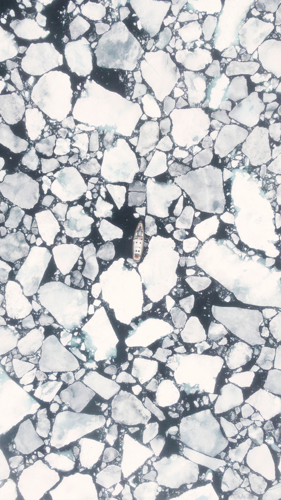


A photo of Ozenger & Co.’s boat taken by a drone
This is what most people know about Svalbard: nothing. The archipelago, roughly halfway between Norway and the North Pole, is fully inside the Arctic Circle and home to the world’s northernmost permanent civilian settlement.
Like in many places on the edges of the earth, the normal rules don’t apply in Svalbard. Activists on both sides of the immigration debate could study the islands — technically under Norwegian sovereignty — for what truly open borders look like. Under a 1925 treaty, citizens of any country that signed the treaty can settle and work on the islands indefinitely and without a visa. Functionally, anybody — citizen of a signatory or not — can do so, and after seven years apply to become a Norwegian subject. Or not. It’s up to them.
Given that the population struggles to crack the 3,000-person mark, very few people have taken advantage of the policy.
Of course, there’s disadvantages to moving there. It’s extraordinarily expensive, relying on aerial or shipborne food drops from the mainland. There’s not much in the way of industry for anyone without a background in coal mining or intense scientific research.
And like many places on the edges of the earth, it can be dangerous. Modern-day explorers searching for Pytheas’ Thule, the legendarily remote northlands, could easily start and finish their quest on Svalbard. A more ghoulish type might set an apocalyptic novel there: Burials have been illegal for decades after scientists discovered corpses buried during the 1918 global flu pandemic hadn’t decomposed, and researchers worried they might still be harboring live strains of the virus that killed one in 20 earthlings.
As ecotourism has taken off, Svalbard has become a destination for travelers, with chartered cruises circumnavigating the archipelago to give well-heeled tourists the opportunity to see polar bears, walruses, seals and the like. There they also see evidence of global warming, which, in temperate zones, can be hard to grasp. A 1-degree Celsius average change in temperature over half a century is imperceptible in the middle latitudes. In the transboreal, it’s hard to ignore glaciers withering away, receding into the northern distance, groaning as they birth ever more icebergs.
Stark, remote and unlike anywhere else, Svalbard drew eight prominent Nashville men for a unique adventure in July — and they ended up getting more adventure than they asked for.
OZ Arts founder Tim Ozgener — a taut and gregarious bundle of enthusiasm — turned 50 in June. His friend, local real estate investment bigwig Frank Garrison — who apparently has a penchant for this type of travel, having visited Antarctica in the past — had been planning the Svalbard expedition for two years and asked Ozgener if he wanted to join up. The other six on the trip: real estate magnate Bert Mathews, longtime health care executive John Deane, corporate finance man Breck Walker, accountant Kevin Crumbo, St. Thomas Midtown chief medical officer Jeff Smallwood, and a fellow named Karl Dean, who used to be mayor.
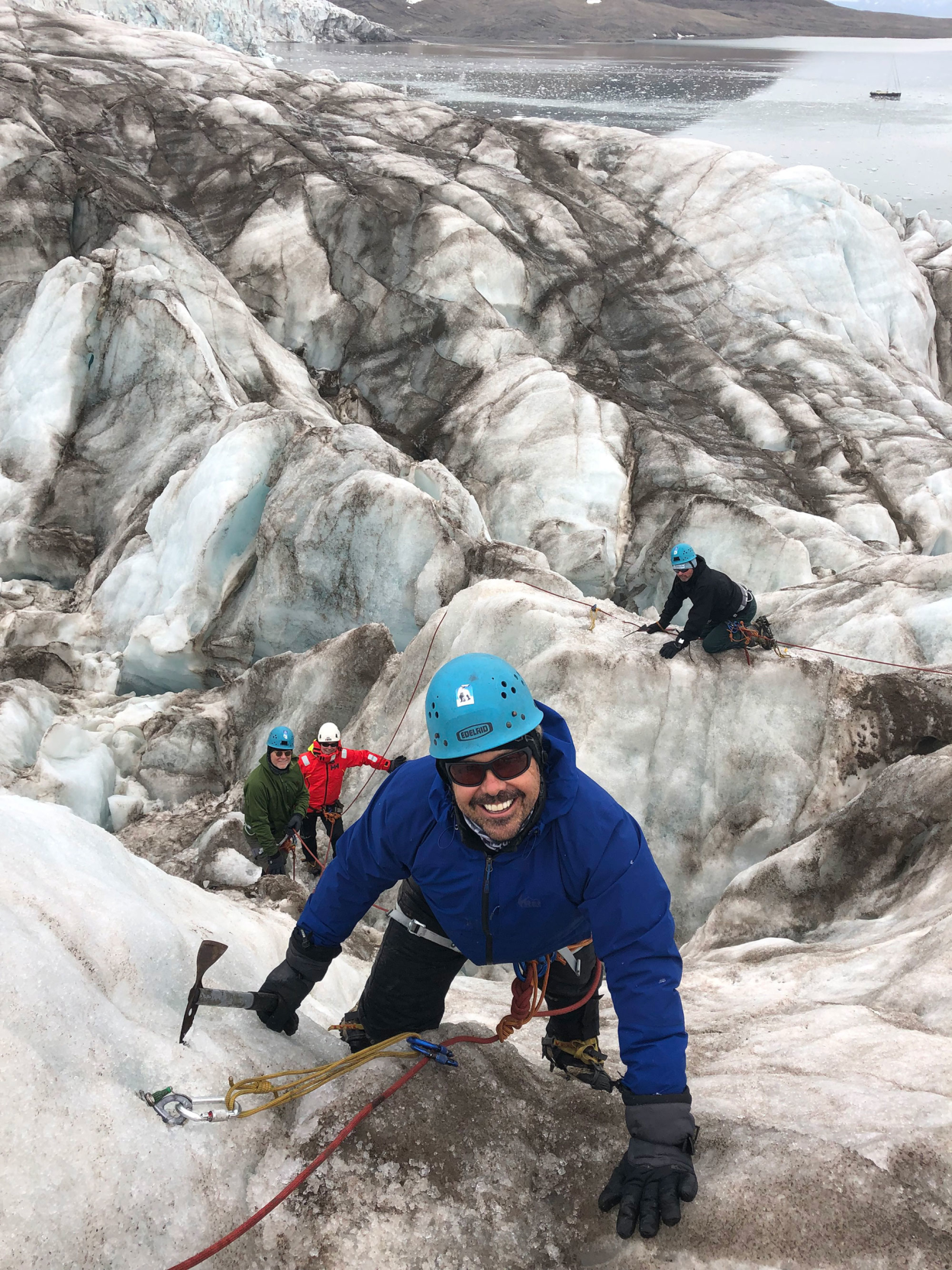
Tim Ozgener, center, as the crew gets into more technical climbs
The octet — perhaps likelier to form a nonprofit board or feature in a spread in our sister publication Nfocus than make up the complement of a Nordic expedition — set out from Svalbard’s largest town, Longyearbyen (population 2,144) on July 9. They were set for a two-week sail around the island.
On Day 1, the 24-year-old captain — who Ozgener says is considered a “savant” in the treacherous and presumably extremely small world of Norwegian Sea sailors — told the group the sea ice forecast was such that he could take them up as far north as the 81st parallel. The North Pole, for illumination’s sake, is 90 degrees north. The group said absolutely.
“‘Are you guys down?’” Ozgener recalls the captain saying. “ ‘Because we have to go now.’ ”
And set sail they did, the captain deftly navigating the fjords and floating sea ice along Svalbard’s west coast, pushing the 65-foot yacht farther and farther north.
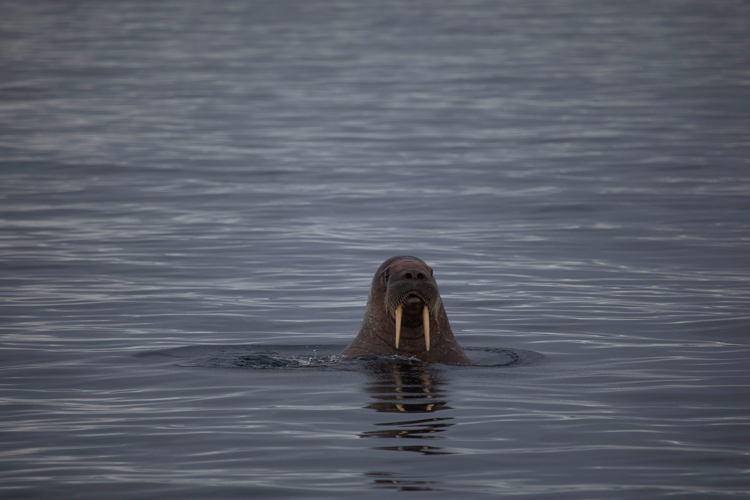
Wildlife — including seven polar bears and walruses — frolicked on nearby shores and alongside the boat. In a bit of foreshadowing, perhaps, the yacht passed a boat that had crept too close to land and foundered on a bar.
Pushing through the ice, they reached the waypoint, surrounded on all sides by bobbing chunks of frozen seawater. It was July, so the area was at its warmest, though its warmest is only about 40 degrees Fahrenheit — but at least the sun never sets. The captain came to the group with another offer: Did they want to get on the ice? The men, who it’s increasingly obvious are definitely up for whatever comes their way, said yes and donned their survival suits, cumbersome insulated coveralls that could keep them from freezing in the piercing sea for an hour or so. The ice was sturdy, Ozgener says, but it was still floating in the ocean, so it would rise and fall with the waves. Video of the excursion shows that it’s not unlike some real-life version of an early 4-bit video game: It takes timing to move from one chunk to the next with the perilous sea flowing underneath.
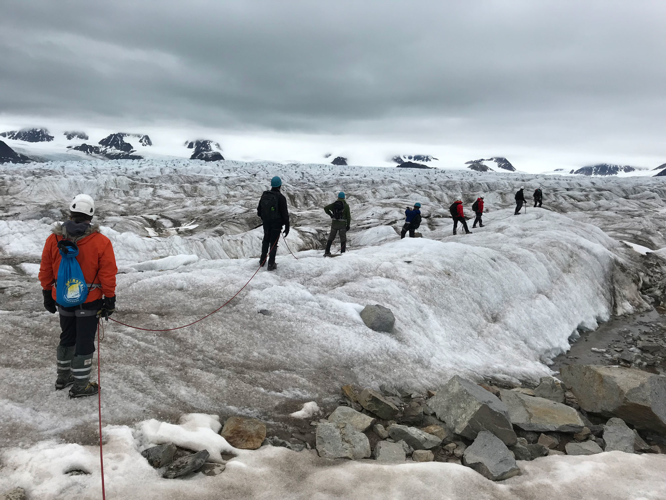
But it’s worth tucking away the fear, Ozgener says, to experience the stark beauty of thousands of miles of ice. Having gone as far north as possible without the aid of an icebreaker — and the ice to be broken is very stubborn indeed, such that the Russians use nuclear-powered icebreakers — the boat turned south and headed for the Svalbardian coast to continue its loop. The group spent the (long, moonless) days on hikes across glaciers, which Ozgener says is like “stepping on the moon” for its empty beauty. They turned east and found that even in midsummer, the Arctic pays little heed to the wants of man: Their passage, which was to send them south down the east coast and then back around to Longyearbyen, was iced over. The boat had to reverse course to make it back.
More hiking, more wildlife watching, more camaraderie was created from the experience. Even among men who are already friends, special bonds beyond the realm of normal bonhomie are built in such isolated places.
And even stronger bonds are built in the wake of danger.
On Sunday, July 21, two days before the trip was to conclude, the ship started to traverse the inlets leading back to Longyearbyen. At 4:30 a.m., the captain woke the group. There was to be one more adventure.
A fire had broken out in the engine room. It had been extinguished, but smoke still lingered. Fires at sea are dangerous situations, and it’s critical they be put out quickly before imperiling the entire vessel. The captain and his crew of three ably dispensed with that danger. But, Ozgener says, a few weeks earlier, a similar small fire had broken out, and — though he faced no immediate ill effects — the captain had fallen ill some 15 hours later, passing out from some chemical whatsit floating in the smoke. Taking no chances, the captain said they were abandoning ship, and everyone needed to don those survival suits.
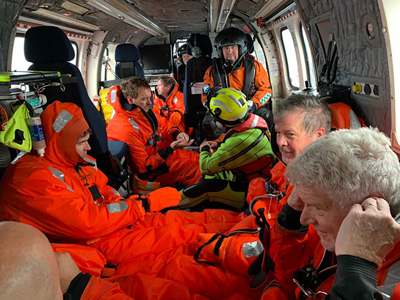
Forced into two inflatable lifeboats in the unforgiving sea, the group waited and quickly heard a pair of helicopters approach overhead. Ozgener was sitting next to the “door” of his raft, which was topped by a sort of tent, when he caught a glimpse of a yellow-clad figure descending from the sky.
“The figure in yellow hits the tent with a harness,” says Ozgener. “I can hear the helicopter with the blades turning, but he’s moving in the wind. My mouth became dry, and I’m thinking to myself, ‘The best thing to do is remain calm, be very aware and very alert.’ ”
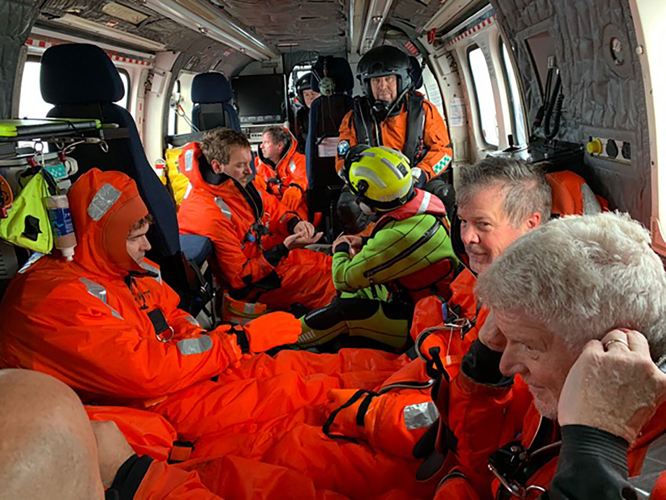
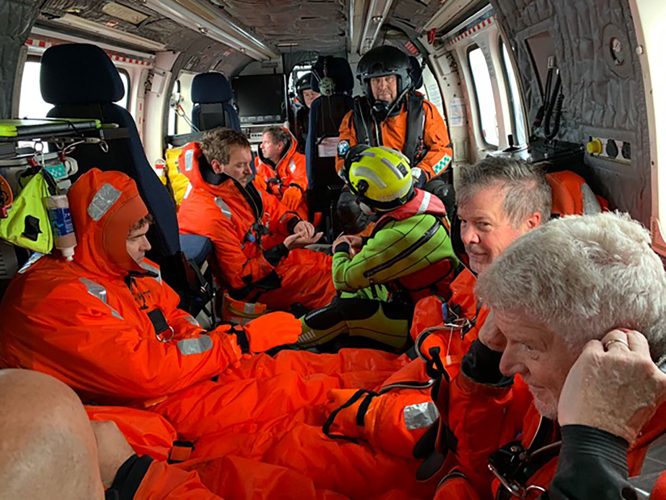
The rescuer attached a harness to the first of Ozegner’s companions after wordlessly but clearly instructing him using gestures — between the wind and the noise of the rotors, verbal communication would be impossible. And up they went, pulled on a line connected to a helicopter 100 feet in the sky. Based on the seating arrangement, Ozgener knew he’d be next.

The rescued Nashvillians onboard the helicopter
“You tend to think about what’s most important to you,” he remembers. “I was thinking I wanted to be there for my kids.”
When the rescuer came back down, she made eye contact with Ozgener, and in a few seconds, up they went.
“The wind hits you and pulls you to one side and then back to the other,” says Ozgener. Held in by a harness and a Norwegian stranger, Ozgener was lifted 100 feet into the air and the safety of the helicopter.
He watched as the rest of his group and the crew were rescued one by one: Ozgener and six others who were in his lifeboat in one helicopter, the other five being pulled from theirs into a chopper operating 40 feet lower. The Norwegians told Ozgener this particularly type of rescue — double-helicopter aerial rescues — are rare. Rarer still was the courage of the captain. The ship’s cook had a tear in his suit, so the captain offered up his dry suit, opting to be rescued in street clothes.
But the rescue from the other lifeboat was a bit different from Ozgener’s. Instead of hauling up the stranded directly from the boat, the rescuer and rescuee were hauled over the gunwale, briefly dipped in the water and then brought up. For those with the survival suits, there’s little to worry about — but a man wearing little more than he might wear on a trip to the grocery, as the captain was, could be in grave danger indeed. All in all, the whole operation took less than an hour between the fire alarm and the time the group got to the barebones hospital in Longyearbyen where everyone was checked for smoke inhalation and given the all clear.
“We were all pretty cool,” Ozgener says. But later that day, when they gathered for a meal of thanksgiving with their crew and their rescuers, he said it hit them. It was emotional. There were hugs for the rescuers and a new sort of connection between the men. There were jokes that The Tennessean would run a story about “Former mayor, seven others rescued.” (Ultimately, the local daily used the phrase “prominent Nashvillians” in its headline, a choice that Ozgener — joking on the square — said pleased the rest of the group.)
“Every single one of us would do it again in a heartbeat,” Ozgener says. “Including the rescue. … It was a life-changing trip, but in a good way. It’s a beautiful, magical part of the world, and you come back understanding why the Arctic has this allure.”

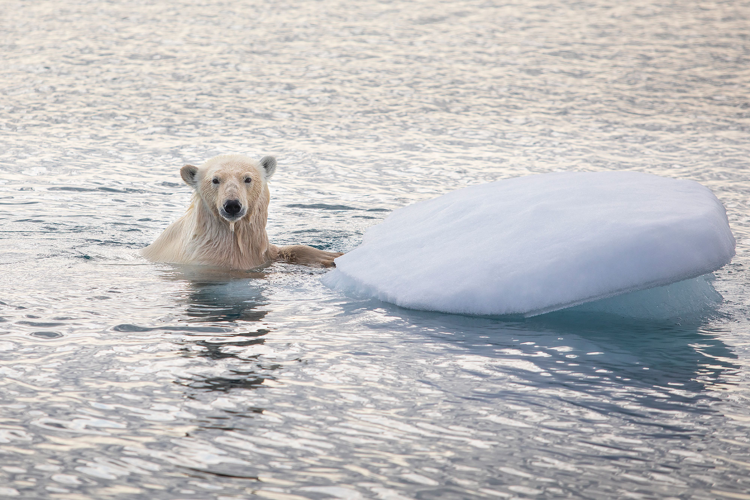
Polar bear that came very close to the boat

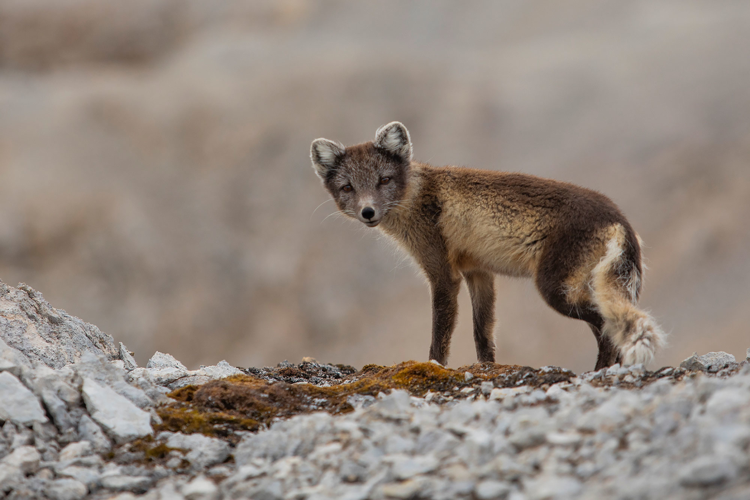
An arctic fox

Glacier hiking

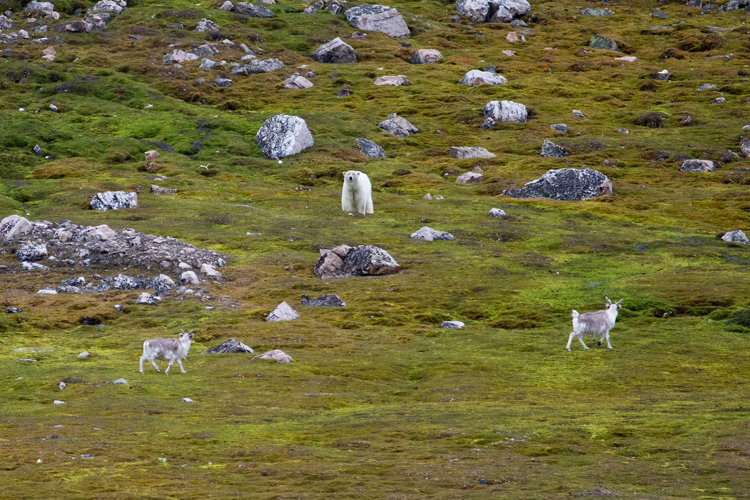
Polar bear and arctic reindeer on a rare patch of greenery

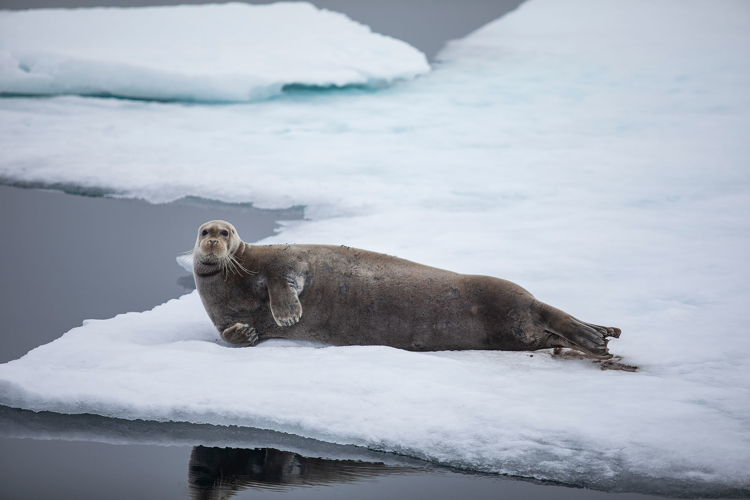
Bearded seal right off the bow of the boat

A male walrus



