
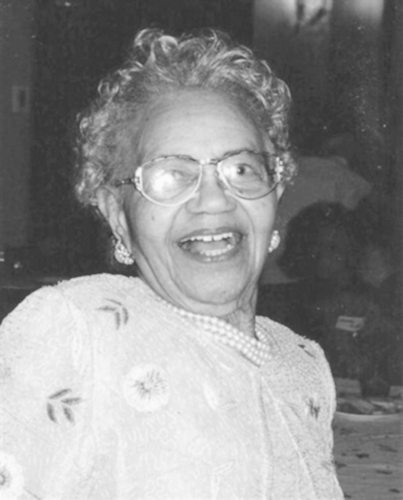

On Nov. 4, 2008, an exuberant crowd of 240,000 gathered around Chicago's Grant Park to witness history: the victory speech of the nation's first African-American president-elect. In his address, President Barack Obama mentioned Ann Nixon Cooper, a 106-year-old African-American woman who cast her vote for him in Atlanta earlier that day.
President Obama reflected upon the many things that Cooper had witnessed in her lifetime. The Great Depression. Women's suffrage. Two world wars. The civil rights movement. As a woman born only a generation after slavery, he said, she had witnessed how far a nation could progress in a century.
"And this year, in this election, she touched her finger to a screen, and cast her vote," the newly elected president said. "Because after 106 years in America, through the best of times and the darkest of hours, she knows how America can change."
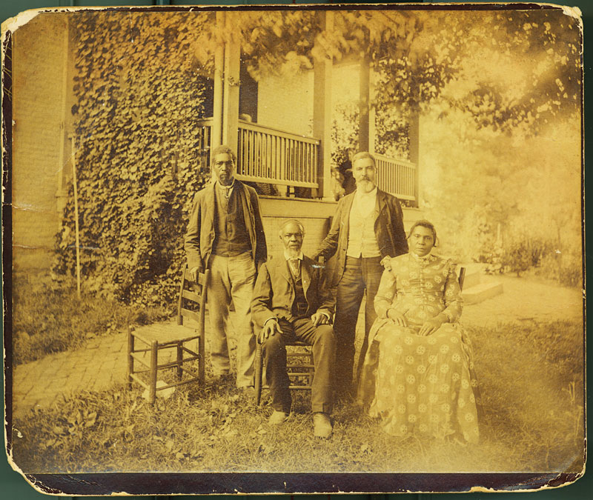
Where Cooper is concerned, that is an understatement. Orphaned at a young age, Ann Nixon Cooper was raised by the daughter of Granville Washington, the man standing on the right in the photo above. Granville Washington was a personal valet at Wessyngton Plantation, the vast Middle Tennessee estate that at one time was the country's single largest producer of tobacco. And like his daughter, Granville Washington was a slave.
For all that's been written about slavery, gaping holes remain in our understanding of plantation life. Those complexities, contradictions and mysteries lie at the heart of Slaves and Slaveholders of Wessyngton Plantation, an ambitious and groundbreaking new exhibit that opens this week at the Tennessee State Museum. Running through Aug. 31, the six-month exhibit casts light on the complex ecosystem that was the antebellum plantation, a place where business, blood, captivity and everyday life were inextricably linked — and the bonds of family were sometimes only too literal.
Wessyngton is uniquely suited to such study. In its heyday, Wessyngton's 13,000 acres in Robertson County were home to nearly 300 slaves, many of whom adopted the Washington surname of their white masters. Joseph Washington, a cousin of President George Washington, established the plantation, traveling from Virginia to Robertson County in 1796. His son, George A. Washington, inherited Wessyngton when his father died in 1848. By 1860, the plantation's tobacco crop had made the Washingtons one of Tennessee's wealthiest families.
Little was known, however, about the enslaved Wessyngton residents on whom their fortune was built. The process that would bring that history to light began when a Springfield, Tenn., middle-schooler named John Baker opened up his seventh-grade social studies textbook, Your Tennessee — and saw that photo of Granville Washington's family.
Baker had lived all his life just minutes from the plantation. Looking at the picture, though, which was taken in 1891, he sensed something familiar in the seated couple. Particularly the woman. He couldn't say why, but she reminded him of his maternal grandmother.
The reason, he discovered, would change the course of his life. It would also ultimately affect tens of thousands of descendants of those enslaved at Wessyngton. Over the next 30 years, Baker's research would unearth hundreds of missing branches in an enormous family tree — and the fascinating story of its tangled roots.
In the summer of 1976, 13-year-old John Baker's maternal grandmother, Sallie Washington Nicholson, was visiting Springfield from Chicago. She was excited to find an article about Wessyngton in the Robertson County Times, which she wanted Baker to photograph for her. Immediately, he recognized one of the photos.
"She showed me the newspaper article, and I said, 'Grandma, that picture is in our social studies textbook.' " Baker says. "She told me that the couple seated were her grandfather and grandmother, and that her grandfather was the cook on the Washington farm — which is what everyone called Wessyngton — and told me that's how her family got the Washington surname."
Baker then asked about the identity of the "white man" in the photo, a person he'd always assumed was the slave owner. Nicholson told him that was Granville Washington, a cousin of theirs who was allegedly the son of George A. Washington, one of the white plantation owners, and a slave girl.
Baker was stunned. He couldn't wait to tell his classmates that a photo of his great-great-grandparents was in their textbook. From that point on, he was determined to learn more.
But his grandmother had little to add. Her grandfather, Emanuel Washington, died before she was born, and her grandmother, Hettie Washington, died when she was a little girl. All she knew of them was through stories her family told. Her older brother informed Baker that direct descendants of the white Washington family still lived in the Wessyngton mansion, and that perhaps he could learn more by reaching out to them.
"Immediately, I started the research," Baker recalls.
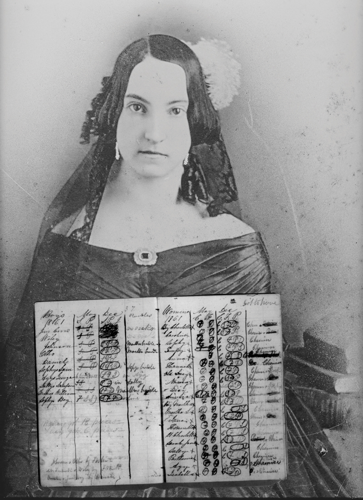
Baker contacted Anne Talbott, a sixth-generation descendant of Joseph Washington. She offered to meet with him and brought photographs and other documents, including one that recorded the births of the Wessyngton slaves from 1795 to 1860. When Baker found his great-great grandparents' names on that list, it gave life to people he'd known only through stories.
"She told me a number of individuals who lived there when she was a kid, and I went to church with a lot of these people who were in their 80s, 90s, some of them over 100 years old," Baker says. "So they were telling me stories about their families' history at Wessyngton as well, and I became as interested in all of these other families as I did my own."
Talbott told Baker that in the 1960s, her family deposited their records in the Tennessee State Library and Archives in Nashville. That was Baker's next stop. He studied approximately 11,200 documents from Wessyngton: letters, bills of sale, court records, inventories, financial records, maps, diaries, photographs and newspapers.
From his archival research and interviews with children and grandchildren of the enslaved Wessyngton inhabitants, Baker gleaned a detailed view of plantation life and life after emancipation — a view that sharply contrasted with what he'd learned in school.
"There was very little on African-American history taught when I was in school," says Baker, who graduated from high school in 1981. "I found that as soon as [the former Wessyngton slaves] were given voting rights, every man on the plantation was a registered voter. They met at the church that they helped establish to determine who they were going to vote for in the first election.
"Some of the former slaves purchased hundreds of acres of land — some of which was part of the plantation that they had formerly been enslaved on — or started their own businesses. Many of them became educators. Some of these people went to school to learn to read and write when they were 40 or 50 years old. I'd never heard of things like that."
Learning that the emancipated slaves had accomplished so much when the odds were stacked entirely against them propelled Baker further in his research — not just of his own ancestors, but of other enslaved individuals whose genealogy ground to a halt around the time of the Civil War. It has become his life's work. Baker's research has spanned more than three decades, prompting the release of his book The Washingtons of Wessyngton Plantation in 2009.
Baker's book, which inspired the current exhibit, draws from the extensive Wessyngton archives, linking tangible facts with oral histories collected from his interviews. Many of these are presented as transcripts, channeling the spirit of both the storytellers and their subjects while revealing family ties between thousands of descendants of the enslaved Wessyngton residents. Photos and portraits are plentiful, connecting faces to names that previously only existed in folklore.
"Daily correspondence in the Washington papers provided so much personal information about various slaves on the plantation and the Washington family I felt as though I knew them personally," Baker writes in his book. "My mother has often said that if you listen to me speak about my ancestors and all the others from Wessyngton you would think that I did. As I found information, I shared it with some of the older relatives and other families."
While Baker notes that there are many more African-American genealogical societies today than in the 1970s, he caught a closing window of historic preservation by recording interviews with children and grandchildren of slaves. Fortunately, advances in technology — such as DNA research — can aid descendants who followed in his footsteps too late. Baker delights in passing this information on to younger generations.
"Our family is very family-oriented; we've had Washington family reunions for the last 70 years," Baker says. "A lot of us still live in Springfield. There are several families in Springfield whose ancestors came from Wessyngton. Each year, a lot of these families have big family reunions, so I'll go and give them a presentation about their family's history.
"I tell them when their first ancestor came, and I have the documents to show them," he adds. "I've got a family tree that's about five feet long with a thousand descendants — and this is for our family, but I've done the same thing for other families — and they'll post the family tree at the family reunion. All the little kids will run to see where their names are, and how they fit, and how they're connected to people. A lot of these trees, some of them span 10 generations, so a lot of these people will see names on there that they may not even realize are their cousins. So they're really excited."
Robert DeHart, curator at the Tennessee State Museum, hopes the Wessyngton exhibit will provide an authentic representation of plantation life — a topic of much concern at historic sites in recent years. (See the related article about Belle Meade Plantation on this page.)
"The way that some historic houses have sometimes interpreted slavery has not been as accurate as it could be," DeHart says. "One thing I will say, in museums of public history, the interpretation of slavery has changed a lot. It's better now than even 10 years ago."
The exhibit is certainly enriched by the Tennessee State Library's immense amount of archival material. But what makes Slaves and Slaveholders unique, DeHart says, is the insight Baker and his book brought to bear.
"It's really difficult to interpret what the slaves thought; if taken from a white-produced record, it's not really reliable," DeHart says. "One of the things that makes this exhibit different is that John Baker was able to do so many oral histories with grandchildren and great-grandchildren of slaves who would pass down stories from Wessyngton, so we have that voice of the African-American in this exhibit that's very difficult to find in other places."
The exhibit begins with two maps on facing walls, one titled "Land of Opportunity" and the other "Land of Slavery." Both lead to the same destination.
"We're trying to show the two paths of migrants from England and Africa that eventually wind up at Wessyngton," DeHart explains, motioning to a depiction of a slave ship's cramped quarters. "This is to scale what a compartment would be in a slave ship, where they would have to travel for months from Africa to the United States." Because of Baker's DNA research, he says, the exhibit lists some of the African nations of origin for some Wessyngton slaves.
Over on the "Land of Opportunity" side, the map traces the route of English settlers including the Washingtons, who came to Virginia in the 1600s. As tobacco cultivation, which is hard on soil, taxed the available land, the settlers moved west. The map details Joseph Washington's journey from Southampton County, Va., to Robertson County, Tenn., where he established Wessyngton in 1796.
Alongside maps, historical documents and reconstructions of plantation interiors and exteriors, the exhibit features a scale model of Wessyngton in the mid 1800s. Supplementing these are short films that depict the lives of Wessyngton slaves — among them Jenny Washington, who was taken from her mother at age 10, sold with her sister, and transported from Virginia to Wessyngton in 1802. Another vignette tells the story of Davy White, who was one of only two Wessyngton slaves that the white Washingtons sold.
"He ran away a number of times, and eventually the Washingtons gave up and sold him," DeHart explains. "He eventually became a sharecropper. He was sold in New Orleans, somehow made it back to Robertson County after the war, which I think shows the tight-knit community that the slaves had. He wanted to get back to his family."
Far sadder is the fate of Granville Washington, the alleged son of George A. Washington and a slave girl named Fanny, though George never claimed Granville as his son. Baker learned more about Granville Washington through his conversations with Ann Nixon Cooper, whom he first met in 1996 when she was 94. A newspaper obituary pasted inside a family Bible revealed that Granville took his life in 1898 at age 67. The obituary suggested an extremely close relationship with George A. Washington, perpetuating the paternity rumor.
While a decade ago Baker was able to locate a direct descendant from Granville's first marriage — he wed twice — that person did not want to submit to a DNA test to authenticate Granville's paternity. Baker has been unable to track down another direct descendant since.
The exhibit provides a glimpse into plantation life for both the enslaved and the slaveholders. Daily life at Wessyngton was a constant balance of power, affecting the overall economy of this largely self-sufficient community.
"The slave master knows if he's too brutal, he's going to have this workforce that's not going to work for him, so he's trying to strike a balance to keep them working, but control them," DeHart says. "Really, the plantation is constant negotiation. [The slaves] did have some sense of power. They did have ways to make choices regarding their lives, even within bondage. And that's a story that we're trying to tell that we think is more interesting than just talking about the brutality of it, like 12 Years a Slave."
Yet the brutality of slavery must be acknowledged. The Wessyngton record-keeping, which is diligent in most matters, is unusual in that it actually contains accounts of whippings and punishment. Though accounts at other plantations are often lacking such detail, DeHart cautions that people should not jump to the wishful conclusion it never happened.
"Even with Thomas Jefferson's Monticello, there's no evidence of him punishing a slave, so the tendency with historic houses is to say, 'There's no evidence of it, therefore, [we're] not sure if it happened,' " DeHart explains. "It probably happened. And if you have evidence that says maybe it didn't, then we can talk about it differently."
While the Wessyngton owners didn't split up families — there were three to five generations of slaves living together, and records show that only two slaves were sold from the plantation — DeHart says this wasn't necessarily out of kindness.
"We don't know for sure, but we suspect it was because they were so wealthy," he says. "It's more that than any idea of good master/bad master. We're trying to get away from that, too, because that's just so hard to quantify. The bottom line is, these people were enslaved, they had no choice over their lives, and they were being exploited. It's hard to say if one set is being treated better than this other set. I think it was more the luxury of their wealth rather than any kind of humanitarianism."
Nevertheless, DeHart says the Wessyngton records, to his knowledge, are among the most complete archives of antebellum plantation life in Tennessee.
"They saved everything," he says. "Farm records, correspondence between the overseer and the slave master — that's where we find out a lot about the whippings and the discipline. They saved medical records when doctors came to the plantation to treat slaves for diseases, which we don't see a lot of other places. We're able to get an complete look at what the slave experience was like at Wessyngton, where it's very difficult to find other places."
These detailed records show the Wessyngton owners as sharp businessmen, investing outside the plantation and traveling to other cities while the enslaved laborers kept Wessyngton running in their absence. As a result, Wessyngton remained profitable after the Civil War.
"The business on the plantation, this is what sustained the South, and that was tied to slavery," DeHart says. "Looking at the Washingtons, you see that these were capitalists of the first class. George and Joseph Washington were gone all the time, working and investing in credit houses. [They] had very diversified ways of earning income. The plantation was one part of it, but there were other ways as well."
Though he hardly sympathizes with plantation owners, DeHart says understanding their mentality is crucial to understanding the period, and how such an institution was allowed (and encouraged) to flourish — so much so that white Southerners were willing to kill and die for it.
"The enslaved labor, plus these businessmen, were able to drive the South's economy, which becomes so important when we get to the Civil War," he says. "You start to understand why this idea of removing these slaves is so detrimental to the South, and why so many [plantation owners] opposed any kind of emancipation. This was their way of life, and their whole world was based around this."
After the end of the Civil War, many of the former Wessyngton slaves stayed in Robertson County. More than a century later, many of their descendants were still there, providing Baker with a large, geographically convenient pool of interview subjects.
"Once emancipation came, we'll be talking about how they had choices then, and how they used those choices," DeHart says. "The slave community was so tight at Wessyngton, so many stayed in Robertson County after the war, and John grew up in Robertson County. Most of the time, when these plantations broke up, the slaves went everywhere — some went north, or to other counties to find better opportunities, but Wessyngton is unique in that so many of them stayed in that area."
In 1983, Wessyngton was sold out of the Washington family. While many of the plantation-era buildings are gone, the main house remains. It is privately owned and is not open to the public.
"When it was sold, it was the largest farm in America still continuously owned by the same family," Baker says. "When the new owners took possession, they dismantled some of the [slave] cabins — there's a restored cabin still on the property."
On the edges of the property, a slave cemetery stands. A recent ground-penetrating radar survey conducted by archaeologists from the University of Tennessee suggests that at least 200 individuals are buried in this location. Robert DeHart suggests the Wessyngton exhibit is in some ways their memorial, as well as a reminder of how much more we may never know.
"Of course, we can't know exactly who they are, but it's a way for us, I think, to honor these people," DeHart says. "This is the labor that built Wessyngton and contributed to Tennessee's economy, and rather than being nameless, faceless — we literally don't even know where they're buried — now we're able to get a better idea of where they are."
The exhibit closes, fittingly, with a video of Obama's 2008 speech featuring Ann Nixon Cooper, who died in 2009 at age 107.
"This talks about how far Americans have come," DeHart says. "It's a really cool way to end the exhibit. You come from Africa, to the president of the United States.
"This is all of our story; we didn't want it to be labeled as an African-American history exhibit," DeHart continues. "It's really a Tennessee history exhibit, because with the story of enslaved Americans, you can't separate that from the economic history of Tennessee, or the history of the slaveholders, or the Civil War. They're all tied together."
Email editor@nashvillescene.com.



