
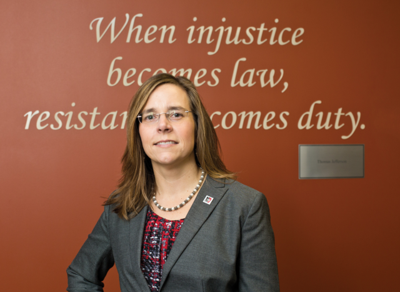


Dawn DeanerPhoto: Daniel Meigs
After more than 20 years in the Metro Public Defender’s Office, Dawn Deaner is stepping away. With her successor, Marthesa Johnson, sworn in last week, Deaner is no longer coming to work in the office she led as Public Defender since 2008. But she’s not leaving Nashville’s criminal justice system, or the increasingly vibrant discussion about how to make it more just for more people.
Deaner is kicking off a new project called the Choosing Justice Initiative — when she spoke to the Scene recently, she was still working out some of the finer details. But importantly, she’ll be practicing law on the ground again. Through CJI, she’ll take on clients who can’t afford an attorney but also can’t get a public defender, largely due to workload controls that she implemented in the office in response to an unmanageable volume of cases. Typically in those cases, a judge appoints a private attorney. But in an effort to give poor defendants more say in the process, Deaner says she’ll seek to be appointed to cases after clients choose her to represent them. CJI will also be a vehicle through which Deaner can advocate for reforms in other areas of the system.
Deaner spoke to the Scene about her career in public defense, what she’s learned and what she wants to do next.
So what was the inspiration for this new project?
This is the culmination of some growth that I’ve had as a lawyer in the last five years and as a public defender in the last five to six years, really coming to understand the criminal justice system by looking at it through the lens of our clients — rather than looking at it through the lens of the lawyer that I am. I think coming to value our clients and the people who we represent as individuals with agency and [who are] the best judges of what’s good for them, of what they want, of what their goals are — we don’t do enough to invite individuals who are most impacted by the decisions that get made to participate in those decisions.
What brought about that growth and change in perspective?
For me, I think a lot of it was I just started reading a lot more. I started listening. I don’t know what I was listening to. But I feel like I’ve always been a lawyer who wanted to do a really good job for my clients and cared about their input. But I don’t know that I really, in my practice, respected the individuals that I was representing as, you know, equal human beings. ...
I’ve started doing a lot more reading about what it means to be oppressed. What privilege is about. Things that I never really thought about, in terms of, what does it mean to have white privilege? What does it mean to have affluence? Not that I grew up wealthy, but I did not grow up in poverty, either.
I think, also, getting training in capital defense representation was some of the best training I ever got as a lawyer. Because when you get training in capital defense representation, you come to understand and you’re taught how important it is to know the entire life story of your client. Because all of the environmental factors, as well as the biological factors, as well as the generational factors, impact who that person is and how that person came to be in the situation they’re in. And if you think about that, you have to understand that if it’s impacting this person and the choices they made, then it’s impacting all of our clients.
By the time you walk out the door, you will have worked in the Public Defender’s office more than 20 years. What would you tell yourself if you could go back to when you started in that office?
I would tell myself it’s going to get better. I look around today at the conversations and people opening their eyes to what mass incarceration is. Mass incarceration was not a term that we used 22 years ago. … It was “tough on crime” and “war on drugs.” ...
When I started practicing, we very rarely talked to clients about the collateral consequences, like court costs and the fees associated with going to court.
Your office has been doing its own version of community oversight for something like a year now. How has that experience been?
It’s been challenging. It’s been rewarding. I value it a lot. I think that the reality is finding individuals who have the time to devote to it is one of our challenges, but also finding resources within our office to try to do the things that the client advisory board wants us to do is an even bigger challenge. I have been really, really impressed and energized by the suggestions and, frankly, in some ways vindicated by the suggestions that the client advisory board has made. Things like, “Do you have a formalized complaint process?” And our answer was no. I think we had to confront ourselves as individuals who do pay attention to what happens in other Metro agencies, particularly in the police department — which has a complaint process — to look at our own selves and say: “Well, we don’t have that. What are we going to do about that?”
What’s the conversation we’re not having about criminal justice in Nashville that we need to be having?
I think the conversation we’re not having is what is the value of a good lawyer, of a good defense lawyer. There’s a lot of conversation going on around policing, as the front end of how people get into the criminal justice system. And I think there’s conversation that almost always happens on the back end of things — the sentencing and sentencing reform and collateral consequences. I think the bail-reform conversation has started down the road of what happens in the middle. But there really isn’t much conversation going on around, what’s the role of prosecutorial discretion, and what’s the role of having a defense lawyer who is prepared and skilled and can do a good job. …
The other conversation that’s really not going on is, how much money are we spending in Nashville on our public safety and are we really safer for it. How are we measuring if we’re any safer for it. There’s a lot of money that goes into policing, there’s a lot of money that goes into the sheriff’s office, there’s a lot of money that goes into the prosecutor, the public defender, the courts. Add all that money up, and are we getting our money’s worth? Is that really how we want to be spending our money? I don’t think people really realize how much it costs to operate this behemoth of a system.
I want to invite you to do some media criticism. How do you think the media here does at covering crime and criminal justice issues?
A general media criticism, I think, is blindly accepting everything the police department says is true. I don’t know how many times they have to establish that their initial release of information was not correct. Everything the police department says is not fact. It is spin on a fact, or it is a perception. It is one side of a story that is a complicated story. I think media often accepts what anyone in government says as true, without really questioning it. So that is one thing.



Post a comment as anonymous
Report
Watch this discussion.
(0) comments
Welcome to the discussion.
Log In
Keep it Clean. Please avoid obscene, vulgar, lewd, racist or sexually-oriented language.
PLEASE TURN OFF YOUR CAPS LOCK.
Don't Threaten. Threats of harming another person will not be tolerated.
Be Truthful. Don't knowingly lie about anyone or anything.
Be Nice. No racism, sexism or any sort of -ism that is degrading to another person.
Be Proactive. Use the 'Report' link on each comment to let us know of abusive posts.
Share with Us. We'd love to hear eyewitness accounts, the history behind an article.