
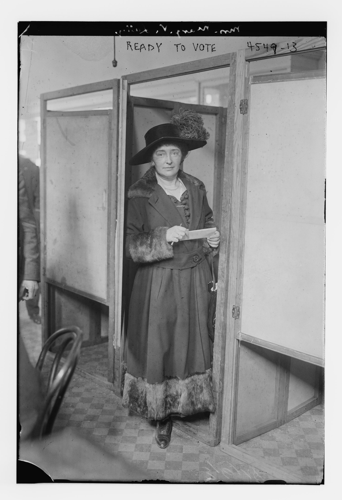
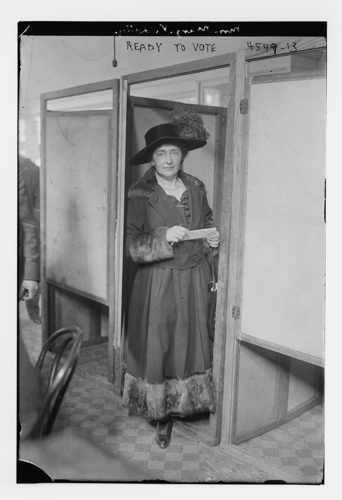


Margaret V. Lally votes in New York City, 1918
With a curtain at their backs, Erica Hayden and her dad stood in the cramped booth at their local polling station. It was a small space, and Hayden’s dad was marking his paper ballot as his daughter watched wide-eyed. Once Hayden’s father had cast his vote, the two stood by as her mother entered and did the same. Hayden marveled at the size of the high school where voting was being held. She watched as the other voters moved between check-in tables and disappeared behind curtains.
Hayden, who is now a professor of history at Trevecca University, says she didn’t always understand what was happening when she went with her parents to vote, but still, something about the process struck her as meaningful.
When Hayden turned 18 and was able to vote in her first presidential election, she says, some of the magic was gone — the ballot boxes and the curtains were replaced with electronic machines with buttons alongside corresponding candidate names. Still, the moment had weight; it felt significant. And years later in 2016, as she prepared to cast her vote for who she thought would be the first female president, the significance was even greater.
“It was so exciting to be able to have the opportunity to vote for a female candidate,” says Hayden. “To vote at all is really an honor and a privilege, especially because you can look around the globe and see that the right to vote is not something that is granted to all women. It’s a gift we’ve been given, and you don’t want to take that for granted. This isn’t something we’ve even had for that long.”
Indeed, this year marks the 100th anniversary of the 19th Amendment’s ratification, which granted women the right to vote. To commemorate the centennial and celebrate the unwavering pursuit of social change, the Tennessee State Museum is opening Ratified! Tennessee Women and the Right to Vote, the Nashville Public Library will unveil the exhibit Votes for Women on Aug. 18, and more events are planned around the city. (See a list of those on the right.)
Hayden says the legacies of the women’s suffrage movement are plentiful — and they go far beyond just her ability to walk into her polling station and freely cast her vote. Since the ratification of the 19th Amendment, much of politics has been shaped by the votes of women. According to a Brookings Institute report from February, women have consistently outvoted men since 1980 — women made up 58 percent of voters at this year’s Iowa caucus.
With the power of the women’s vote becoming greater and more evident, Hayden says it’s important to understand the legacy left by the early suffragists who paved the way for women voters and policy makers now.
“Women of the 21st century are standing on the shoulders of the women who had seen and spoken on these issues decades before,” she says. “I think looking for ways to advocate for others is an important part of the legacy. You can look at a lot of social issues in the past decades since women have gotten the vote and see how women may have swayed opinion or shaped outcomes, particularly in who they vote for and the platforms of those candidates. In recent elections, women have become a demographic category important to candidates, and I think we’ll continue to see women as an important bloc for candidates to try to persuade.”
Kathleen Pate, education specialist for the Clinton Presidential Library, says that when celebrating the work of the early suffragists, it’s important to see the full scope. The 19th Amendment’s ratification was only the beginning. Native American women did not get the vote until the 1924 Indian Citizenship Act, and Black men and women were still working for enfranchisement 40 years after that. It wasn’t until the Voting Rights Act of 1965 that Black people were able to fully participate in the voting process. Since that legislation’s passage, vital parts of the act have been invalidated, allowing some Southern states to change voting laws without federal approval.
“When we think about the legacy, I think it’s important to not say we are celebrating,” says Pate. “We know that the 19th Amendment did not extend women’s suffrage universally. We know that Black men and women were largely prevented from voting and that Native American women did not get the vote until 1924. The amendment was a significant step, but it was in no way the solution. Even now, there are lots of obstacles between some people getting to vote. Some are purposeful, and some are structural. Voting is a right, a responsibility, but it’s certainly a privilege that not everyone has the opportunity to exercise. I think that’s part of the legacy and part of what we need to address next.”
Tequila Johnson says that’s where she hopes to help. Johnson is the co-founder and co-executive director of The Equity Alliance, a nonpartisan nonprofit organization that empowers people to take action around issues that affect daily life.
Johnson, who is Black, says she doesn’t remember the first time she voted. No one made a big deal of it, and she thought she was just doing what was expected of her. It wasn’t until the election of President Barack Obama that she began to understand the impact of her vote. Now she says her vote is her voice.
“When you think about the average patriotic American white man, they are very proud to be American,” says Johnson. “They know this is their country. They feel entitled to have a voice and a sense of ownership, but my ancestors fought and died for it. No matter who you stack up against me or how much money they throw at the vote, they still go to the ballot box equal to me. My vote is my power.”
Johnson says the legacy left by suffragists who fought for the vote is powerful, and as transformative as the ratification was, she thinks calls to commemorate the centennial fall flat in some ways. As with so many historical movements, Black women and other marginalized people were there doing the work for progress, and as has so often been the case, they were largely left out of the record. Though their names and stories are not remembered, Johnson says she still feels them in the legacy.
“Knowing what they had to endure to get us to where we are now feels so [moving],” says Johnson. “They put us one step closer to the finish line, but the reality is we still have a long way to go. We can and will use the tools they left for us, but it feels like running a relay race where you have to run faster and faster with each leg. My focus is to take the baton from them and run faster, so when I pass the baton to the person next to me, they’re even closer, if not already there. We have come too far, and so many people have sacrificed so much — lives, family, time, livelihood — we cannot stop now. It’s like Nipsey [Hustle] said. The marathon continues. We celebrate the good, and then we keep going.”



Post a comment as anonymous
Report
Watch this discussion.
(0) comments
Welcome to the discussion.
Log In
Welcome to the discussion.
Keep it clean. Please avoid obscene, vulgar, lewd, racist or otherwise abusive language. Comments featuring hate speech or threatening or violent content will not be tolerated.
PLEASE TURN OFF YOUR CAPS LOCK.
Be truthful. Don't knowingly lie or mislead.
Be proactive. Use the “report” link on any comment that violates our comment policy.
Share with us. We'd love to hear your feedback.