
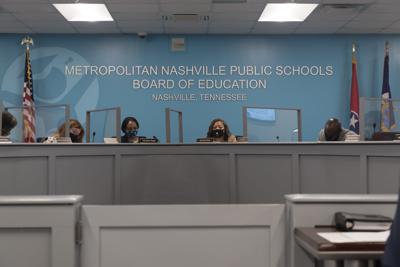

Partisan school board elections are doing exactly what critics were afraid of — pulling attention away from students and their education.
When the Tennessee General Assembly passed a law in 2021 allowing partisan school board elections, Nashville Republicans and Democrats scrambled to decide whether to hold primaries. After a game of political chicken, each party announced its plan to do so, and now we’re approaching Nashville’s first partisan school board primaries. Fold in the education-related culture wars happening across the country and tension between the Metro Nashville Public Schools board and the state, and you’ve got a highly politicized climate that has already diverted focus from students and schools.
District 6 candidate and Democrat Natalie Martin missed the deadline to apply for a teachers’ union endorsement because, she said at the time, she was busy teaching. Martin is a member of the Metropolitan Nashville Education Association, but instead of endorsing its own member, the MNEA Political Action Committee for Education endorsed Cheryl Mayes, a former MNPS board chair and employee of U.S. Rep. Jim Cooper, because Mayes turned in the paperwork on time.
One significant consequence of partisan school board elections is changes in timing. With early voting for primaries having started April 13 and ending April 28, the timeframe to campaign is significantly shorter for those running with a partisan affiliation. That also means voters have less time to familiarize themselves with candidates. But those who win the primary and move on to the general election will see a longer, more expensive campaign season before Election Day on Aug. 4.
Early campaigning aligns with a busy time for MNPS as the school year is wrapping up and the board is in its budget season. “Us having primaries during that is very, very hard,” says District 2 incumbent Rachael Anne Elrod. “But [campaigning] should not be more important than your actual job. So managing those two and juggling it, I think, is a new experience for sure.”
Not all candidates have to worry about the primaries. Elrod is the only Democrat running in her district, and Kelli Phillps is the only Republican running in District 4. There are also three candidates running independently: Amy Pate in District 8, District 6 incumbent Fran Bush and Edward Arnold in District 2. Running independently eliminates the need to win a primary election, but it also means less political recognition.
“I wondered, should I run as an independent?” says Elrod. “Because I do very much pride myself in being a middle-ground person, and [I try] to consider all viewpoints. … But all studies and data and encouragement from both sides of the aisle show that independents do not get votes. You need to have the acceptance of a party, or you do not typically get … as many votes.”
Partisan elections aren’t the only curveball the state has thrown at school boards. Last month, Axios reported on legislation with a proposed amendment that would have required a mayoral-appointed school board in districts that have 10 or more priority schools — Davidson and Shelby counties are the only Tennessee school districts with more than 10 priority schools. The legislation — and the Nashville Area Chamber of Commerce, which backed it — got attention from the Metro Council, which passed a resolution at its April 5 meeting “condemning the Nashville Area Chamber of Commerce’s efforts to subvert democracy and eliminate the people’s voice in determining who serves on the Metropolitan Nashville Board of Public Education.” The bill is not likely to pass, but it demonstrates the politics and power struggles surrounding school board elections.
MNPS board members aren’t particularly shy about their frustrations with state and national politicians either. On March 22, a hot mic caught District 1 representative Sharon Gentry saying, “Can we just go set Marsha Blackburn on fire?” The comment came amid a conversation about Ketanji Brown Jackson’s Supreme Court confirmation hearings. Tennessee’s Sen. Marsha Blackburn asked Jackson to define the word “woman” (earning her a roast from Saturday Night Live), while fellow Republican Sen. Ted Cruz questioned Jackson about critical race theory, a legal concept that is typically taught in law school but has become shorthand for a conservative wedge issue. (Gentry is not up for reelection during this cycle — only the even-numbered districts are.)
Some candidates are centering these same topics in their campaigns. District 2’s “ ‘No Woke’ Todd Pembroke,” for example, is campaigning in part on the concept of removing critical race theory and “gender identification” from public school criteria. Meanwhile, District 8 Democratic candidate Chris Moth’s website challenges the conservative talking point. His website states that “Chris will stand up to those who claim teaching about our nation’s history with race is some version of a spooky ‘Critical Race Theory’ curriculum.”
Every moment spent discussing these sorts of political-football issues distracts the conversations from the staff and students whom candidates are running to serve. There are still staff shortages, underpaid employees and students dealing with the fallout of the pandemic — many of whom weren’t on track academically to begin with. Most candidates have acknowledged these issues and their intentions to address them on the board, but they can’t entirely ignore the politics either.
“A lot of our positions are not political positions,” says Elrod. “They are … procedural positions. And if you start letting politics get into it, that’s not necessarily what’s best for students.”

Taking a look at the primary races for judicial seats, school board seats and the district attorney’s office



