
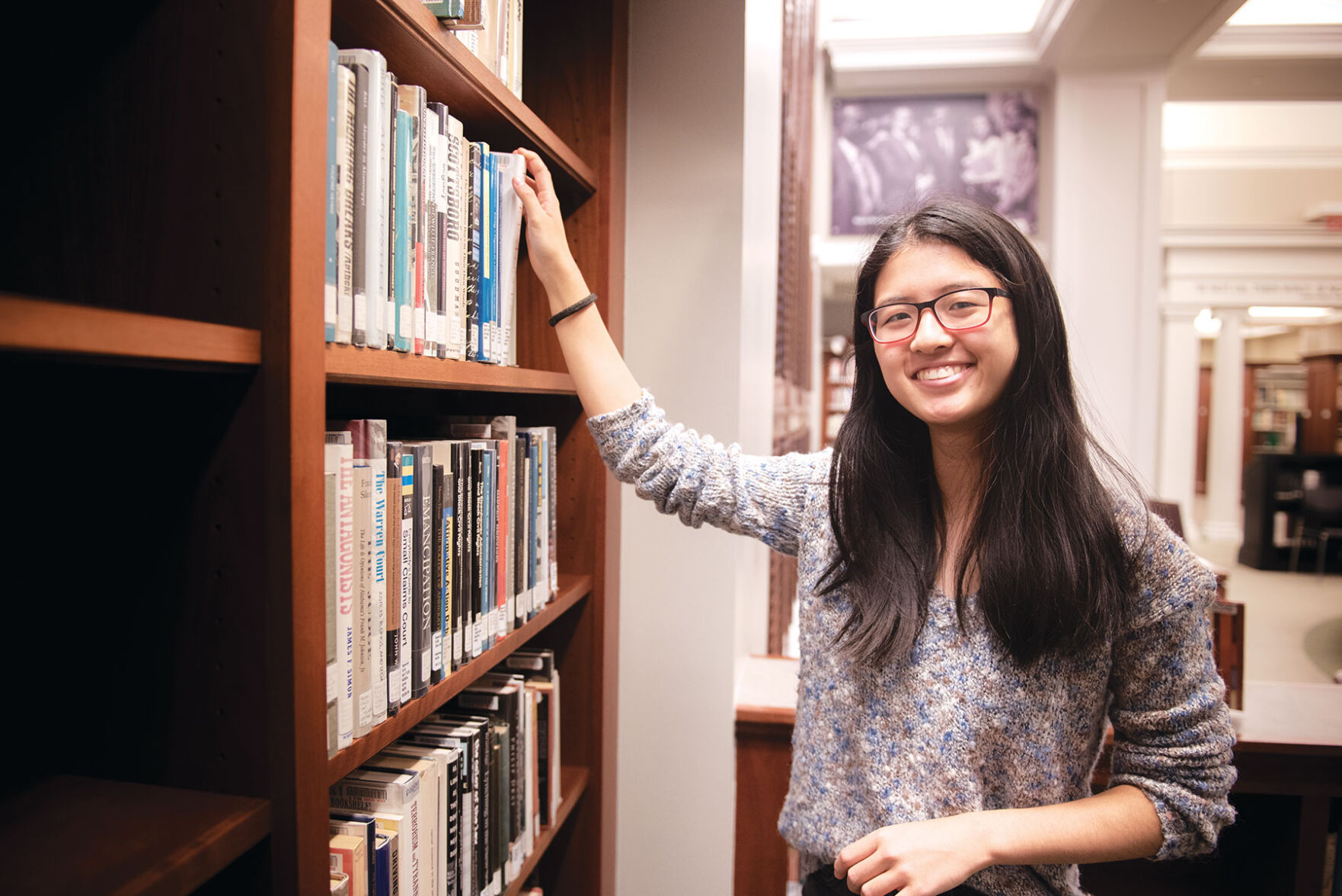

When Sheerea Yu stepped onto the stage at the Nashville Youth Poet Laureate semifinals, she had never read a poem aloud to an audience before. Later on in December, she did it again at Southern Word’s annual State of the Word regional poetry showcase. The event showcases the talented youth involved in the spoken-word education and youth-development organization’s programming. It’s also the stage where poets compete to be the city’s next laureate. Yu won the competition with her poem “reading newspaper headlines,” which you can read below.
Now in its eighth year, the Nashville Youth Poet Laureate is a joint program of Southern Word, Metro Nashville and national youth literary-arts organization Urban Word. The Youth Poet Laureate program’s goal is to include youth perspectives in civic dialogue because “teens are uniquely positioned to remind us of our commitments to our children, to our future, and to our shared ideals.” Youth Poet Laureates perform at functions like Metro Council meetings and the mayor’s State of Metro address, as well as at cultural events throughout the city.
Yu says she surprised herself by getting up on that stage, but talking with her, it’s easy to perceive her courage and motivation. The Scene asked Yu about the role of poetry in her life, what we should know about teens today and more.
Did you start with writing poetry or with poetry performance?
I feel like I sort of fell into everything. I don’t want to say [it was] a calling at all. But sometimes I see something happening. I’m like, “Oh, I don’t like that.” And I get this phrase or this image that stays in my mind after. And I write it down, and I turn those scraps into poems sometimes. So I found [former Youth Poet Laureates] Marie Shields and Alora Young — I’m like, big fans of them, but they don’t know I exist. I found their performances and poems online. I was like, “Whoa, this is such a cool program. You don’t really share your poetry very much.” Before this, my family didn’t really get to read anything I’d ever written. It was a surprise for me that I applied to this and I got into performance. At the semifinals that day, it was the first time I ever tried doing spoken word or reading something that I had written. It felt really right. ... I always thought poetry should be something that comments on society — that makes a point about racism or something like that. That day, I was really happy that I had unlocked this skill or leveled up or whatever. I was like, “Yeah, it’s really important for you to be able to actually present what you write. Because society needs that.”
What role has poetry been playing in your life?
I think it’s made me a little more aware. Like, I’m always thinking, “Could I turn this into a piece that could alleviate this social problem? Is what my friends are talking about, what they’re crying in the bathroom about, what they’re living through — is that something that is important that I could potentially make a difference in a way?” I think I’m always looking around now for scraps of images and things like that.
What do you think it means for a younger person to have a voice?
I don’t know what it means to have a voice. I don’t know. I think everyone has one. And when I was reading through the questions [you sent before our interview], I thought about this in conjunction with the last question [about what I want people to know about teenagers today]. It’s that teenagers do have a voice. They might be the people overlooked, but we care a lot. We’re doing things.
What are you looking forward to about your position as Youth Poet Laureate?
I think the main thing is a series of performances. But also I was talking with Ben [Smith, director of Southern Word] about maybe working on a poetry collection. I love interviewing people for the [University School] newspaper. I just love talking to different kinds of people and learning their stories. So I would love to try and write a poetry collection from the perspectives of different people. … [Ben] told me that you step into the position [of Youth Poet Laureate] and who you are shapes the role.
What else do you want our readers to know about teenagers in 2022?
I keep thinking about a line from one of Alora’s poems. … It was about our generation, and it answers all the questions of what we should know about teenagers. But my favorite line was like, “Prejudice is no match for Google Translate.” And I just thought that was so perfect, because I think we’re growing up with different ideas of diversity and LGBTQ [life] and social norms. I feel like that changes so much. Like our lens of how we view the world ... with social media, you see a lot of things changing, but also I feel like there’s more teenagers than ever who can get to that activist point. Because with technology, we know how to reach more people than ever. I always felt like I grew up knowing that. If there was something I wanted to say, there would be a way to get it out there to do it.
'reading newspaper headlines'
By Sheerea Yu
I.
i always thought democracy was guaranteed, i took it for granted, i thought if
i worked hard i could make it in
white man’s
christian america,
but now i see the pot shaking
on the stove,
and i find i cannot raise my voice
over the sound
of seething.
II.
my classmate says,
these killings should have been
a bigger deal. he is angry, and i feel
so embarrassingly grateful
and relieved, that
people of other races would care about
stopasianhate because i know
white
supremacy is not the only supremacy, and even the word-asian.
do you know how much history and identity is between
those countries, who would never think
they could ever
fit together. certainly not
into just one word.
yet i stay silent.
on some level, i feel i have no
jurisdiction
over pride and protest, i
am consumed by self-doubt.
when it is the people who look like me
murdered, why do i feel the urge
to look away?
i cannot stand how my face could result
in the pattering
of gunfire.
III.
embrace
this conflict. as a reflection of facing
issues rather
than burying them, better to roar and rage than
dejected acceptance, i promise
in countries where everyone looks
the same racism never
has the chance
to bubble to the surface.
diversity
is a powerful heat.
i say
it is better to feel its burn than let racism simmer, kept to
dinner table murmurings.
only with it can we
work, can we
challenge
racism, can we turn the heat dial
until the water finally boils.
clear and sure,
cleansed.
our knees ache
from standing by the stovetop, but there-
the sudden rush of quiet,
and that moment of held breath.

Student activists, the Youth Poet Laureate, banned books, our first student essay contest and more



