
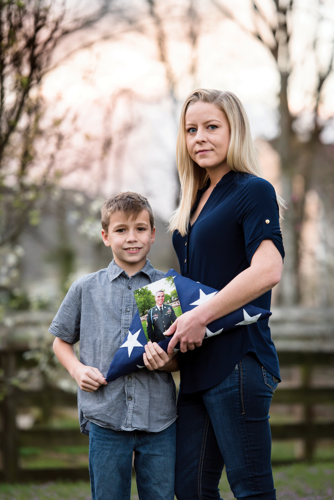
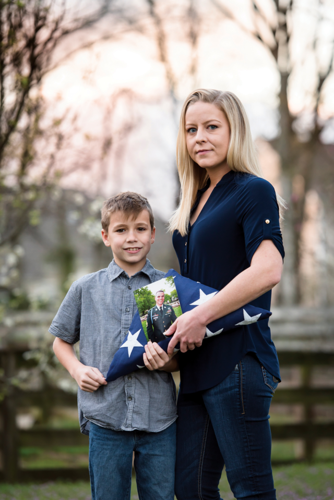


Seana Arrechaga with her son AlstonPhoto: Eric England
For Seana Arrechaga, her husband’s fourth combat deployment was characterized by a throbbing sense of anxiety and fear. Then came a fixed moment of stupefying sorrow. Then, slowly, came acclimation to a new version of “normal,” one entirely unlike the one she’d imagined — a gradual process interrupted occasionally by anger, confusion and frustration.
Army Sgt. 1st Class Ofren Arrechaga was killed in combat in Kunar Province, Afghanistan, on March 29, 2011, the day after his son Alston turned 3 years old. His wife Seana was just 22 at the time.
“Before he died, we were planning a move, thinking about what we want, talking about more babies,” says Seana Arrechaga. “And then all the sudden that’s gone. Everything that I was going to be was gone.”
After her husband’s death, Arrechaga spent a lot of time at home crying, then a couple of years traveling and speaking at screenings of The Hornet’s Nest, a documentary about his division’s combat experience. But when that ended, she had to ask herself, What now? Arrechaga and Alston have since moved to Spring Hill, Tenn., to be closer to her family. Alston is nearly 10, and Arrechaga says she’s finally ready to do something for herself — to go to school, maybe for public relations.
Alston doesn’t remember much, if anything, about his father.
“He sees pictures and creates his own memories,” Arrechaga says. “He’s heard the stories enough that he thinks he can remember it. … I don’t think he realizes what he’s missing.”
Ofren Arrechaga was a Cuban immigrant who became a U.S. citizen while on an earlier deployment to Iraq. Seana Arrechaga describes him as fun-loving, someone who made sure his friends were smiling even in the darkest moments of war. But he had his own dark moments, including when he returned home to his wife and son between his third and final deployments. He wasn’t himself, Arrechaga says. He was reclusive and wouldn’t tell her anything, until he did, and after that he returned to normal. But a number of his comrades died by suicide after that third deployment, and more have run into trouble with the law, leaving his widow with a conflicting desire to still have him with her while acknowledging that he might not have been the same man upon returning home.
“I’m friends with a lot of his guys, and I’ve seen them go through a lot of struggles,” Arrechaga says. “That Afghanistan deployment, we lost 18 people altogether. A lot of them were his friends. I know he was struggling with it, so I don’t know what his coming home would have been like.”
Arrechaga noticed a disturbing trend in 2016, around the time Colin Kaepernick began kneeling during the national anthem at NFL games in protest of police brutality. People online would take deeply personal photographs of Arrechaga and other war widows and slap a caption on them — usually something about how this widow kneels for the right reason, and NFL players should stand for the anthem. President Donald Trump shared an image of a widow with a similar message earlier this year.
“When the president did it, it was like, ‘No, wait a minute,’ ” Arrechaga says. “It really bothers me when people feel like they own that fallen hero themselves — but they don’t know their name, they don’t know the spouse’s name, they don’t know their story, they don’t know anything about them. But it’s an image they can use to further their opinion.”
Arrechaga responded on Twitter to Trump, expressing her displeasure with those who share photos of widows without their permission, especially when a political message is appended.
She allowed Washington Post photographer Katherine Frey to accompany her and Alston to her husband’s funeral in 2011. The resulting pictures — of Seana Arrechaga weeping over her husband’s open casket, of Alston dancing carefree down the aisle of the somber ceremony — are haunting and award-winning. Soon after Trump shared the photo of a different widow, right-wing political commentator Dinesh D’Souza shared the one of Arrechaga crying over her husband’s body.
Her responses to D’Souza and Trump went viral.
“Most typically when that photo is used, it’s in reference to football players kneeling,” Arrechaga says. “I always call them out. If I see it — it could be the president, it could be Joe Schmo, I don’t care — I’m going to call them out. … If you’re going to share a photo like that, it should be out of respect. You shouldn’t attach your own political opinion to it.
“My husband was a real man,” she continues. “It’s very disrespectful to show him in a casket just to prove your point.”
For the record, Arrechaga says she agrees with the players’ protest (she “can’t wait” for the next presidential election), and she says the Titans invited her and Alston to a game during the 2016 season.
As her tweets gathered thousands of shares, she accumulated more and more followers. Most of her posts aren’t about politics, though: She tweets about The Bachelor and her problems with Spectrum cable.
“All the sudden I have all these new Twitter followers,” she says. “They’re about to be real disappointed.”



