
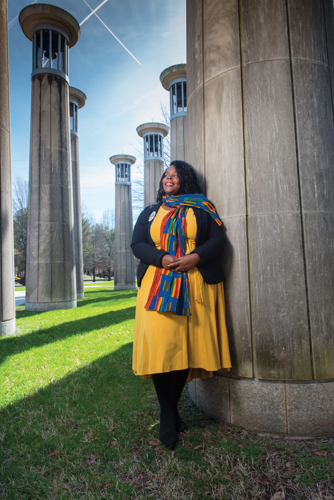


Gicola LanePhoto: Eric England
For a long time, Gicola Lane never really considered herself an activist. But she’s spent the better part of the past 14 years organizing and trying to build community as the center of her work.
Over the past year, Lane has mostly focused on defending Nashville’s need for a Community Oversight Board. After the fatal police shootings of Jocques Clemmons in 2017 and Daniel Hambrick in 2018, Nashvillians voted overwhelmingly in favor of creating a citizen accountability board for the police — though some in the GOP-dominated state legislature are attempting to diminish the power of the board.
It’s a subject close to Lane’s heart. She watched her family suffer after her uncle was shot and killed by a police officer 20 years ago, and she wanted to be there for Clemmons’ and Hambrick’s families in a way that nobody was for her family.
“I remember how my grandmother didn’t have any support,” says Lane. “And I remember literally going every weekend for years after church with my grandma to his grave, and she would keep a rag and Windex in her car and we would go wipe off his grave. And I remember how she felt isolated in this process and how she couldn’t even get an attorney to represent her or the family.”
Lane sees activism work as an array of interconnected efforts, and she says people often see issues in silos without realizing just how much one issue can relate to larger systemic matters. Voter ID laws, police oversight, bail reform, schools: It’s all connected. Lane has spent almost her entire life in Nashville — she went to Stratford High School in East Nashville and worked at the anti-poverty nonprofit Martha O’Bryan Center — and says she’s had years to develop meaningful relationships in the city.
A large part of her work is educating the community. For example, she’s done a lot of work around bail reform and says it can be really tricky to educate people about that particular issue. Some activists say bail monetizes the criminal justice system and believe it should be done away with completely. But when Andrew Delke, the officer who shot and killed Hambrick, was given a $25,000 bail, she got several calls from people who thought his bail amount was too low.
“A big part of this work is being able to break this down in a way that makes sense, because our understanding of this system is from the system,” Lane says. “We may say, ‘Oh, his bail looks too high,’ but should someone even have a bail at all? It’s really hard to take our mindset out of the system, though.”
But Lane says her biggest goal is to bring the community together — teaching people who may never have engaged in activism that they have a voice.
“I think that is what we have to do — to lift each other up and continue to center things on members of the community,” Lane says. “That’s the solution, they are the experts.”



