
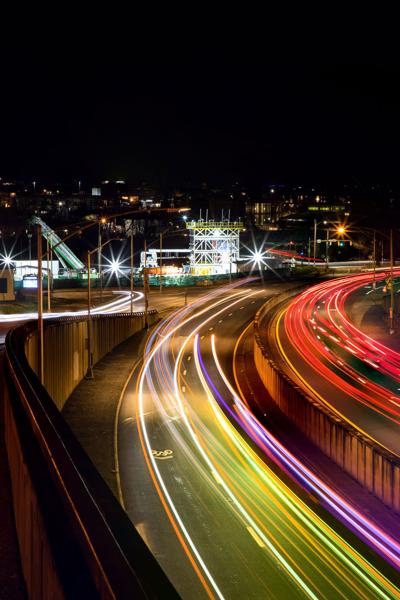
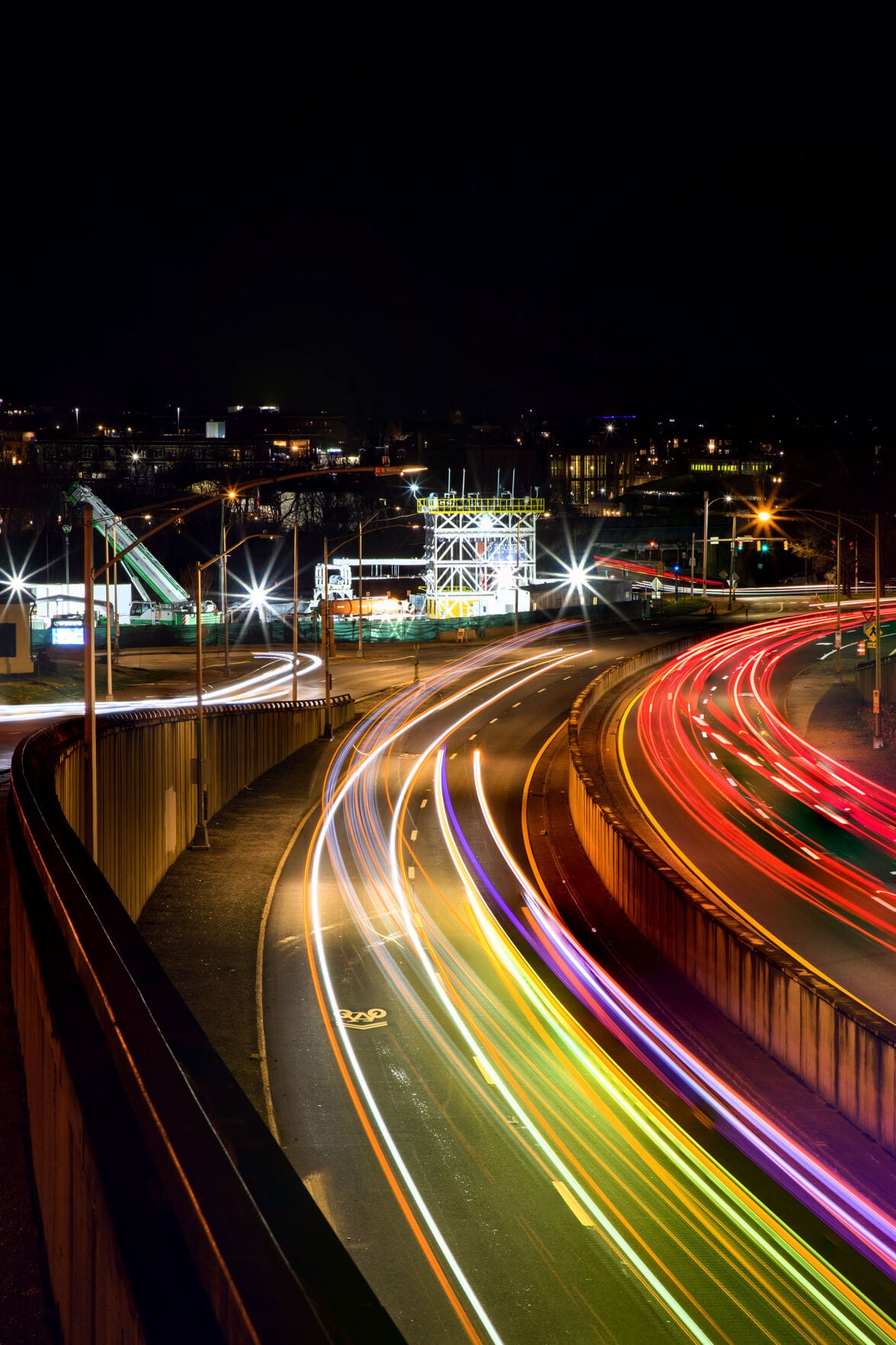
A long exposure of The Boring Company's Music City Loop worksite at night
This article is part of a three-part cover package on the Music City Loop. Read the rest here.
For a project billing itself as “express public transportation,” little about The Boring Company’s proposed Music City Loop follows the traditional playbook. State officials, including Gov. Bill Lee, have promoted the tunneling project as fast, privately financed and built without taxpayer dollars. Critics argue that the framing may be misleading and question whether the proposed Loop project functions as public transit at all.
As Nashville residents weigh what the proposed Music City Loop could mean for the city, Las Vegas provides the only operational, real-world preview. The Vegas Loop, which opened in 2021, is a network of underground tunnels that transports passengers between the Las Vegas Convention Center and nearby hotels using Tesla Model Y vehicles. Construction began in 2019, and the system currently includes eight stations, with roughly 15 more expected to be built in the coming months, according to Boring. The company still has much more work to do. The Vegas Loop has been approved for a sprawling 68-mile network with 104 stations. Boring says that, if that ambitious goal is ever met, it would become the second-largest tunnel transportation system in the U.S., behind only the New York City subway system.
The company claims the Vegas project has “already transported more than 3 million passengers,” and “in its final form, the Vegas Loop will serve up to 90,000 passengers per hour.” The Vegas Loop’s real-world performance is far more limited than its long-term projections. At peak, the company claims it has demonstrated a throughput of about 4,400 to 4,500 passengers per hour. During large conventions, it can move roughly 30,000 passengers per day. While Boring projects a much higher capacity for a fully built network, the existing system shows that as of now, the Vegas Loop operates at a scale closer to buses or a high-frequency shuttle system than to traditional mass transit like light rail. This relatively low passenger capacity is one reason why Ben Leffel, an assistant professor of public policy at the University of Nevada, Las Vegas, has emerged as an outspoken critic of the Vegas Loop.
“In and of itself, it is better than nothing in terms of a transit option,” Leffel tells the Scene. “But it should never be confused as a substitute for public transportation.”

Steve Davis offers Music City Loop details during virtual town hall meeting; the same day, construction crews leave site due to safety, pay concerns
Despite criticism, cities across the U.S. and abroad continue to express interest in Boring. The company announced plans for a Dubai Loop in early 2025, signaling its ambitions to expand internationally. But the company’s track record is erratic at best. Since 2017, The Boring Company — founded and owned by billionaire Elon Musk — has pitched projects in Washington, D.C.; Baltimore; Chicago; Los Angeles; San Jose, Calif.; San Antonio, Texas; Miami; and Australia, to name a few. None of those proposals ultimately moved forward, falling apart at various stages, sometimes for unusual reasons. In 2022, Bexar County, Texas, selected Boring to build a transit link between downtown San Antonio and the San Antonio International Airport. After Boring won the bid, the Alamo Regional Mobility Authority entered into a development agreement to study the project’s feasibility. But the process stalled soon after. Officials say the company never responded to the agreement, and follow-up calls went unanswered. Reggie Fountain, operations engineer for the Alamo RMA, told the San Antonio Report last year, “They just kind of ghosted us. So we essentially just assumed that it was dead and didn’t move further with it.”
Much of the company’s publicity is supercharged by X, the social media platform also owned by Musk, which promotes its projects and engages directly with followers. Boring (@boringcompany) has 1.1 million followers on X, and its posts regularly draw high engagement with videos of in-progress tunneling in Las Vegas and Nashville. One of its more unconventional outreach efforts was the “Tunnel Vision” competition, which invited the public to submit proposals for a one-mile tunnel in their own communities.
In Knoxville, that approach created an awkward situation for the city government. The company selected a proposal from a local small-business owner as a contest finalist. But a city spokesperson said Knoxville Mayor Indya Kincannon and the city administration had no involvement with the application.
Kacee Leekley — a resident of Sweetwater, Tenn., and owner of a web design firm — submitted the “Vol Loop” concept for a one-mile tunnel connecting Market Square in downtown Knoxville to the University of Tennessee campus. As the proposal gained visibility, Leekley reached out to local officials to gauge interest. He said Knox County Mayor Glenn Jacobs — the former WWE wrestler once known as Kane, and a current Republican political insider — was supportive. But Leekley’s experience with Knoxville’s city leadership was far less encouraging. “One thing I learned very quickly is that there’s a lot of politics involved in stuff like this,” Leekley tells the Scene.
The Boring Company’s website lists a range of projects in various stages of development, some of which sound like science-fiction. One is a proposed “Hyperloop” near Bastrop, Texas, where the company says passengers could travel in autonomous electric pods at speeds exceeding 600 mph. The company says a test track is already complete and in use, and notes that it partnered with SpaceX — another of Musk’s ventures — to host four student competitions. The company claims prototype pods reached speeds of up to 288 mph. Beyond infrastructure, the company has also ventured into consumer products, including a $500 flamethrower that is now sold out. When The Boring Company launched in 2018, CNBC reported that the company sold $3.5 million worth of the product in a matter of days.
The company’s strange behavior and track record raise a larger question: Why would a state government like Tennessee trust The Boring Company for a critical public infrastructure project? Leffel, the UNLV professor, says the appeal is driven by “the illusion of tech innovation” and the lower upfront cost compared to more proven systems like light rail. “Elon Musk is selling a false image of what transit should look like, similar to the way Henry Ford once framed cars as freedom,” Leffel argues.
While Loop projects may generate excitement among Musk devotees, Leffel cautions that cities should take a measured approach to the privately funded proposals. “My message would be simple,” he says. “Don’t take the bait.”

As The Boring Company tunnels forward, we explore the company’s track record, the tunnel’s environmental impact and the politics surrounding the project



Post a comment as anonymous
Report
Watch this discussion.
(0) comments
Welcome to the discussion.
Log In
Welcome to the discussion.
Keep it clean. Please avoid obscene, vulgar, lewd, racist or otherwise abusive language. Comments featuring hate speech or threatening or violent content will not be tolerated.
PLEASE TURN OFF YOUR CAPS LOCK.
Be truthful. Don't knowingly lie or mislead.
Be proactive. Use the “report” link on any comment that violates our comment policy.
Share with us. We'd love to hear your feedback.