
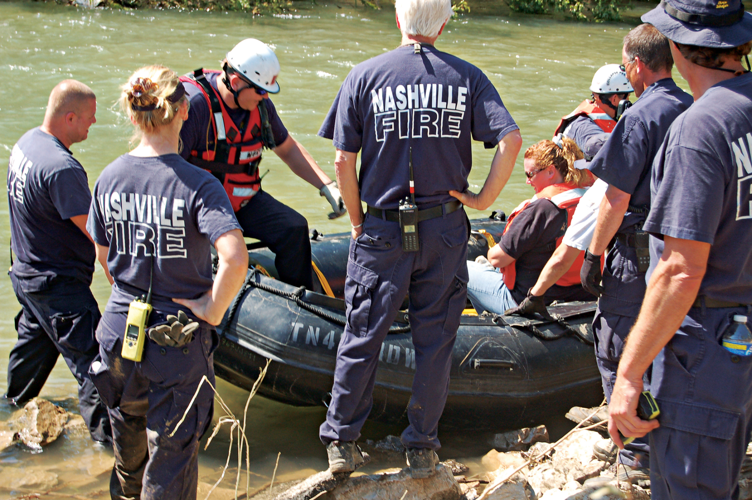


Urban Search-and-Rescue team
It is not an exaggeration — in fact, it may even be cliché — to say the flood of May 2010 is the seminal event of the 21st century in Nashville. Perhaps it was even the most seminal event since city-county consolidation in 1963.
The rise of the river, the devastation it left, the rush of volunteers, the citywide fellow feeling that followed and the recovery are tied inexorably — if not in fact, certainly in the version promoted by Official Nashville and the boosterism-industrial complex — to the beginning of the “It City” era. A chug-along midsize city on the cusp of greatness stares down a once-in-a-millenium natural disaster, and comes out better on the other end.
Nashville had faced disaster before: other floods (some even, in a technical sense, worse); tornadoes; even war.
But 2010 was different. Tornadoes are high-adrenaline and infamously random. The storm itself is brief, if incomprehensibly destructive, but the recovery can begin nearly as soon as the skies clear. Witness what happened this year: By the time the sun rose on March 3, Nashvillians were already out with chainsaws and trash bags.
On the other end of the spectrum: the pandemic. We can see it coming, and though there may be occasional blips and upticks in infections and death, the disaster itself is a long simmer. The damage isn’t nearly as dramatic or tangible as that of a tornado, but the metaphysical destruction is more chronic than acute, going on and on and on.
Floods, though, somehow draw from the worst of these two extremes.
Floods have a slow but inevitable build. The rains keep falling, the water keeps rising. Their destruction is no less than a tornado, but has a far larger ambit. There are periods of intense work — remember the sandbagging crews, drawn from the jail? Inmates worked hours on end at the vintage Omohundro Water Treatment Plant to keep fresh water flowing to the city’s homes. Remember the ad hoc sandbaggers at the MetroCenter levee? But there is also the excruciating waiting: Recovery cannot begin until the waters recede.
In this way, floods are an epic test of emergency preparedness.
Lessons drawn from a flood can be applied to a variety of natural disasters. With Davidson County almost perfectly bifurcated by the Cumberland — its tributary creeks stretching their fingers into every neighborhood — plus the web of springs undergirding nearly every acre, a once-in-several-lifetimes flood can potentially touch every part of the county in a way a tornado simply cannot. And indeed, that’s what happened in 2010.
Even a particularly wicked designer would have a hard time drawing up an exercise for Nashville’s emergency preparedness apparatus that was more devious than the real-world test our city was forced to take a decade ago.
Tucked away in the recesses of nashville.gov is a 335-page document, produced in July 2011: “SEVERE FLOODING MAY 2010, Disaster Declaration #FEMA-1909-DR, After Action Report/Improvement Plan.”
Its cover is a collage of black-and-white memories from the first week of May 2010. There’s a man wiping down a muddy dresser, a line of sandbaggers, then-Mayor Karl Dean in a polo shirt flanked by then-Gov. Phil Bredesen in a sport coat (but no green vest).
Inside is a recital of nearly every detail from every nook and cranny of the county, and every bureau, agency, commission and department of Metro government. But first, there’s a tick-tock — a nearly minute-by-minute breakdown of how things happened, from the first warning of the coming flood on April 29 through the deactivation of the Emergency Operations Center on May 14. There are charts showing how high the water rose. (An interesting and illustrative example: Dry Creek in Edenwold near Rivergate has, as one might guess from its name, no official flood stage; it crested at nearly 14 feet.) There’s an explanation of the 16 “emergency support functions,” laying out which department is in charge of everything from transportation to donations to animal services, and who is expected to offer support to those agencies.
But the meat of the report is the breakdown of how all of those departments performed and what they could have done better. Some of the notes are obvious: The fire department, for example, did a lot of work under less-than-ideal conditions, to put it mildly. Altogether, the NFD answered more than 5,300 calls for assistance between May 1 and May 11. The praise for the city’s firefighters, EMTs and paramedics was effusive. (At one point in the document, the emergency workers’ response is favorably compared with the Allies fighting in two major theaters during World War II.) The primary problem as outlined was an inability to resupply the crews when they were on site, not an unexpected issue with so many streets blocked.

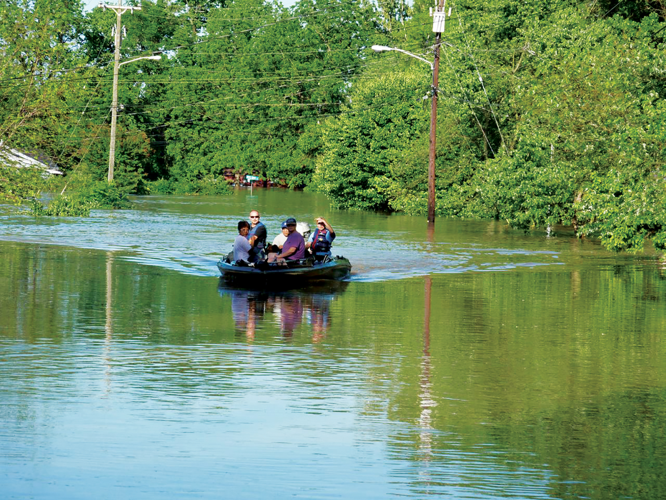
Neighbors help residents to dry land on McGinnis Drive in Inglewood
Some of the notes are less predictable. While Metro’s Department of General Services, as indicated by its comprehensive title, is responsible for numerous things, it’s a virtual certainty no one in the city ever thought about the necessity of or the challenges faced by its print-and-copy-services division. Yet it was vital: Reports had to be produced for officials, handouts to flood victims were needed. Deadlines were tight, and copiers had to be relocated — not just to save them from rising waters, but also because Metro had shifted nearly all of its resources to facing the flood.
These breakdowns are largely self-assessments, and as anyone who has had to do a self-assessment for an annual employee review knows, it can be difficult. People are often harder on themselves than necessary and are uncomfortable being too generous with praise, lest they be seen as disingenuous.
That’s not to say there aren’t hard truths buried inside.
Many departments found that if they had a disaster plan at all, it hadn’t been updated in years. The personnel tasked with coordinating with the city’s hospitals, for example, ran into trouble. Either the contacts were out of date or — because the flood was primarily a weekend event — unavailable with no secondary contacts listed in the binder. A small thing, perhaps, but notable enough that ahead of the COVID-19 pandemic striking the city, the Metro Public Health Department made sure to update that same contact information.
On May 4, 2010, NFD Chief Steve Halford called for Metro’s human resources emergency services coordinator to come to the Emergency Operations Center. Halford wanted to know which departments were shut down, partially staffed or operating at full capacity. The coordinator learned that there was no procedure or requirement that the departments tell H.R. if they are closing or operating at reduced capacity — he had to call every department head to find out, even though many of those department heads were in the EOC and could have offered that information on the front end.
Speaking of the EOC, the Office of Emergency Management’s synopsis is more like a novel than a brief list of bullet points. Obviously, the OEM is going to play a critical role in disaster response; it’s the whole raison d’etre for the department. And a major problem? It was crowded at the EOC.
“Personnel and vehicle congestion at the EOC will be more effectively checked and managed in future large scale activations,” the report reads. “Without a clear role, some persons appeared regularly and unannounced at the ECC / EOC Compton complex and had free access most of the time, but did not have a discernable and official function.
“This caused multiple minor issues with the limited space and increased noise and will be strictly controlled with sign-in procedures and special access entry required to gain access past Metro property guards.”
Furthermore, coordination with the National Weather Service proved difficult, if not impossible. While Nashville is without a doubt the hub of Middle Tennessee, the NWS Forecast Office in Old Hickory must provide services to the entire Grand Division.
“Communications with the local office of the National Weather Service was [sic] exceptional until the flood situation became a 72-hour, regional disaster,” the report reads. “This situation soon caused limited availability of their key expertise to Metro Government decision makers. The same can be said of the U.S. Army Corps of Engineers. Phone calls and voice mails were an inadequate form of communication most of the time. Critical information was often not shared and confirmed amongst the NWS, USACE and local government officials, as it should have been. Major flooding events in the future necessitate OEM to change its activation procedures and require attendance in the Metro EOC of high level personnel from both of these agencies to be able to communicate, in person with key local decision makers.”
Indeed, in the months after the flood, Metro, the Army Corps of Engineers and the NWS signed a memorandum of understanding promising attendance from the federal agencies during a meteorological disaster.
Some departments were faced with the destruction of their offices altogether, notably what was then the Metropolitan Transit Authority (now WeGo). MTA’s major facility on Nestor Street was among the first in the city to be inundated. MTA’s disaster solution, thus, was relatively straightforward: Move to higher ground.
The flood, in a way perhaps no other type of disaster could have, identified critical shortcomings in how Metro handles disasters of all types. It demonstrated the need for the city to be able to broadcast information on its own, without relying on the federal Emergency Alert System — a capability it now has, and one that has improved greatly in the past decade as the city continues to update its siren system.
Shortcomings in the various memoranda and the oodles of other legalese that govern operations in such disasters were not identified until they were actually implemented. Davidson County’s satellite cities — Belle Meade, Berry Hill, Forest Hills, Goodlettsville and Oak Hill — were not then signatories to the county’s hazard mitigation plan; that has since been rectified. Shelter operations were a major complaint in the review of the flood. Who was in charge? How would people get there? How would they be accounted for? The services within the shelters provided by various Metro departments — health, social services and the EMA itself — were not coordinated, nor were they coordinated with nongovernmental organizations like the Red Cross. That resulted in, at best, duplication, and at worst, people falling through the cracks at a most trying time.
All the tabletop exercises and drills that the city has run in the decade since the flood can go only so far to test the limits of the system. Only real-world events can truly demonstrate how much was learned, and Nashville has been hit with a brutal one-two punch in the past six weeks.
While the community response to the March 3 tornado — so overwhelming that Hands On Nashville’s volunteer sign-up web page crashed before 9 a.m. — was similar to that of 2010 (if not larger in part because the city has grown by nearly 70,000 people in the past decade), Metro’s response was far less frazzled than in 2010.
Take shelters, for instance. Within hours of the tornado crossing the county, temporary shelters were operational. By the afternoon of March 3, three permanent shelters were ready for occupation, with personnel already on site to coordinate recovery for everything from clean-up to warm meals to looking after pets.
When COVID came to town, Metro already had plans for shelters for the homeless — a particularly hard-struck population during the flood, given the proximity of so many camps to the river.
Communication both within Metro government and from it to the people was often chaotic during the flood. Improvements have come, not just because of technological upgrades, but because the plan now recognizes the importance of disseminating accurate and useful information quickly, if only to fight rumors. This was a particularly difficult situation during the flood, and the hard-won lesson’s aftermath can be seen with the daily briefings by the mayor and top health officials during the ongoing pandemic.
No disaster response is perfect, as every event is different, presenting challenges that couldn’t possibly be predicted. The goal is to respond efficiently to the foreseeable, and adapt to respond to the unforeseeable as effectively as possible.
It’s like being graded on a constantly changing curve: Was it better than the last event? Hopefully. Was it as good as it could have been? Almost certainly not.
In a year or so, Nashville will produce a document similar to the one it published in July 2011. In fact, it will probably produce two — one each for the tornado and COVID-19. Departments will have to answer tough questions and proffer solutions. They’ll note how things went compared to 2010.
Ideally, any shortfalls will be addressed, because when the next disaster strikes, someone will ask: Did we really learn anything from 2020?




