
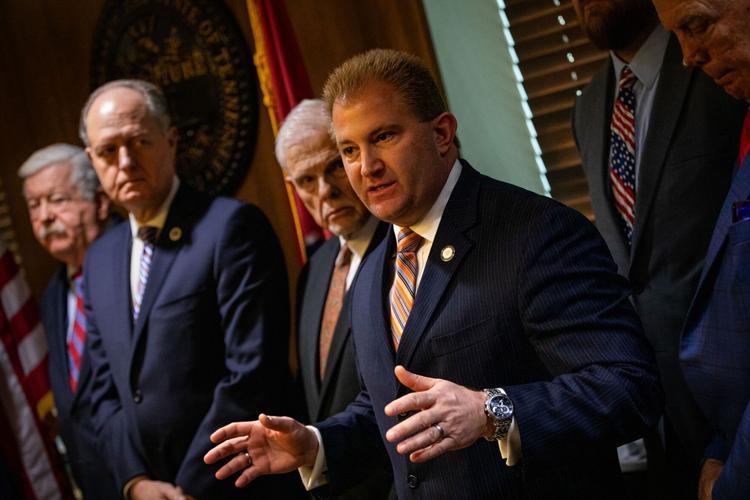


House Majority Leader William Lamberth (R-Portland)
At the beginning of this year’s legislative session, Republican and Democratic lawmakers couldn’t see eye to eye on whether Tennessee was in a positive financial shape. Even now, after passing the $58 billion budget, both parties still don’t agree on the financial outlook of the state.

General Assembly approves $58 billion state budget, school voucher expansion and ‘Charlie Kirk Act’ as session heads toward close
House Majority Leader William Lamberth (R-Portland) says he’s proud of the initiatives offered within this year’s budget, even though it’s $2 billion smaller than the one passed last year. The last of Gov. Bill Lee’s four budgets during his second and final term, it was roughly on par with his previous three budgets. The 2025 budget was the largest, standing around $60 billion, following $52 billion in 2024 and $56 billion in 2023.
“I thought it was a steady progression,” Lamberth says. “Our budget teams did a good job this year.”
Nearly 170 bills were placed “behind the budget,” meaning legislators supported the measures but couldn’t commit the money. Of those, at least 80 bills found funding.
Senate Finance, Ways and Means Chair Bo Watson (R-Hixson) says he considered the budget process smooth this year.
“As things were developing during the course of the session, we had a lot of negotiations,” Watson says. “We have a good working relationship with the executive branch. They didn’t surprise us with anything in the budget. We moved some things around there that we thought were some legislative priorities that outweighed the executive branch. The process went well overall.”
During Senate Finance, Ways and Means Committee meetings, Watson and company sourced $137 million from the state’s general fund for TennCare hospital buybacks — a funding mechanism designed to reimburse hospitals for the tax revenue used by the state. The legislature had to pull funding from various sources since buybacks were not funded in the budget version submitted by the governor.
Both Lamberth and Watson point to $25 million in funds for nuclear and quantum energy as hallmark investments, hoping Tennessee could lead the nation in energy initiatives through Oak Ridge National Laboratory.
“Energy is going to become a valuable commodity around the world,” Watson says. “Looking for different energy sources like nuclear space will yield big dividends and companies coming here because we have shown a real interest in that space.”
Watson notes, however, that gas prices could affect revenues for tourism and agriculture — two of Tennessee’s biggest industries.
“As fuel prices are up, we would love to see a resolution of the Middle East situation so oil prices can come back down,” Watson says.
Lamberth says he’ll continue to push, if he’s reelected, for an end to the grocery tax — something both Democrats and Republicans want cut, though with vastly different approaches.

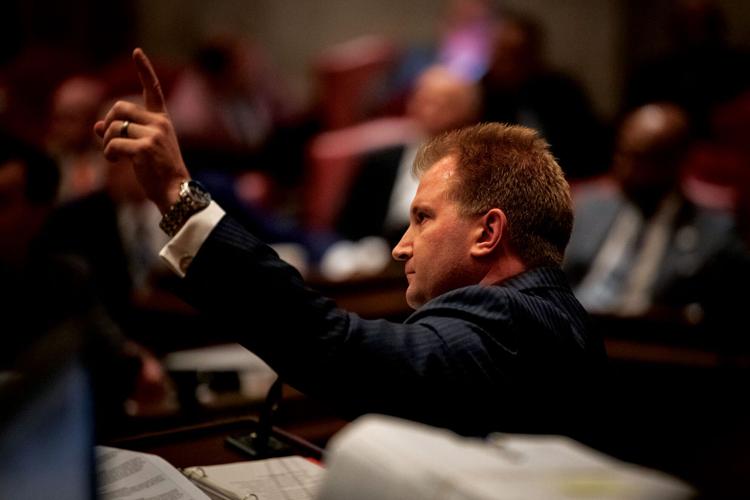
During the 114th Tennessee General Assembly, April 2026
Rep. John Ray Clemmons (D-Nashville) says the political priorities of the Republican supermajority — such as vouchers for students to attend private schools and measures targeting immigration — dominated the budget items.
“It’s not the people’s priorities,” Clemmons says. “Healthcare is not more accessible. Our roads aren’t getting fixed. Traffic isn’t getting addressed. We asked for a gas tax holiday; we got none. Schools are less funded than they were before. The question for people out there: Where is my money going? The state spent more money on immigration than on quality of life. This is a budget of misplaced priorities.”
“I think Tennesseans got their initiatives funded,” Lamberth says. ”We focused on meeting Tennesseans’ priorities. Unfortunately, sometimes members of the minority caucus focus on national issues. Sometimes they are trying to throw rocks through the windows.”
Sen. Jeff Yarbro (D-Nashville) says even some conservatives have noted that in the future they might have to cut spending or increase taxes.
“The next governor is inheriting the disaster of a broken budget,” Yarbro says. “Inflation is a real drag on this budget. It means this rainy-day fund is increasing in value but has less actual purchasing power for bad times. It means the money we spend on roads fills fewer potholes. The money for teachers doesn’t go as far as it used to. The state is dealing with inflation and broke the revenue, passing tax cuts for corporations. Then you add on top of that a multi-hundred-million-dollar entitlement program that just isn’t paid for. Before I can get into the liberal criticisms, the conservative criticisms are damning. This is going to put the state in a crisis.”

We recap what the state legislature did — and didn’t do — this year at the Capitol



Post a comment as anonymous
Report
Watch this discussion.
(0) comments
Welcome to the discussion.
Log In
Welcome to the discussion.
Keep it clean. Please avoid obscene, vulgar, lewd, racist or otherwise abusive language. Comments featuring hate speech or threatening or violent content will not be tolerated.
PLEASE TURN OFF YOUR CAPS LOCK.
Be truthful. Don't knowingly lie or mislead.
Be proactive. Use the “report” link on any comment that violates our comment policy.
Share with us. We'd love to hear your feedback.