
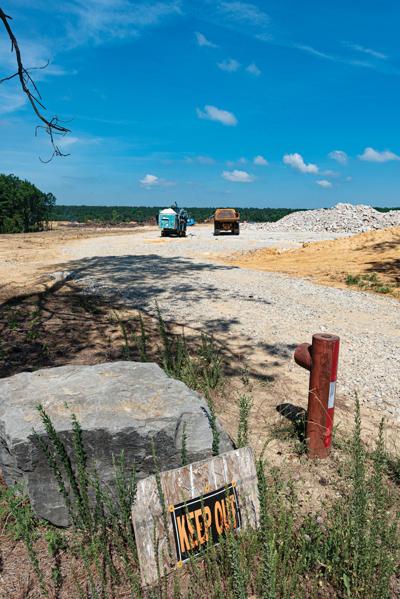


Clouse Hill Sand Quarry
A decision in February by the Tennessee Supreme Court gutted a state law informally called the County Powers Act (CPA), which Grundy County used to shut down a sand quarry in 2022. The law, amended 25 years ago to let rural counties with no zoning ordinances control “nuisances,” had been used to go after not only quarries, but also adult entertainment superstores, opioid-dispensing pain centers and homeless encampments. In this case, the court held that Grundy County had created “in effect, a zoning ordinance enacted in violation of Tennessee’s County Zoning Act.”
Residents near the Clouse Hill Sand Quarry were upset about loud explosions and threats to well water. “I was sitting on the bed,” former Clouse Hill resident Michael Ford tells the Scene. “There was a small decorative pillow on a table beside me, and the explosion blew it a foot-and-a-half up in the air. We were so scared, and then we were so angry.” The community’s fight was against just the sort of nuisance the CPA was supposed to stop.
My dog in the fight: caves and waterways. The same ancient limestone that holds 11,959 caves (that’s the latest count, according to the Tennessee Cave Survey) is perfect for the asphalt and concrete to make more highways, housing developments, industrial parks and money. Cave country’s biggest quarry operator is Tinsley Asphalt, which pursued appeals through multiple courts, losing each time. Even the state attorney general sided with the county until the reversal by the state’s highest court.
A few months before the Clouse Hill operation was shut down, I wrote a Scene cover story on the hidden beauty and ecosystems it threatened, along with pristine streams and groundwater. As a child traveling through Tennessee, I had been captivated by signs advertising Wonder Cave and Ruby Falls. In college I ventured beyond tour caves to pits, underground rivers and massive chambers few will see.
A 2022 dye trace — a method of water-flow tracking — proved that waste sand from Clouse Hill would have washed into the landmark Wonder Cave and more recent discoveries, threatening rare cave-adapted species that live nowhere else. The Grundy County resolution proclaimed, “No quarry, rock crusher or gravel pit may be located within 5,000 feet of a residence, school, licensed daycare facility, park, recreation center, church, retail, commercial, professional or industrial establishment.”
That’s the line that the high court ruled was an illegal zoning ordinance.
“Everybody has found that extremely odd,” Grundy County Mayor Mike Grady tells the Scene. “I think I know what happened, but it’s an opinion. I mean, it started involving big corporations being told, ‘You can’t pick on rural counties anymore,’ which is an economic downfall for the mining association.” Grady says the Tennessee Department of Commerce and the state mining association helped the appeal. “I think money got involved with it.”*
The CPA was originally co-authored by former state Rep. Charles Curtiss (D-Sparta), who is now executive director of the Tennessee County Commissioners Association. Although Curtiss was “disappointed” in the court’s decision, he adds, “I’ve got a lot of trust in the state Supreme Court.” He says he can see how many, perhaps all, resolutions under the act might be legally interpreted as zoning.
“The last thing rural people want is somebody to tell them how to build a barn,” Curtiss explains. “Zoning has nothing to do with farming, but you can’t explain that to the public. I’m 79 years old. I don’t think I’ll live to see rural counties adopt zoning. That’s one reason the legislature was trying to make another way for them to protect themselves.”
Curtiss offers some hope for Grundy County: “They could probably go in and rework the County Powers Act and say, ‘If you’re dealing with something that could be zoning, you have to have public hearings and reflect exactly what’s in the zoning laws.’ That might hold up in court.”
This could be what Mayor Grady plans. Before the next legislative session, he says he will reach out to counties adopting the CPA. He says he wants to “contact each one of those and get support for amended language” to be introduced next year.
Meanwhile, legislation that could offer counties a new tool is making its way through the state legislature. The legislation would empower local governments to “approve the location of any quarry or digital asset mining facility in a public meeting.” It could also require professional reports on potential harm to residents or the environment. (Both the House and Senate versions of the bill are scheduled for votes after this issue goes to press.)
“We’re in this constant struggle between local control and state control,” says state Sen. Heidi Campbell (D-Nashville), a co-sponsor of the Senate bill. “I think it’s best if these decisions are made by the people who are close to the development.”
*Update, April 10: A spokesperson for the Tennessee Department of Commerce and Insurance tells the Scene that his department “does not oversee quarries in Tennessee and played no role whatsoever in the Tennessee Supreme Court's recent decision related to the County Power Act.”

Stories on the local tree canopy, Tennessee quarries, the endangered Nashville crayfish and more — plus, how to get free trees and recycle your electronics



Post a comment as anonymous
Report
Watch this discussion.
(0) comments
Welcome to the discussion.
Log In
Welcome to the discussion.
Keep it clean. Please avoid obscene, vulgar, lewd, racist or otherwise abusive language. Comments featuring hate speech or threatening or violent content will not be tolerated.
PLEASE TURN OFF YOUR CAPS LOCK.
Be truthful. Don't knowingly lie or mislead.
Be proactive. Use the “report” link on any comment that violates our comment policy.
Share with us. We'd love to hear your feedback.