

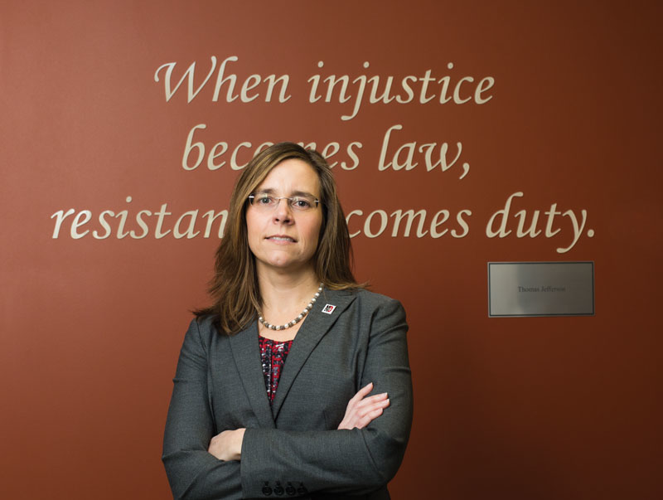



In early September, Dawn Deaner raised her right hand, swore an oath to tell the truth, the whole truth and nothing but the truth, and settled into a seat on the witness stand in a Nashville courtroom. As the city’s elected public defender since 2008 and an attorney in the office for 11 years before that, Deaner has seen a criminal courtroom from just about every angle. But this was an unusual vantage point, and the scene was all the more remarkable because of the person who was rising to cross-examine her — Nashville’s elected district attorney, Glenn Funk.
The hearing — and particularly the faceoff between Nashville’s two top elected attorneys — caused a buzz in some quarters of the Nashville legal community, with some people who were present describing it as an “extraordinary” scene with compelling testimony, contentious moments and lots of objections. It also served to shine light on what has long been a hidden crisis in Nashville’s criminal justice system.
The events that brought Deaner and Funk to that moment were also unusual. In July 2013, John Hernandez had been indicted in the murder of his estranged mother-in-law, Annis Szekely, a case that had gone cold for 20 years. At the time of the indictment — which Metro police said was based on DNA evidence linking him to the murder — Hernandez was in custody in Austin, Texas, facing sex-trafficking charges. He was not extradited until April 2014. The Metro Public Defender’s Office, which is tasked with representing criminal defendants who cannot afford an attorney on their own, was assigned to represent him.
From then on, his case was subject to a series of lengthy delays. His trial date was twice pushed back, and the public defenders representing him had to tell him repeatedly that they weren’t yet ready for trial. Perpetually buried in cases, they hadn’t had enough time to prepare for his.
In February 2016, having sat in a Nashville jail awaiting trial for nearly two years, Hernandez asked the court to appoint him co-counsel. Citing the repeated delays and facing the prospect of more, he said he would rather represent himself than push the trial back again. At the same time, his attorney, assistant public defender Georgia Sims, made a motion to dismiss the charges against him, citing a violation of his right to a speedy trial. The defense was still not prepared to go to trial, and as a result, the motion argued, Hernandez was being forced to choose between two constitutional rights: his right to a speedy trial, and his right to an attorney who could represent him effectively.
With his attorneys, and the public defender’s office in general, now tied up in the case, attorneys from Bass, Berry & Sims — one of Nashville’s most prominent private firms — were brought in to argue the motion on his behalf. They put the blame for Hernandez’s predicament squarely on the state. Typically, when speedy-trial claims are being evaluated, the court does not count delays initiated by the defense against the state. But in this case, the attorneys argued, citing previous case law, it was the state itself — which was prosecuting Hernandez but also obligated by the Constitution to provide for his defense — that was on the hook.
“Tennessee’s affirmative decision to inadequately fund the Metro Public Defender’s Office has not only created an unmanageable caseload for the public defenders, but has also forced both Mr. Hernandez’s attorney and this Court to make the unconscionable decision of whether Mr. Hernandez is entitled to a right to counsel or a right to a speedy trial,” the attorneys wrote in a filing with the court. “Under the circumstances, he cannot receive both.”
Later in that same filing, they say the state’s neglect “has led to a systematic breakdown in the public defender system.”
The following month, the court held an evidentiary hearing allowing the Bass, Berry & Sims attorneys to make their case to that effect. Filling up two long days in court, the hearing featured outside expert testimony and testimony from the two public defenders who represented Hernandez — Georgia Sims and Kevin Griffith — as well as from Deaner. In a rare move, Funk was there himself to cross-examine witnesses and make the state’s case against the motion.
Judge Steve Dozier ultimately denied the motion, and Hernandez was convicted of the murder at his subsequent trial. Dismissing a murder charge is, after all, a drastic step. But in his order denying the motion, Dozier acknowledged that “a legitimate question has been raised as to whether the Metropolitan Davidson County Public Defender’s Office is understaffed and/or underfunded based on the sheer volume of cases.”
That was a question Deaner had already begun to answer. In the fall of 2014, at the same time the office was undertaking an initiative to increase its visibility in the local criminal justice discussion, she announced she was implementing some modest workload controls, capping the number of cases her lawyers would take from the city’s overflowing jail docket. But that was about as effective as bailing water out of a boat positioned under a waterfall. Earlier this year, Deaner implemented more controls, with the goal of reducing the office’s workload by 10,000 cases over the next 12 to 18 months. She’s also getting more vocal about the dire status of indigent defense in Nashville.
In an interview with the Scene at the public defender offices overlooking the half-demolished Criminal Justice Center that once held Nashville’s dilapidated downtown jail, Deaner explained that “the right to counsel and the right to effective counsel” is a criminal defendant’s most crucial constitutional right — the one that, as the United States Supreme Court has noted, gives a person real access to the many other protections they are theoretically afforded.
“Every client has that right, and the legitimacy of our criminal justice system rests on that,” she says. “And I think there is so much unrest and so much distrust of our criminal justice system in large part, I would say, because that right alone hasn’t been honored.”

A pivotal moment for the right to counsel came in 1963. That’s when the Supreme Court’s decision in Gideon v. Wainwright held that states are obligated by the Sixth Amendment to provide legal representation on behalf of criminal defendants who can’t afford an attorney. But Nashville and Shelby County, which includes Memphis, already had their own operating public defender’s offices, funded by their local governments. Nashville’s had been established the year before, while the Shelby County Public Defender’s Office had been providing indigent defense since 1917, making it the third oldest public defender’s office in the country.
For nearly 30 years after the Gideon decision, Tennessee provided for indigent defense in the state’s 29 other judicial districts by paying private attorneys appointed by the courts. But in 1989, the state established the Tennessee District Public Defender Conference, creating public defender’s offices across the state. Three years later, state legislation set up an arrangement whereby the state would appropriate funds for public defense in those 29 districts and also include an annual appropriation to Metro Nashville and Shelby County — on top of what those offices receive from their county governments — that was equal to the percentage of any increase in funding given to the district public defender’s offices.
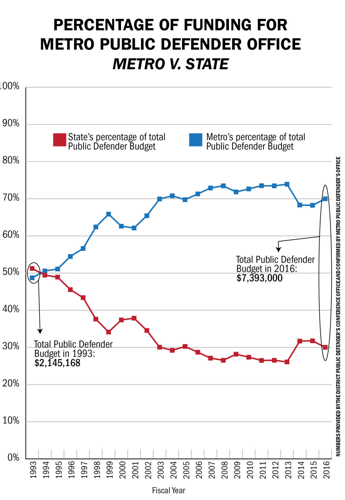
Deaner says the state failed to hold up its end of that bargain, allowing funding to the Nashville and Shelby County public defender’s offices to stagnate, while local governments bear more and more of the burden.
“Metro’s doing right by us,” Deaner says. “Metro has always been a place that has appreciated the value of a strong public defender’s office. They have funded this office fairly, I would say, over the years. And I don’t think the state has.”
The numbers would seem to back her up. In the Hernandez case, the Bass, Berry & Sims attorneys who argued that there had been a “systematic breakdown in the public defender system” presented the court with a comparison of the state appropriations for the Metro Public Defender’s Office and the state’s appropriation for the other judicial districts in the state. The contrast is stark.
“Between 1993 and 2016, funding for Metro Public Defender increased by 98.7 percent,” they write in one filing. “During this same time, funding for the other districts increased by over 220 percent.”
In a recent interview at the Bass, Berry & Sims offices, on the 28th floor of the Pinnacle building, the three attorneys who worked on the case — Angie Bergman, David Esquivel and Courtney Grande — stressed that this comparison is not meant to suggest the other districts are adequately funded. On the contrary, they say, it shows that Metro lags far behind the rest of the state’s public defenders, which are themselves underfunded in many cases.
Even when the Metro government contribution is included, they show in another exhibit, Nashville’s public defenders received just $231 per case closed in fiscal year 2015, lagging behind the state average of $295 per case closed.
The state of Tennessee has, at least tacitly, acknowledged that for decades it was in violation of its own statute with regard to the funding of indigent defense in Nashville and Shelby County. In 2013, confronted by Deaner — armed with stacks of documents showing the budgetary and staffing restraints her office was facing — Gov. Bill Haslam proposed a one-time appropriation for those offices. At the same time, the state legislature amended state law so that, instead of increases in funding to Metro Nashville and Shelby County being in proportion to the increases in funding granted to the rest of the state’s districts, those increases would be equal to the percent of change in the consumer price index each year.
For fiscal year 2017, Deaner explains, that meant her office received an additional $2,200 dollars from the state.
“That doesn’t cover anything,” she says.
The portion of the speedy-trial motion in the Hernandez case that addresses the new state statute is similarly blunt.
“This change,” it reads, “virtually guarantees that the budgetary shortfalls experienced by the Metro Public Defender will persist.”

Dawn Deaner
In 1999, the state of Tennessee contracted with The Spangenberg Group, a research and consulting firm specializing in criminal justice, to develop standards for caseloads and adequate staffing in the state’s public defender’s offices. The resulting guidelines — which remain the most recent official workload standards for public defenders in Tennessee — are arguably unrealistic themselves, and even still, Deaner’s office blows right through them.
In February 2016, at one of her office’s speaking-tour events, Deaner broke it down for an audience at The Temple in Belle Meade. The Spangenburg standards say a public defender shouldn’t handle more than 500 misdemeanor cases in a year. But in fiscal year 2012, Deaner told the crowd, lawyers handling misdemeanors for her took up to 1,000 cases each, typically giving them less than an hour to spend on each case.
In the Hernandez case, Bergman, Esquivel and Grande used caseload figures from fiscal year 2014 to illustrate the same point. Altogether, using the guidelines for first-degree murder cases, felonies, misdemeanors and more, they showed that Deaner’s office would have needed 67 full-time attorneys to be operating within the Spangenburg standards. In reality, her office had “44.5 full-time equivalent attorneys” for that year, during which the office closed just shy of 30,000 cases.
“I cannot imagine adequately representing my clients with those numbers,” Bergman says. From the perspective of a private firm dealing largely with clients who can afford to pay for aggressive legal representation, the workload facing the public defender’s office, she says, just “boggles the mind.”
And interacting with attorneys from that office left a lasting impact.
“Seeing and talking to and getting to know these lawyers has been one of the most rewarding things in my career,” she says. “Because they are some of the smartest, most passionate lawyers that I’ve met.”
Bergman recalls those long hearings in September, when attorneys from the public defender’s office took the stand.
“For me, some of the most compelling testimony that came out in the hearing was from John’s lawyers,” says Bergman, “who at every stage have worked as hard as they possibly could to do the work that they needed to do, and yet have been unable to do what they wanted because it’s humanly impossible.”
Deaner often compares the plight of the public defender’s office to a famous scene from an episode of I Love Lucy, in which Lucy and Ethel go to work at a candy factory. As pieces of chocolate start coming down a conveyor belt, they take each one and carefully wrap it. Then more and more pieces come at them, and at a faster rate. Soon, they aren’t even close to keeping up — some pieces of candy go speeding by while others pile up in front of them. The ones they do manage to wrap don’t look so great.
Always eager to bring the conversation back to the rights of her clients, Deaner sometimes seems a bit uncomfortable with using a rather trivial metaphor to explain such a serious subject. But if the scene seems dehumanizing — poor criminal defendants represented by pieces of candy — then it might be all the more appropriate. That is the frequent result of being pulled into a system that is overloaded and underfunded. Individual human lives turned into cases to be processed and sent away as fast as possible. No matter how dedicated the attorney, Deaner says, this reality leaves them “triaging justice.”
“We are so far from adequately resourced to provide effective representation for the number of clients we’re currently representing.”
The state of Tennessee recently acknowledged that it needs to rethink indigent defense in seemingly the only way it knows how — it created a task force. But while the creation of such a force often sends eyeballs rolling (with some arguing the state would rather study an issue than truly address the problem), the Indigent Defense Representation Task Force has inspired a measure of optimism among defense attorneys.
It didn’t at first. For one thing, the group doesn’t include a single public defender. But since the task force was appointed by the Tennessee Supreme Court in late 2015, its members have taken part in a statewide listening tour and hosted testimony and presentation from experts and people working inside the system. The task force expects to release a report with proposals and recommendations for reforming the system in April. Deaner and other interested attorneys say they are hopeful about what might come out of it.
William Koch Jr., the chairman of the task force, who is also a former Tennessee Supreme Court justice and the current president and dean of the Nashville School of Law, offers a broader view of the problem.
“What we’re seeing in Tennessee,” he says, “which is something that’s not dissimilar to what many other states have experienced and are experiencing, is that our criminal justice system — and when I say that I include not just the public defenders and private defense counsel, but the district attorneys and prosecutors and the courts — over the past three decades have experienced a continually growing workload. More people are being brought into the system.
“Over time, that increase in workload has not been offset by the resources that the courts, the district attorneys and the public defenders need [in order] to do that work as efficiently and effectively as they might otherwise do.”
In July 2016, Patrick Frogge was elected executive director of the Tennessee District Public Defenders Conference. Frogge is a former public defender with a reputation as an aggressive defense attorney, and his election was cheered by criminal justice advocates. He declined to comment for this story, but in his new role, he serves as a liaison of sorts between Tennessee’s public defenders and the state government that funds them. In his new recommended budget, unveiled earlier this week, Gov. Bill Haslam proposes an additional $80,000 for Nashville’s public defender’s office and $180,000 for Shelby County’s. For the rest of the state’s public defender’s offices, the budget would fund nine new public defenders and nine new investigators (a welcome boost, but smaller than the proposed additional funding for prosecutors ).
Although Deaner is not shy about the need for more resources in her office and others around the state, she says she’s equally committed to reducing the demand for them.
“I would love for our office to be able to represent every single client who qualifies who needs a lawyer,” she says. “I would also love for there to be less of a need for taxpayers to have to pay for public defenders, because a lot of the workload that’s going through General Sessions Court is stuff that doesn’t need to be a crime.”
One effort her office is heading up, with cooperation from agencies throughout the criminal justice system, is Steering Clear, a diversion program for people facing citations for driving on a suspended or a revoked driver’s license. The goal is to eliminate one of the ways that thousands of Nashvillians get pulled into the criminal justice system — and a resulting cycle of debt — through minor offenses.
But Deaner is also taking action on the supply side. In the public defender’s office, that means refusing cases. Starting Jan. 1, Metro public defenders will no longer be taking on misdemeanor cases in which the defendant has made bond — a defendant, in other words, who isn’t sitting in jail. They will be making an exception for defendants who aren’t fluent in English, since the office has a part-time immigration specialist and good relationships with translators in the court system.
When she was on the stand in the Hernandez case, being questioned about whether her office was truly as buried as she claimed, Deaner was asked: If things are really so bad, why not sue the state? The answer to that, Deaner tells the Scene, is complicated, although several offices in other states have tried it and had success. An article last month in the ABA Journal detailed such efforts, noting that “at least five lawsuits have reached successful decisions or settlements over the past five years” and that “at least six states were sued — two in state supreme courts — regarding funding of indigent defense.” (The article also notes that public defender’s offices have had a strong ally in President Obama’s Department of Justice, an allegiance that might be in question in a Donald Trump administration.)
On the stand, Deaner was also asked why her office hadn’t declared workload conflicts on thousands of more cases. The only answer to that, she says, was “good question.”
The approach she’s taking now, she says, was designed to have the least negative impact on the rest of the system, from judges to prosecutors to clerks. But, she concedes, it is also meant to bring about a healthy amount of disruption.
“To not stand up and do something about it is to enable the system to provide as little as it wants to provide.”
Email editor@nashvillescene.com




