

In mid-March, Nashville’s boom years — a decade or so of extraordinary growth and prosperity — blinked out like a dying neon sign.
Early in the month, with the deadly coronavirus pandemic tightening its grip on the globe and cases beginning to rise in Tennessee, some businesses had already begun closing their doors. Restaurant reservations on OpenTable were plummeting and would soon be down by 90 percent as compared to the same point in 2019. The SEC Basketball Tournament at Bridgestone Arena was canceled after one night of games. On March 15, Mayor John Cooper and the Metro Board of Health closed down the city’s bars, including the honky-tonks lining Lower Broadway’s neon canyon, which had essentially become a five-block super-spreader zone. A week later the mayor issued a “Safer at Home” order, instructing Nashvillians to stay put. In the wake of the March 3 tornado, many restaurants and businesses had barely begun their recovery efforts by the time the stay-at-home order came along.
The tourists who would typically be crowding the city’s bars and restaurants were suddenly absent. For the week of March 22-28, the city’s hotel occupancy rate was 9.3 percent, compared to 92.6 percent during the same week in 2019.
All of this was done for good reason, in the interest of public health. Arguably, it should have been done even sooner. But the effect was the same: Turn out the lights, the party’s over.
But what about the hangover?
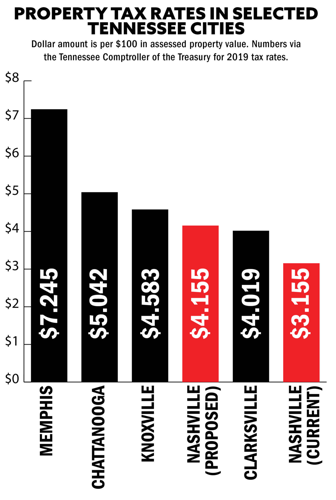
On April 28, Cooper announced his proposed budget for the next fiscal year, which includes a 32 percent property tax increase — $1 per $100 in assessed property value, making the proposed new rate $4.155 of every $100 — as well as significant cuts and another freeze on scheduled Metro employee raises.
No city will escape the pandemic and the ensuing economic shutdown unscathed. But in Nashville, the crisis has revealed weaknesses in a city that had every reason to be at its strongest. What did we get for our time in the sun, our decade of growth and cultural cachet as the burgeoning “It City”? And when the rain came, did it have to be this bad?
Did we blow the boom years?
The word “crisis” was spreading around Metro government before anyone had even heard of COVID-19.
In July 2018, an article published by Governing — a publication focused on state and local governments — keyed on that year’s looming budget shortfall and asked the question: “How, in the middle of unprecedented growth, did Nashville’s government run short of funds?” (The author of the piece, John Buntin, now works as the director of policy and community safety in Cooper’s administration.)
In a dire address to the Metro Council in November 2019, Tennessee Comptroller Justin Wilson said the city’s finances were a “mess” and told council members, “Despite all this wonderful growth and this booming economy that we have, Metro government is cash-poor.”
When presented with the question in this story’s headline, Metro At-Large Councilmember Bob Mendes, who is in his first year chairing the council’s Budget and Finance Committee, shares a slide from a presentation on the city’s finances given by Metro’s Blue Ribbon Commission on March 9. It shows Nashville in last place on a graph showing the health of Rainy Day Funds in large American cities.
“That alone answers the question,” Mendes tells the Scene.
In a subsequent interview, he elaborates: “Every time the revenue shortfall comes up, I’m quick to want to add, ‘And we chose to have essentially a nonexistent rainy-day fund.’ You could’ve maybe withstood the revenue shortfall if we had even an average rainy-day fund for a big city in America. But choices were made in previous years to not do that. So when you combine the fundamentally worst-in-America big-city rainy-day fund with a tourist-heavy economy in a state with no income tax, that’s a significant budget issue.”
Cooper and Mendes have been on opposite sides of the budgetary debates in recent years, but the mayor has acknowledged the city’s anemic reserves.
“Unexpected disasters such as the tornado and COVID-19 are why cities have rainy-day funds,” Cooper said during his socially distanced State of Metro address in March. “Unfortunately, Metro government doesn’t have a rainy-day fund, and instead, actually thinned its cash balances. Our lack of a rainy-day fund has left us vulnerable in what has become a stormy season.”
Mendes has been sounding the alarm about Metro’s finances and calling for a property tax increase for the past couple of years. In a 2018 interview with the Scene — in which he explained his proposal for an alternate budget that would have raised taxes — Mendes described then-Mayor David Briley’s budget as “built on quicksand.”
Even at that point, nearly two years before the current crisis, Mendes said his inbox was full of emails from constituents “fundamentally not understanding how we can be in a budget crunch when the city’s booming.”
He supported a property tax increase in 2019 as well, but it failed by just one vote.
After Cooper released his new budget proposal, Mendes tweeted: “I have sworn off saying ‘I told you so,’ but these presentations are like a bizarre mash-up of my blog posts over the last two years.”
Although the city’s strategy of using incentives and tax breaks to lure corporations to town is often referenced in discussions of the city’s finances, Mendes says the problem is far bigger than that.
“I’m confident that you could cancel every economic incentive, and you would not avoid a rate increase,” he says.
Mendes addressed that issue in a May 2019 blog post as he was pushing for a property tax increase for the second year in a row. Even assuming that Nashville gets no financial benefits out of its economic incentives packages, he approximated that current deals had a $41 million impact on the operating budget. That’s approximately the amount of money, Mendes wrote, the city would bring in by raising the property tax rate by 13 cents per $100 of assessed value — nowhere near enough to fill the hole in last year’s budget, much less the one the city is trying to dig out of now.
A basic explanation of how we ended up here now can start with another set of twin crises that took place as the Aughts gave way to the 2010s.
In 2010 — while the country was still reeling from the Great Recession and with the waters from that year’s disastrous flood having just receded from Nashville’s streets — then-Mayor Karl Dean and his finance director Rich Riebeling announced their plan to avoid a tax increase and save the city some money in the short term. They refinanced around $190 million of the city’s debt and made payments only on interest for a couple years, a move a 2019 Tennessean report on the city’s debt described as “akin to making only the minimum payment on a credit card.” The strategy essentially pushed large debt payments off toward the end of the decade.
Two years later, with the economic landscape a little more settled, Dean raised property taxes by 53 cents per $100 of assessed value. Concerns about the looming debt still lingered — as documented in a February 2014 Scene article — but Dean and others involved in the decision still defend it as the right thing to do at the time.
In 2015, with the city’s economy and cultural prominence growing, Megan Barry was elected mayor. Almost two years into Barry’s term, the countywide property reappraisal — conducted every four years by the Metro Assessor of Property — found a record increase in the median property value. It reflected the city’s rapid growth and churning housing market. State law prohibits the city from bringing in more revenue because of a property reappraisal, so the tax rate was adjusted down to make it revenue neutral.
As Mendes has frequently noted in recent years, that is typically when Metro leaders would propose an increase in the property tax rate to take advantage of the increase in property values. But Barry decided against it, and the budget that was approved by the council — under the leadership of then-Budget and Finance Committee chair John Cooper — left in place the lowest property tax rate in Metro’s history.
“That was the most consequential decision in the decade,” says Jason Freeman, the political director for SEIU Local 205, the health care and public service workers union that represents many Metro employees. Freeman has carved a niche for himself in local Twitter circles posting about city government and, in particular, the city’s taxes.
The decision not to raise taxes left about $400 million in annual revenue on the table, Freeman says. Beyond the historically low tax rate, some 17,000 property owners appealed their new tax rate, and — The Tennessean reported — 80 percent of them got their rates lowered. The result was a loss of around $20 million in expected revenue for Metro.
At the time, many elected officials were happy to tout record low taxes. But Freeman says there’s an insidious dynamic involved in the reappraisal process that made 2017 worse. The process of resetting the property tax rate to make it revenue-neutral after an appraisal is called equalization. Essentially, Freeman explains, the tax rate is redistributed to achieve the goal of keeping overall revenue at the same level. The results are sometimes confounding.
“The example we always use is,” says Freeman, “if you lived in Cleveland Park between the years of 2013 and 2017, and your home value went from $90,000 to $180,000, your tax bill went up by $400 a year, roughly. But if you lived in Green Hills and your house went from $600,000 to $700,000 — which is larger as a total-dollar increase, but on a percentage basis it’s much lower; you have a roughly 100 percent increase on one side, on the other side it’s like a 15 percent increase — your tax bill went down by three times what the other person’s went up. Your tax bill went down by $1,200. So you’ve redistributed that tax burden from a wealthy home to three small lower-value homes.”
Freeman acknowledges that in the future it could work the other way — Green Hills residents could see their tax bill increase while others see theirs go down. But in any case, in 2017, some middle- and working-class residents learned they’d be owing more in taxes without the accompanying increase in government services that one hopes to see from a tax increase.
Fully aware that her decision not to raise taxes in 2017 looms large in the narrative of How We Got Here, Barry defends the decision in part by alluding to the lack of appetite on the Metro Council for a tax increase at the time.
“I didn’t propose a tax increase in 2017 after the reappraisal, and I don’t believe the Metro Council would have supported one,” she tells the Scene in a written statement.
She also references the same dynamic that Freeman highlights, suggesting that a property tax increase would have simply added more hardship to the homeowners who saw their taxes go up as a result of the reappraisal.
“Projections had us capturing over $120M in new revenue that year without [a property tax increase], and we were seeing equity issues with the reappraisal where families in areas with historically high poverty were going to see increases in their tax bill, while areas of affluence would see reductions,” Barry says. “Given numerous successful property tax appeals by commercial entities and other sources of revenue shortfall, it would have been prudent to adjust the property tax in the following budget year, which is when members of the Metro Council began calling for it.”
Barry, of course, wasn’t in office to take that “prudent” step. After her resignation in March 2018, Vice Mayor David Briley ascended to the office. A referendum on Barry’s mass transit plan awaited him, as did a snap mayoral election to determine who would serve out the rest of Barry’s first term. The transit plan was decisively rejected by voters.
Riebeling, who stayed on after serving in the Dean administration and became Barry’s chief operating officer, tells the Scene that — as Barry suggests in her statement — the former mayor has told him she would have proposed a tax increase after the transit plan’s defeat if she’d still been in office.
Riebeling concedes that 2017 would have been an “ideal” time to raise property taxes, but also cites the same issues as Barry. Additionally, he notes that the Metro officials at the time assumed that utilities — the value of which is assessed by the state — would rise as home values did. When they didn’t, it added to the revenue shortfall.
“The last half of the decade we sort of lived off [the 2012] tax increase and the growth,” Riebeling says. “So what I would say is that the citizens of this community, taxpayers, have sort of benefited from that growth in lower taxes. … There comes a time when it catches up with you.”
Briley, who won the election to serve out Barry’s term and suddenly became an accidental incumbent, resisted a tax increase that year, citing in part the same concern that Barry had. In a letter to the council’s Budget and Finance Committee ahead of a final budget vote, he wrote: “Many of our most vulnerable neighborhoods were already effectively hit with a sizable tax increase due to the reappraisal just last year, and we can’t ask them to pay even more.”
The following year, facing another election, he vowed not to raise property taxes. That position was supported by one of his opponents, then-At-Large Councilmember John Cooper.
Cooper campaigned on the idea that Nashville had given too much attention to the downtown core and handed out too many corporate tax incentives at the expense of the rest of the city. He quickly built a reputation on the council as anti-everything, and his opposition to property tax increases flowed from that, and what he described as financial stewardship. After spending more than $2 million of his own money on the campaign, he hurled Briley out of office in a landslide. For the first time in Metro history, an incumbent mayor had failed to win re-election.
More than one longtime Metro insider noted with grim amusement the fact that a years-long refusal to increase property taxes had created conditions that fostered frustration with Metro government and contributed to the election of a characteristically anti-tax candidate like Cooper.
Briley did not respond to requests for comment for this story.

Now, after building a political brand on saying “No” and playing a pivotal role in blocking tax hikes, Cooper finds himself seeking a large increase. This increase is not designed to invest in a bold new vision for the city, but is rather a desperate attempt to plug holes in a ship that once seemed like it would cruise easily forever.
As the mayor acknowledged in his State of Metro address, ahead of announcing what he described as a “crisis budget,” the city has drained its reserves. In recent years, as Cooper and his two predecessors, among others, refused to raise taxes, Nashville has been drawing on its rainy-day fund. At the same time, the city’s debt payments increased year after year.
Cooper’s anti-tax stance over the past few years is firmly stuck in the craw of some Metro insiders (some of whom grumbled in Cooper’s direction on the condition of anonymity).
Asked whether he regrets his crucial Metro Council votes against raising property tax rates, Mayor Cooper — responding through a spokesperson — suggested he does not.
“In the last two budget cycles, property tax hikes were considered before we explored every possible opportunity for new revenue sources and management savings,” says the mayor in a written statement. “While we’ve had a need for better fiscal responsibility in Metro for some time, our current budget situation has forced us to do exactly that.”
The current crisis will hit Metro departments hard. Metro Nashville Public Schools had already been asked to cut $100 million out of its budget for the current fiscal year, and the district is up against a $25 million shortfall for the upcoming year. The direct cause of today’s pain is the pandemic, but it was arguably inevitable after a decade of good times that was not matched by the political action needed to make it sustainable or equitable.
The city has increased property tax rates only once since 2005.
“We sort of baked in a tax rate that didn’t support running the city,” says Freeman of the decision to let taxes stay at a record low in 2017. “So the idea that people are used to paying now what they’re used to paying and looking at this as a big increase — it is a big increase in the context of what they were paying before, but when we set that tax rate, that tax rate did not support the needs of the city of Nashville.”
Freeman points to under-resourced Metro departments like Public Works, which added only two full-time positions between 2008 and 2018, and the Emergency Communications Center, which fields 911 calls and saw a net loss in dispatchers during that time frame. The SEIU represents many Metro workers, Freeman emphasizes, who have seen the city treat their agreed-upon pay plan as a discretionary expense.
Despite prosperous times for the city, it has failed to meaningfully address issues like public transportation or the need for affordable housing. The boom decade saw many Nashvillians left behind. In a letter accompanying the 2019 Community Needs Evaluation conducted by Metro Social Services, executive director Renee Pratt notes, “Nashville’s poverty levels remain higher than pre-Great Recession, even amid high levels of overall economic growth.”
Councilmember Tanaka Vercher — who served as Budget and Finance Committee chair and supported a property tax increase last year — points to other core government responsibilities that she says have been neglected, like infrastructure.
“We, meaning all of us — government, citizens, ‘we’ because we’re all in this collectively — we lost focus,” she says. “We were romanced by being coined the ‘It City.’ ”
She says, with a laugh, that if she had to vote right now, she would vote against Cooper’s proposed budget “because I’m pretty sure Councilmember At-Large Cooper would be a ‘no’ vote.”
She goes on: “We can’t be asking the city to pay more for the same services that they’re paying less for. Right? Am I the only one that feels that way, or are you OK with getting the same thing but paying more for it?”
Vercher says “there’s more trimming” that can be done in the budget, and under some questioning, she concedes that means laying off some Metro employees.
Mendes adds the caveat that the budget conversation will change if the federal government decides to send financial aid to cities. In the meantime, though, he fears the upcoming budget will hurt the same people whether it leans toward taxes or cuts. Given the hole Nashville finds itself in, the budget will almost certainly include both.
“You got two different dials,” Mendes says. “One is tax rate, the other is what you’re gonna cut. Different budgets might pick different balances of the two dials. I think the reality is that both dials hurt the same people the most. The least privileged people in town are gonna feel [a tax increase] most acutely, and they’re gonna feel the cut in services most acutely.”




Post a comment as anonymous
Report
Watch this discussion.
(0) comments
Welcome to the discussion.
Log In
Welcome to the discussion.
Keep it clean. Please avoid obscene, vulgar, lewd, racist or otherwise abusive language. Comments featuring hate speech or threatening or violent content will not be tolerated.
PLEASE TURN OFF YOUR CAPS LOCK.
Be truthful. Don't knowingly lie or mislead.
Be proactive. Use the “report” link on any comment that violates our comment policy.
Share with us. We'd love to hear your feedback.