


It’s an early Saturday afternoon in November, sunny and unseasonably mild, the temperature threatening 70 degrees. But it’s even hotter inside Artista Brazilian Jiujitsu. So warm, in fact, that the facility’s floor-to-ceiling windows are fogged with condensation. From inside, you can’t see the line at the Green Hills Shake Shack across the street. Of course, from outside, you can’t see into Artista either. That’s too bad for the gridlocked drivers on Hillsboro Pike, since one of the greatest athletes in the world happens to be on the gym’s mats, performing what, even to the trained eye, looks like something close to magic.
This is Rafa (pronounced “HAH-fah”) Mendes, a second-degree black belt and six-time world champion in Brazilian Jiujitsu; he’s concluding a three-hour seminar by sparring with all comers, most of whom are black belts themselves, and laying waste to each. Along with his older brother Guilherme, a four-time world champion, Mendes is considered to be among the sport’s very best, a living legend. He is practicing this martial art in a way that is at once so innovative and devastating, so balletically artful and quicksilver-fast, that to see him up close feels surreal — like watching Steph Curry blur a crossover dribble, launch a shot with a hummingbird’s speed from five feet beyond the arc, and hit nothing but net.
Artista owner and head instructor Felix Garcia, 26, takes a break from sparring to join me in watching Mendes. Garcia is slender, long-limbed. Like Mendes, he’s not physically imposing — both might be 5-foot-11 and, after a Shackburger, maybe 160 pounds. But Garcia’s appearance is closer to elfin, a look accentuated by his black hair, cut close at the sides, which makes his ears — mildly cauliflowered from years in the sport — seem more protuberant. Soft-spoken and quick to smile, Garcia is as transfixed as everyone by Mendes’ talent.
“Rafa’s awareness and his ability to connect different techniques is incomparable,” Garcia says. “He’ll see arm bars no one else sees or be able to take an opponent’s back from anywhere. He gets to positions from places that are unimaginable.”
To me, it’s like watching someone dance on an opponent, or occasionally float atop them, while he or she lags woefully behind. Thus the uncanny sense that Mendes comes from a different point on the space-time continuum, that he’s exempt from the laws of gravity we mere mortals must obey. He’s like Neo in The Matrix.

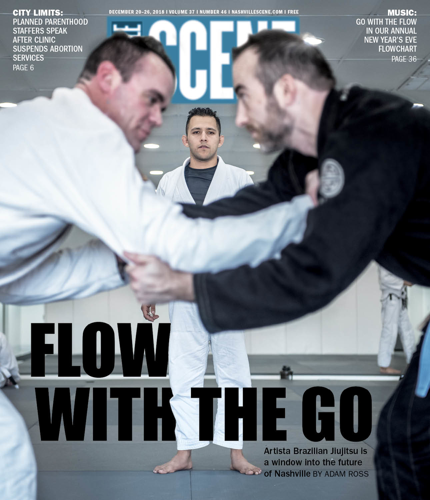
Rafa Mendes (center)
“He played a game,” golf legend Bobby Jones once said of upstart Jack Nicklaus, “with which I am not familiar.” Exactly.
Jiujitsu, for the uninitiated, is both a sport and a martial art, one that relies on grappling and which aims to take all fights “to the ground.” As a method of self-defense, jiujitsu not only recognizes that nearly all fights end up there anyway (sorry Jason Statham) but also aims to rob an assailant of distance, of the space necessary to generate dangerous kinetic energy — energy that would be used to kick or punch. With someone safely “in your guard,” jiujitsu deploys Archimedean leverage through clenches, joint locks and chokes to break an attacker’s bones or render them unconscious — that is, to end the fight quickly and effectively.
As a martial art, then, jiujitsu is brutally practical. “It beats all styles,” says Garcia. YouTube is full of examples of Muay Thai, Taekwondo and Kung Fu practitioners showing up with their teams at jiujitsu academies, full of sound and fury, only to be put into such horrendously awful positions that they submit — “tap out” — or if they’re stubborn, are “put to sleep.” This was exactly how the sport was introduced to America, famously, with the first Ultimate Fighting Championship in 1993. Legendary fighter Royce (pronounced “Hoyce”) Gracie took on challengers small and gigantic alike, each versed in a different fighting discipline, only to smite them all. It was Jean-Claude Van Damme’s Bloodsport become real, sans the flying roundhouse kicks. So it was that mixed martial arts as a sport was born, jiujitsu became popularly known in the United States, and the many-branched Gracie family, through their schools, became the pre-eminent importer of jiujitsu instruction in the United States.
Worldwide, however, jiujitsu has been on the scene for many decades, with millions of participants at the amateur, semi-professional and professional levels currently competing in several major federations. It has its luminaries and heroes, illuminati and mystically gifted coaches, from John Danaher and Eddie Bravo to Marcelo Garcia and Renzo Gracie, each academy taking on the personality of its leader, like the royal houses in Game of Thrones. It is as beloved in Abu Dhabi as it is in Brazil, and the sport’s tactical complexity is perhaps best described as human chess that requires an improvisational acuity to rival jazz. Practiced in either the traditional uniform, known as a gi, or in a no gi — a rash guard and shorts — its goal is to score ever more dominant positions during a match and win by either points or by submission, most often in a single period.
This is what Garcia teaches — jiujitsu as a sport, but also in many ways, as a lifestyle — and his academy is thriving. Since Artista was born in 2017, Garcia has gone from 70 students to more than 240. After Guilherme Mendes visited in 2017, he invited Artista to join the ATOS fighting team, an affiliation, in the jiujitsu nation, with the blue-chip credibility and successful track record of the Yankees. In a way, then, Garcia’s is a uniquely American brand of success story. He is a first-generation immigrant and a Nashville kid, who at 19 was — by his own admission — headed nowhere.
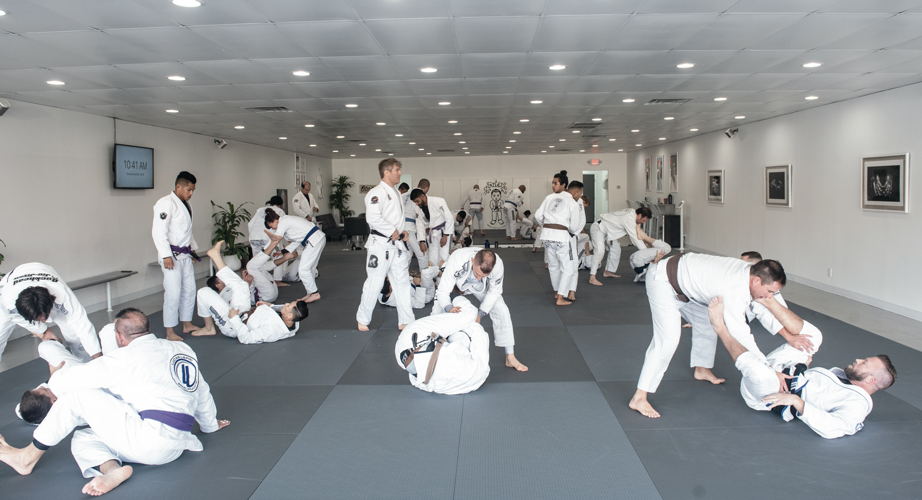
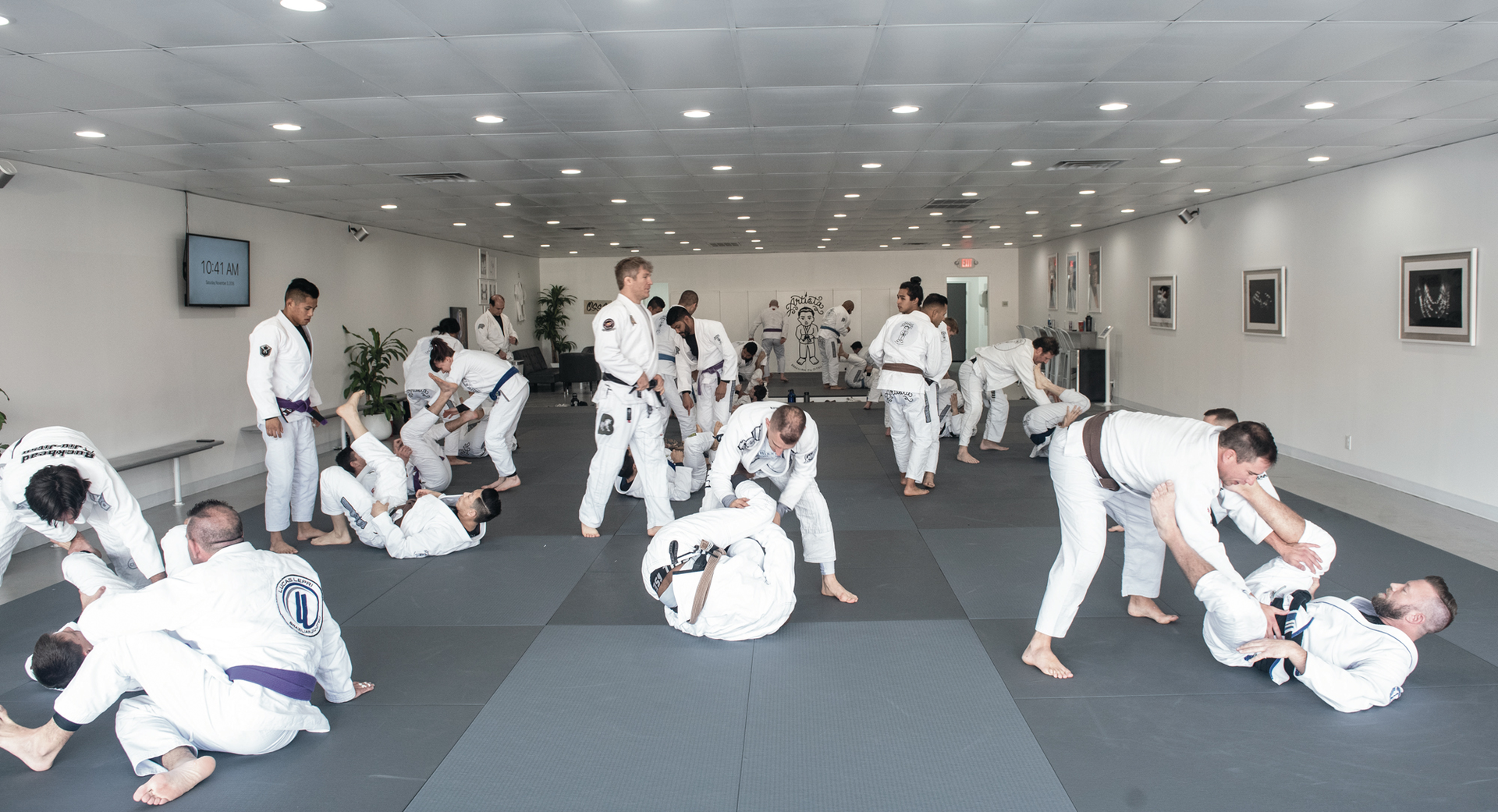
Looking around the gym, there’s something you can’t help but notice: the profoundly eclectic, diverse group of people who make up Artista’s student body. Every color and creed from every walk of life is here, the broadest swath of the socioeconomic spectrum, all of them slapping hands, knocking fists and then fighting. Nashville is growing and changing with the blinding speed of Mendes’ spinning arm bar. For locals and even transplants like me (1995), the city’s former charms often seem overshadowed by our ever-changing, crane-dotted skyline. “Little Dubai” was what late, great Nashville Scene editor Jim Ridley once dubbed the Gulch as we passed its high-rises on the walk from the paper’s offices to Otaku Ramen. (His nostalgia was immediately dispelled after our waiter appeared with his char siu roasted pork buns and shoyu tonkotsu.) For all our residents’ well-founded anxiety about Nashville’s transformation — from its impossible commutes to skyrocketing rents, its metamorphosis from four-square single-family homes into shoulder-to-shoulder tall-and-skinnies — a peek into Artista’s academy might reveal what sort of metropolis Nashville is becoming.
“I didn’t set out to create a place like this,” Garcia admits. “It just sort of happened.”
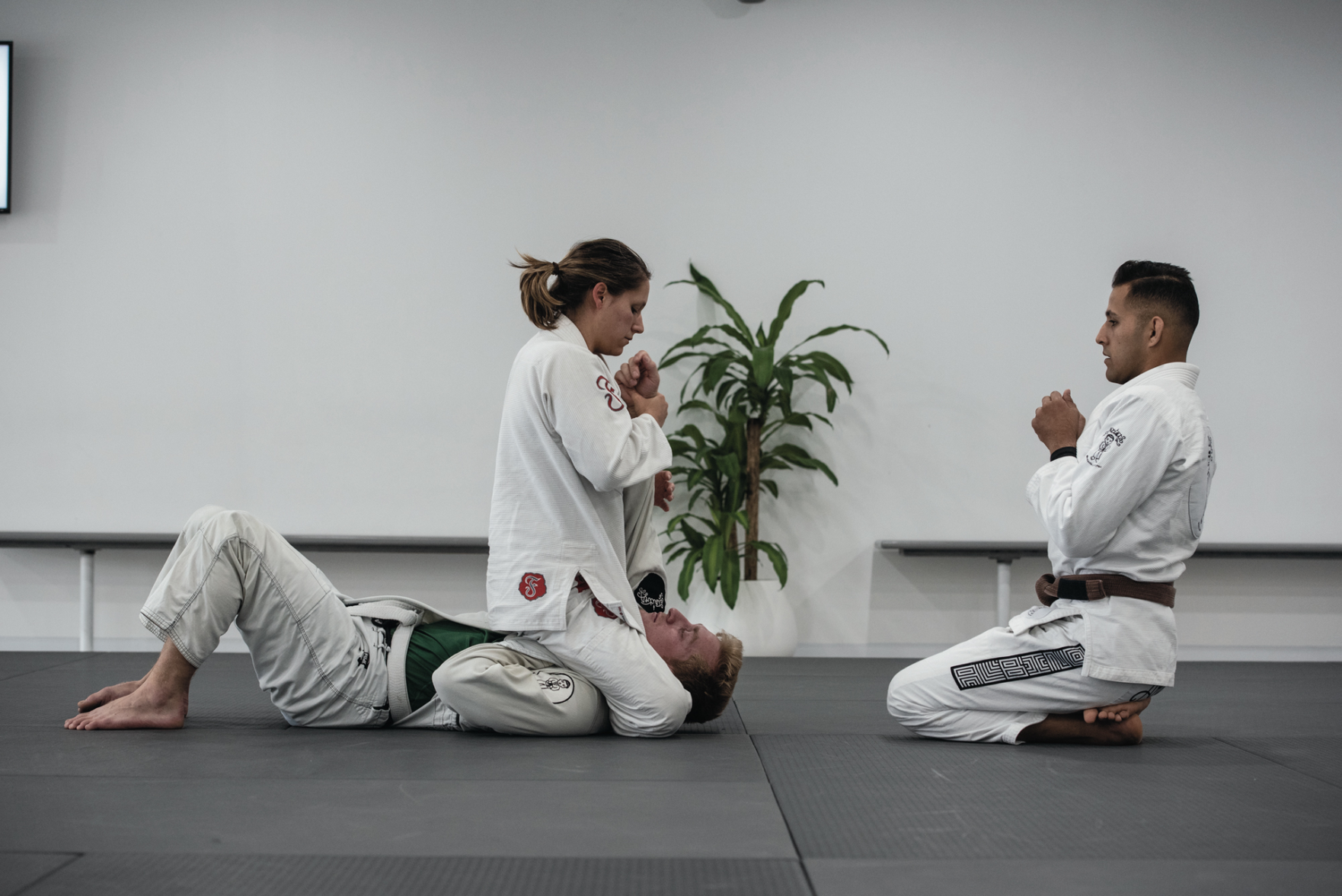
Felix Garcia reviews the technique of Jessie Torelli and Josh Smith
Garcia, whose parents immigrated from Jalisco, Mexico, was born in Oregon, but his family soon moved to Santa Ana, Calif.
“It was a terrible neighborhood,” Garcia remembers. “A lot of poverty and gang violence.” The family of five — Garcia has two sisters — moved to Franklin in 2000, and settled into a middle-class life. Garcia’s father was a car mechanic; his mother a restaurant worker.
“I was a class clown, a disrupter,” he says. He describes himself as a mediocre student at Centennial High who ran with a bad crowd, until he found himself at an alternative learning school, which had a zero-tolerance fighting policy. Fighting was a behavior that had plagued Garcia all through school. Come graduation, college was out of the picture, and at 19, he found himself working at Discount Tire in Franklin, on his way to living the very life his father had wanted him to exceed.
Three things kept Garcia from going off the rails. His family, first and foremost, both the nuclear and extended one. There were aunts and uncles and cousins in town. Second was his high school girlfriend, Val, whom he was determined to marry, “once I was financially stable,” Garcia says. And then there was jiujitsu, which he discovered a couple of years after graduating. The UFC having risen to prominence, Garcia, a martial arts fan, had the interest but not the bug. That is, not until he noticed a jiujitsu dojo on his commute home. He decided to take a class. “It might seem strange,” Garcia says, “but what immediately hooked me were two things: how bad I was and how badly I wanted to get better.”
Garcia trained in Franklin for the next three years and quickly discovered he had talent. As a blue belt — the progression is white, blue, purple, brown and black, and achieving the last of these usually takes about a decade — he won the International Brazilian Jiujitsu Federation’s New York and Atlanta Opens in 2013 and 2014, respectively. He toyed with the idea of going pro, or at least exploring what that meant. In 2015, he decided to commit to jiujitsu full time, and moved to Costa Mesa, Calif., to train with the Mendes brothers at their Art of Jiujitsu academy.
Garcia was regularly competing and enjoying success, but he missed his family and Val, and found the spartan existence somehow wanting. Upon returning to Nashville, he took a job at the front desk of the Green Hills Gracie Barra academy. He’d been promoted to purple belt by this point, but he was broke and a little depressed. What lifted his spirits was helping his younger cousin Kevin Mendez. Like Felix, Kevin had been something of a class clown, and he was going through a rough patch after the death of a beloved cousin. Felix convinced him to start training, and soon Mendez proved wicked talented at the sport. (In 2018, 16-year-old Mendez won double gold as a blue belt at the IBJJF Chicago International Open in both his weight class and the absolute division.)
Timing being everything, the pair of instructors running the Green Hills franchise where Garcia worked suddenly decided to quit. Garcia took over the business, renamed it, and appointed Val, whom he’d married in 2016, its CFO. He also realized that one of the most important things he’d learned from the Mendes brothers wasn’t their jiujitsu.
“I decided,” Garcia says, “that I wanted to run my own school, and that it would be a place that was an expression of my own jiujitsu, of what I believe.”
Nashville has become, among many things, a foodie destination, and two of the city’s top chefs, Josh Habiger and Ryan Poli — the former at Bastion, the latter leaving The Catbird Seat at the end of the year — both train at Artista. Both also appeared on the late Anthony Bourdain’s 2016 Parts Unknown episode featuring Music City. Bourdain, who was a blue belt, was famously obsessed with jiujitsu. (His ex-wife, Ottavia Busia, is a brown belt and professional MMA fighter.)
“We were waiting for the crew to set up,” recalls Habiger, “and Bourdain kept bringing up the sport. When I mentioned I’d always been intrigued by it, he looked at me like I was crazy, and said, ‘Why wouldn’t you just try it?’ Which was a good point.”
After a week of training, Habiger, who’s now a blue belt, became obsessed. “I embrace the chaos of the restaurant business, but jiujitsu helps me to think before I react to things — it teaches you how to figure a way out of a shitty situation. To always slow down and trust what you know.”
Poli, who was a high school wrestler and had begun training before he met Bourdain, was asked by the crew not to bring up the sport with the show’s host — otherwise, they said, it would be all he’d talk about. “The guys at Catbird know when I train and when I don’t,” says Poli. “When I come here [to the jiujitsu studio] and get smashed for an hour, I arrive to work more humble. It makes me a better manager, more open to people’s mistakes. It turns me into a teacher.”
There’s Sean Davé, a filmmaker from Kapolei, Hawaii, whose video for Bronze Radio Return’s single “Only Temporary” you may have seen on Vevo. (His “Eclipse Party” commercial for Corona was also everywhere for a time.) Heather Tharp, a Maryland transplant and the cafe manager at Nectar Urban Cantina, has lived in Nashville for five years and has been training for nearly three. Chris Salazar, part-owner and barber at Ten Barber Studio, is originally from Galveston, Texas, but grew up in Hickman County. Charles Link is a fleet mechanic for Kerr Brothers & Associates; he doesn’t compete, but his 10-year-old daughter Maggie regularly medals at local tournaments while he helps teach the kids’ classes.

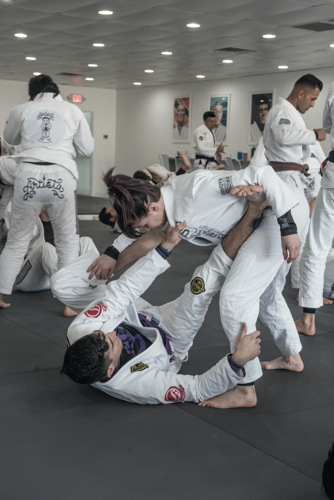
Heather Tharp (center) and Jordan Evans
Jessie Torelli is getting her Ph.D. in special education at Vanderbilt’s Peabody College. “Artista has become a really important community to me,” says Torelli. “Shortly after I started, I went through a divorce. So much outside of jiujitsu was getting blown up, and this was the place that I came back to that was purely a stress release.”
Jessica Jones is neither a superhero nor a reporter, but rather a marketing communicator at Caterpillar who decided to try jiujitsu after she was mugged in Green Hills. She grew up in Franklin and went to MTSU, and she says she’s astonished by the city’s growth and change. “It’s like watching a kid grow up,” says Jones. “None of the buildings look the same, there’s a more diverse collection of people and mindsets, and it’s refreshing. I grew up in Williamson County, which isn’t always like that. It’s also what I loved about training here: Fighting brings you closer to people because it breaks down barriers. It pops bubbles.”
Instructor Bernard Au works in IT at Willis Towers Watson, an insurance broker. He grew up in Forest Hills, Queens, and is a New Yorker through and through. Like Garcia, he’s also a first-generation immigrant: His parents are Chinese, from Hong Kong, although his father grew up in Cuba. “In Jiujitsu,” Au says, “there’s always another door that I feel like I can walk through. There’s always a new problem to solve, and that helps me in so many ways.”
Fernando Freire, a purple belt and a semi-professional in the sport, is from Ecuador. He’s been working in Nashville at his father’s company, Pride Staffing Services, for the past year-and-a-half. “Everyone in this gym has made me a better person, because everyone here cares about each other’s jiujitsu and wants you to get better. I’ve learned more about the sport at Artista than in my entire seven years of training.”
Dr. Frank Mayorquin, a blue belt, has an internal-medicine practice at Centennial. He grew up in Tampa, Fla. Another first-generation immigrant — his parents are from Cuba — he adopted jiujitsu as his sport after he nearly drowned during his fifth Ironman triathlon due to a neck herniation.
“Look at this place,” Mayorquin says. “It’s a melting pot. There are people from all over the world here. Once people start sparring together, there are no religions here. I don’t know another sport where two people come out of mortal combat with a smile.”
Mayorquin is close friends with Maruf Sarwar’s father, a Nashville maintenance man who immigrated here from Dhaka, Bangladesh, in 1979. Sarwar, a purple belt, is a fourth-year medical student at UT Memphis. “The truth,” Sarwar says, “is that you don’t always see the results you’re working towards in med school. If I didn’t go through that with jiujitsu, I think I would’ve just quit trying to become a doctor.”
Tina Tappouni, a purple belt, is a first-generation immigrant from Baghdad. Her parents tried to flee the country during the Iraq’s war with Iran — her father made it out and settled in Oregon, but her mother, a doctor, was conscripted and not allowed to leave Iraq for 11 years. Tappouni is a nurse practitioner and graduate of Marian University, and she says jiujitsu has helped her manage depression, and the sport has become an organizing activity in her life.
“Jiujitsu is the thing that I wish everyone would find for themselves,” she says. “Everyone wants to experience of sense of belonging to a community, and that’s exactly what the sport is for me. I do it for the competition, for the discipline of the technique. I want to share it because I know it will have a different meaning for everyone.”
For Pemberton Heath, a first-year medical student at Vanderbilt, the value of jiujitsu is more temperamental, even spiritual. As both a student and athlete, she’d struggled with intensity: She was incapable of easing off of anything. “Felix talks to me about the bigger journey in jiujitsu, and that it’s not made or broken in one competition, and it’s the same in medicine. Competition,” Heath reflects, “is about getting better, for sure, but it’s really easy to give 95 percent. What’s hard is to give 100 percent without always putting pedal to the metal. That’s the struggle, that’s the balance.”
“Jiujitsu has taught me the difference between problems and dilemmas, and that there’s always an answer to a dilemma,” says Cedric Mills, a metal-finishing specialist originally from Charleston, S.C.
And there’s Bob Freeman, a state legislator recently elected to represent House District 56 (and whose father, Bill Freeman, co-owns the Nashville Scene). He’s also a purple belt who place third in the 2017 Masters Worlds. “Maybe the most important thing I’ve learned is that you truly can’t judge a book by its cover,” says Freeman. “Someone can show up in class that’s, no kidding, 105 pounds, and they will completely dominate you. And the opposite obtains. It teaches you that you never want to take anything for granted, you never want to assume outcomes. Jiujitsu leads to a certain humility with respect to everyone you interact with and everything you do.”
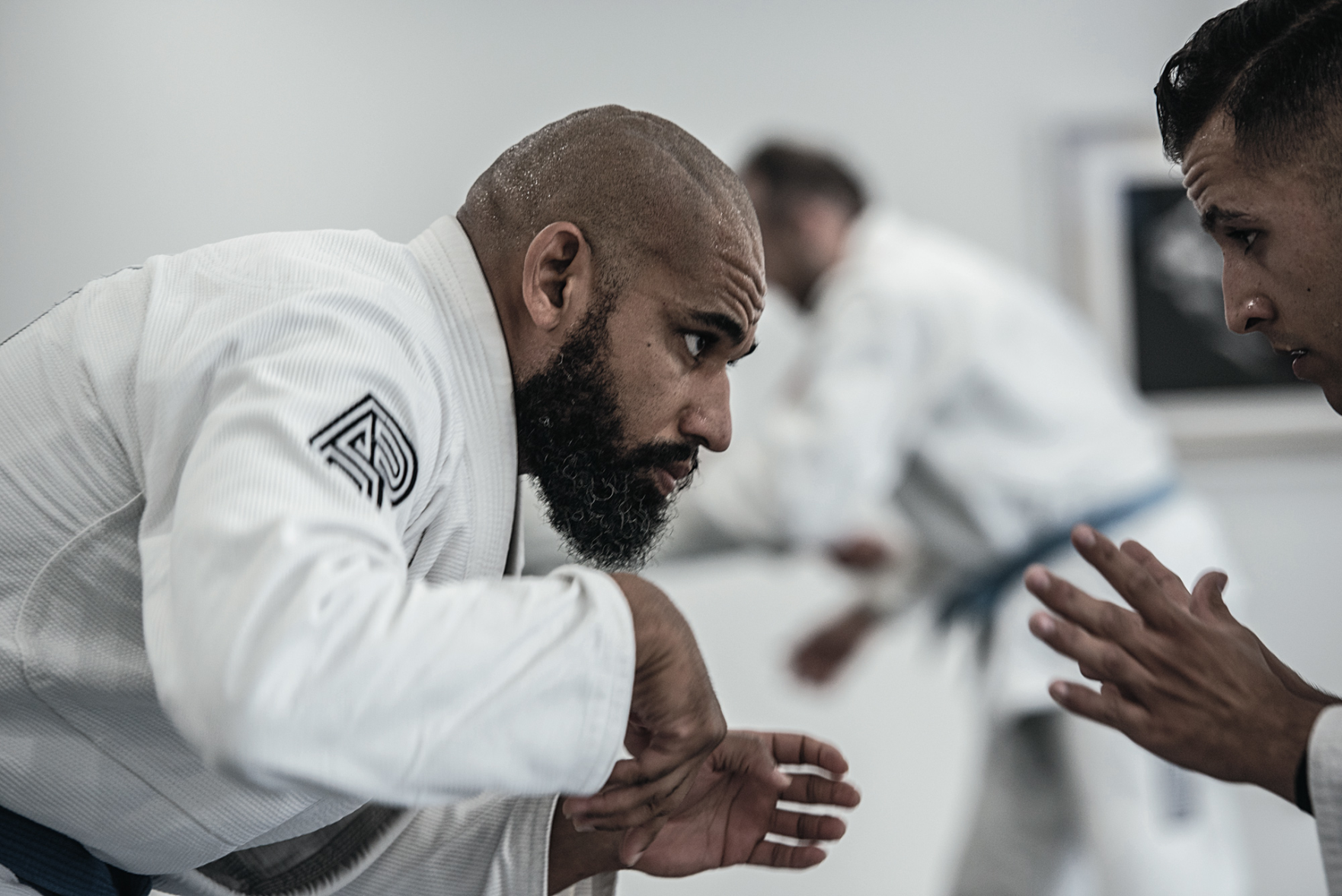
Cedric Mills (left) and Felix Garcia
For me, the sport has become many things. I began training at Artista two years ago — I’m a blue belt now — because my daughters, who’d been doing it for about a year, asked me to join them. (I quit after a brief stint at Nashville MMA several years ago, due to an injury.) I was a high school wrestler, a state champion, but it was only after I began training that I realized every sport I’d done since I was 18, with varying degrees of obsession, had been an attempt to get back to that very pure, very unforgiving place you inhabit in grappling.
In jiujitsu, you win or lose at the very edge of your limits; you are forced to problem-solve under the most extreme duress and in real time. You completely own your victories and your losses. Like writing a novel, your failures and shortcomings aren’t simply evident, there, on the page — they demand redress. To ignore them would be to fail yourself. There’s a strange comfort in such inescapability. Deal. Adapt. Grow. Just as you begin your novel with outsized dreams for its success — which are soon dashed in the fog of composition — on the mat, any momentary lapse in focus is exposed by your training partner, and any swelling of ego is soon burst in the next round. Every roll reveals just how much you have to learn, making it impossible to be satisfied with yourself for more than a minute.
“In jiujitsu,” said the great Rickson Gracie, “you don’t go with the flow, you flow with the go.” A good attitude, then, over time, is the great savior. It’s probably the most important lesson Garcia teaches his students. Influenced by their leaders, they become leaders themselves.
“In about one minute,” says Garcia, “I can spot the person who is more interested in dominating other people, in winning, than in learning technique and improving. And you know what? They never stick around.”
There’s another takeaway that being at Artista has brought home, one that speaks to the state of our exploding city. We are bigger than ever, more metropolitan, richer in culture, and while we face many challenges managing this growth, we should revel in these changes. Nashville has the chance to become a great city because it has become more liberal, in the broadest sense of the word. It’s impossible not to become more open when you encounter more new people from different walks of life, especially if their lives touch your own.
It’s a lovely irony how many walls between people I’ve seen get broken down by fighting, and it also points to the true gift of diversity. It’s not just the chance to sample different cuisines and live among people from different backgrounds and ethnicities — it’s recognizing that when push comes to shove or guard pass leads to arm bar, we are all, in fact, fighting for the same good things.
Adam Ross is a former Nashville Scene staffer and current editor of The Sewanee Review. His books include the acclaimed novel Mr. Peanut and his story collection Ladies and Gentlemen.

Felix Garcia (center)



Post a comment as anonymous
Report
Watch this discussion.
(0) comments
Welcome to the discussion.
Log In
Welcome to the discussion.
Keep it clean. Please avoid obscene, vulgar, lewd, racist or otherwise abusive language. Comments featuring hate speech or threatening or violent content will not be tolerated.
PLEASE TURN OFF YOUR CAPS LOCK.
Be truthful. Don't knowingly lie or mislead.
Be proactive. Use the “report” link on any comment that violates our comment policy.
Share with us. We'd love to hear your feedback.