




Just before 6 a.m. on July 14, a 26-year-old man maneuvered to the top of a 31-story office building in downtown Nashville. After getting onto the roof of the Snodgrass Tower, he removed his brown sandals and took his wallet, the keys to his new car, his Samsung cellphone and two colored meditation rocks wrapped in tissue and placed them neatly near a door on the roof. Then Anton Kanevsky, a would-be travel blogger who was coming through Nashville on his first real road trip, jumped.
On a sparsely clouded morning like that one, it might not feel windy on the ground, but there’s a strong breeze at the top of the tower. From that height in the middle of summer, you can see a bend of the Cumberland River, the verdant rolling hills that surround the city and a full view of the flock of cranes stationed at various construction sites downtown.
The height of the building is awe-inspiring. The tower was originally built in 1970 for the National Life and Accident Insurance Co., and the state took ownership of the building in 1994. It now houses government offices. But in the context of falling from the top, the height is terrifying. The building, while not the tallest downtown, is actually the highest point in the city because of its perch on a hill.
Kanevsky started his travel blog earlier this year. In May, he’d journeyed to Sedona, Ariz., and the Grand Canyon, and wrote that he’d caught “travel fever.”
“In fact, I’m planning an open ended road trip across the states starting July 2016,” Kanevsky wrote in an introductory post on his blog’s homepage. “It’s going to be my first road trip, and my primary objectives are to see other places, learn about people, and eventually find a new and better place to live.”
But by the time he found himself atop the tower, something had changed. After climbing up, he sent a cryptic message to a young woman named Alexandra Amaral whom he’d met online and visited during the trip to Sedona. The final-hour text message indicated that he would jump, but it was also rambling and unclear:
“After I climbed the tower and jumped over the source back there, you want me to decode an impossible lock? I think the password is live and the door is not meant to be opened exept [sic] from inside. I don’t know what else I can do. Exept [sic] jump off this building. I don’t believe your [sic] would have me do this. This would be evil. : (”
The message appears to be part of a back-and-forth conversation of some kind, but both police and Amaral say the message stood alone. On the roof, there’s only one set of glass doors that lead to the inside of the building. The impossible lock mentioned in the text is a code lock, and there is one on the inside of the doors as well as the outside. Even if Kanevsky had figured out the code on the outside, somebody on the other side would have to undo the other lock to let him in.
Nobody can answer exactly how Kanevsky got on top of the building in the first place. That day, construction crews were working on the building, but they arrived right about the time he jumped. There’s no camera footage that shows him actually entering the building.
All of the lobbies in the building are manned by guards, and Kanevsky hadn’t logged in through any of them. In fact, he wouldn’t have been allowed to come in if he had. As at other state buildings, if a person wishes to enter they must have either an employee badge or a state ID and a reason for the visit. Security personnel at the lobby doors snap a photo, scan visitor IDs and print visitor destinations on a sticker that must be worn in the building.
Once inside the building, there are only three elevators that go to the 28th floor, and from there, there’s another elevator, which requires a key to get to the top. People who work in the building say most employees have never been allowed to go to the roof of the building — only maintenance people ever have access to the top.
The best explanation is that Kanevsky didn’t get to the top by going through the building at all.
A report from the Tennessee Department of Safety concludes that he must have scaled the building from the outside. The report notes that Kanevsky “had a travel blog where he wrote about rock climbing and conquering his fear. It’s not unreasonable to believe that he climbed the metal scaffolding the construction elevator is attached to. It is essentially a 30-story ladder that can be accessed from the ground.”
With no active cameras near that part of the building, even that assessment is a best guess based on the circumstances. If you look up at the building from Charlotte Avenue, the thought of crawling up the metal scaffolding, grabbing each rung hand by hand and nimbly grappling foot by foot, is daunting. Even without setting a foot on the scaffolding, the mere idea is enough to make your stomach turn and your brow sweat.
From the top of the building, the decision to jump could not have been easy.

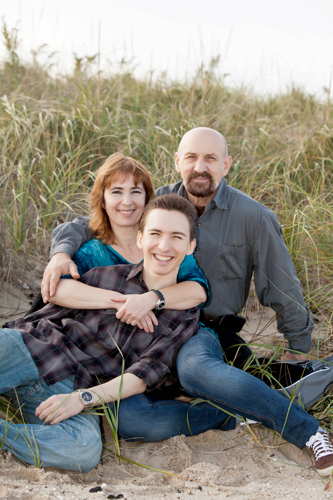
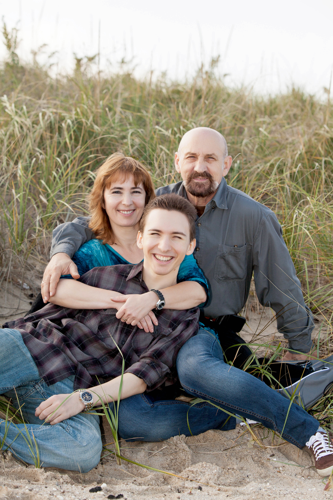
Anton Kanevsky with his parents.
Anton Kanevsky and his family came to the U.S. from Lithuania when he was a child. Originally from Odessa, Ukraine, his family moved to the Baltic republic when he was 1 month old. Kanevsky was an only child, and his parents, Victor and Natasha, agreed to answer emailed questions about their son through their lawyer.
“It was a hard time before the collapse of the Soviet Union,” says Kanevsky’s mother, Natasha Kanevsky. “In Lithuania, at that moment, life was better.”
When they immigrated to the U.S. in 2002, they moved to East Meadow, N.Y., a town of just more than 30,000 residents on Long Island. Kanevsky hadn’t traveled a lot since — once to Boston and twice to Toronto. His mother says he always made sure to take care of his family: Because of a language barrier, he spent a lot of time translating for his parents with banks, insurance companies, doctors and others, just to make sure nothing was missing, forgotten or misunderstood.
Even after Kanevsky’s short trip to Sedona in May, his mother was scared about her only son taking the extended cross-country trip he planned for July. It took some courage on her part, she says, to let him go. Kanevsky bought a new Mitsubishi Mirage to avoid troubles on the road.
His family, who called him Tony, says he was smart, tech-savvy and had a great sense of humor at home. But he was also delicate, and his mother says he was shy and more of a listener than a talker when he was out in the world.
“He didn’t know how to make ‘simple talk,’ to chat about nothing,” she says in an email. “He longed to open up to the world. He spent lots of time on self-improvement.”
Two days after he left New York on his first extensive road trip, Kanevsky sat at a coffee shop in Weaverville, N.C., debating his next course of action. Hearing rave reviews from a friend, he decided to head toward Nashville. He made his way northeast through Great Smoky Mountains National Park and then on past Knoxville on U.S. Route 25W — observing in his blog that he felt unimpressed by the mountains and people he met along the way.
When he arrived in Music City, he detailed his days in obsessive — and at times banal — detail. He’d done the same on his blog while in Sedona. From the Nashville trip: “I arrived there around 8 or 9 p.m. I found a hostel and went to it, but there were no people there. I decided to go eat first and ask around for a place to stay. I found a pizzeria, and chatted up to the guy working at the order desk.”
During his time in Nashville, Kanevsky stayed at the Nashville Downtown Hostel. He spent a night checking out Lower Broadway, and went to a couchsurfing meetup at Cafe Coco. His second day in town, he met a man at the hostel named Bill, who was in town for an international barbershop quartet conference. They ate a few meals together in Kanevsky’s first couple days in Nashville, and visited the museum at Cheekwood mansion. Kanevsky stopped blogging after his third day in town.
On his trip to Sedona, Kanevsky had spent one or two nights with a former criminal defense attorney and public defender turned mountain guide, Peter Gersten. Gersten is a host on the hospitality website CouchSurfing; he allows strangers to bunk up in his house as long as they take a trip with him to the top of Bell Rock, a 4,000-foot outcrop near Sedona that is said to imbue some visitors with epiphany-like inspiration. He shepherds people up to Bell Rock as a way of helping them conquer their fears, and believes it’s his duty to guide 2,222 people to the top of Bell Rock before the winter solstice of 2018.
“I believe this reality is a futuristic holographic form of entertainment,” Gersten writes on his CouchSurfing profile. “I believe I programmed my entire life before I was born and then ‘downloaded’ into my carbon based physical body to experience this life. Implicit in this belief is the realization that I have, either directly or indirectly, already consented to everything that happens to me.”
Reached by phone, Gersten recalls that Kanevsky was “incredibly quiet” and fairly socially awkward.
“He wasn’t like the average person that comes here,” Gersten says in a thick New York accent. “I’ve hosted over 700 couchsurfers, and he was probably one of the most different ones. I guess this was his first time out West, and maybe the first time he did something like this, go to the top of Bell Rock, do things like that.”
Kanevsky had gone to Arizona at the urging of Amaral, who’d been staying with Gersten. She was there on an extended trip in May when Kanevsky decided to fly out and meet her. By the time Kanevsky arrived in Arizona, Amaral had already stopped staying with Gersten.
Gersten says Kanevsky was “borderline obsessed” with Amaral, who was asked to leave his home after downloading movies illegally. (Gersten got upset when his internet provider cut his service because of the downloads.)
“When I first heard he died, I kind of guessed it was a suicide,” Gersten says. “He didn’t seem suicidal when I met him, but he did seem like maybe he just wasn’t in a good place. If he was that attached to Alexandra — she’s a beautiful girl and all — I could see that being really hard on him.”
While exhaustive in many other ways, the blog leaves little to explain what happened to Kanevsky in his final day on earth. Outside of his messages to Amaral, the last of his online presence shows he checked in on Facebook at Lasaters Coffee & Tea in Clarksville to write a Yelp review the day before.
P
olice say most people who jump from a high place leap from a bridge and into water.
Tim Codling says the day of Kanevsky’s death was one of the toughest days he’s had on the job. A detective with the Metro Nashville Police Department, Codling and the officers who arrived at Snodgrass found a scene that will be with them for a long time. A Davidson County medical examiner’s report is no less gruesome: Dental records were required to make an identification. It also notes that a toxicology report found that Kanevsky was free of any drugs or alcohol.
“I’ve never seen anything like it, and I’ve been here 20 years,” Codling says. “It was very graphic.”
Determining that it was a suspected suicide involved a number of factors.
“When I talked to Central Precinct that day, they saw that his wallet and his shoes and his other belongings were neatly placed on the roof,” MNPD spokesperson Kris Mumford says. “It’s tough, because we may never know why he jumped — nobody witnessed anybody up there with him — but those are some indications that it was a suicide.”
Codling says the text message and interviews with family members about Kanevsky’s mental state also indicated it was a suicide. Police said his cousin told them Kanevsky had recently been hearing voices.
Two contractors coming on the job for the day found the items on the roof, but Kanevsky had already jumped by then. A woman who works for the Tennessee Department of Environment on the 10th floor is listed as the last person who saw him alive — she saw his body fall past her window as she sat down to work that morning. So did a co-worker.
“I just saw some color and the shape of clothes falling past the window, and I looked across to my co-worker and said, ‘I know you saw that,’ ” says Nikki Beasley, who’s worked for the state for 16 years. “I think I didn’t want to believe it was a person, but there’s something about that shape that makes you just know.”
Shortly after, she heard a loud thud, almost like something exploded.
“At first I thought the construction crews might have dropped something,” Beasley says. “I went over and looked out of the window first and saw him laying there and just started screaming, ‘It’s a body! It’s a body!’ ”
Her co-worker, Mia Morley, who’s worked for the state for a little less than two years, says she first thought the victim was a state worker.
“I’ve been in that kind of mentality before,” Morley, 28, says. “You feel like there’s no way out and there’s no help, even though there is. There are a lot of groups and programs out there to help people who feel suicidal, but there’s not a good way to communicate it to the people that need it. I think it’s really hard to get across to the people who are feeling that way — that nothing bad is going to happen if you talk to someone.”
Management has rearranged the room where the women worked that morning. They no longer have to look out the window where the blurred shape of a man hurtled by while they used the copy machine. Morley says the weeks following the event brought out the best and worst in people in the building.
“I think a lot more people took it hard here, especially people who haven’t been exposed to that before — [they] were more freaked out than anything,” Morley says. “Some people don’t understand the stigma and said horrible things afterward, and maybe just didn’t know how to react, but it was very eye-opening for a lot of us. I really hope nobody else is going to be in that position where they feel like that can be their only choice.”

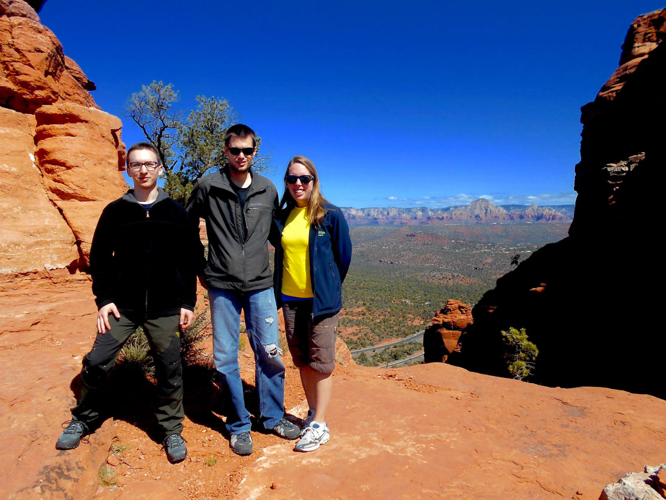
Kanevsky visited Sedona, Ariz., in May. He climbed to the top of Bell Rock with people he met in Arizona.
He’d been in the city only a few days, but Kanevsky changed his location on Facebook to Nashville. He’d hinted on his blog at wanting to make connections with other humans, and it seemed he’d done that here in some capacity. His mom says his goal on the road was to “make friends, to see different places, to learn new things to do and, eventually, to find a new place to live. He wanted to get all of us away from New York.” She says he found the people in New York snobby and too fixated on financial gain. He asked before he left on the trip what his parents’ requirements were in a place to live.
“He wanted to live among more spiritual and sincere people,” she writes. “He was a timid person who was not used to any extreme. He took his first steps into the world. He wanted to live and be happy. He wanted to find himself.”
The small, sincere interactions with people on his trip seemed to mean a lot to him: When Gersten offered him a banana, he wrote about it on his blog. Gersten says Kanevsky couldn’t seem to understand why someone he didn’t know would be nice to him. During that trip, Kanevsky described his feelings of being able to let go as “almost like jumping into an abyss and hoping that there would be a net on the bottom.”
When Kanevsky and Amaral went to a restaurant in Sedona, a server quipped that maybe “his wife” wanted to take the leftovers. He seemingly read a lot into it, and wrote on the blog that he wouldn’t mind if Amaral was his wife.
Amaral didn’t receive Kanevsky’s final message until almost 12 hours after he sent it. The night before, she had received several messages from him telling her that things were going great in Nashville and that he had finally found a place he thought he could live. When she saw the message he sent before jumping, she was confused. She didn’t fully understand what the message meant, and didn’t know at that point that he had actually jumped.
This was her reply: “Anton, you’ve always had problems with relationships with people your whole life. You cannot expect this to go away overnight. From the bottom of my heart, a psychologist is like a spiritual master to help. It’s like a nurse who treats your wounds. Psychologists are analysts. Believe me when I say that I changed my life completely by going to a psychologist. You just have to decide to own your life and mind. Do not project anything to me. Unfortunately, it’s the way you’ve grown up.”
Amaral, 26, who is from São Paulo, Brazil, first met Kanevsky in a Facebook forum on manifestation, which is a belief in the law of attraction. The idea is that if one thinks positively about one’s life and its prospects, the chances of good things happening will be greater. Amaral also says she is a medium who can connect to ghosts, and only agreed to be interviewed for this story because she says Kanevsky told her she should.
“I don’t know if you believe it, but that’s what it is,” Amaral said in a Facebook message before agreeing to a Skype call.
She says she first told Kanevsky to get help when they met in Sedona in May. He told her he never really felt connected to anybody but his family. He’d struggled to make friends in high school.
“He felt that there were things inside him that no one ever really saw,” Amaral says.
She didn’t agree that Kanevsky was obsessed with her, but said she knew he liked her. Like Gersten said, Amaral is beautiful: She has dark hair, a perfect olive complexion and a wide, inviting smile. She says she made it clear from the beginning that it was a friendship — she says she has to do that often with male friends — and that she wouldn’t always be available to communicate with him. She says she wishes she had seen the message and replied earlier, but knows she could not control his actions. She knew he had a fear of rejection, that he felt lost, but she didn’t realize he was potentially suicidal.
“My message was never delivered to him,” Amaral says, sighing. “He never saw the reply. At first I thought he was just taking a while, because I had another friend who would do the same thing, but then I went to his Facebook, and the Facebook of his mom, and my heart stopped beating. I was like: I can’t believe he did this.
“I could not even sleep. I couldn’t even breathe. I felt like a failure.”
Kanevsky was in between contract work doing software development — his LinkedIn page shows long positive reviews from two former clients. His mother says his last project was working on a software program to help teach reading to students with special difficulties. Because of his efficiency, he had actually replaced a group of several people and done the project on his own. He hadn’t picked up another gig and decided this was the time to make the trek to find something new.
Kanevsky’s family has hired a lawyer with Nashville-based Sutherland & Belk to look into what happened in Nashville the day he died. The law firm says they are not yet pursuing any litigation, but they’re still gathering facts. At this point, the family just wants to understand as much as possible about what led their son to the top of Snodgrass Tower. The family did not respond to questions about whether they thought their son was struggling or had mental illness.
The fact that his death was ruled a suspected suicide seems void of certain finality. A suspicion is very different from knowing for sure, though all signs point to suicide. We don’t know exactly why Kanevsky climbed the building that day, why he messaged Amaral — but didn’t express his suicidal feelings earlier — why he went to the edge of that building, why he jumped. But there’s not a person on earth who hasn’t felt either the pull of despair, the ache of a broken heart or the longing for answers to life’s questions.
His family takes some solace in knowing he achieved some of his goals: He saw other places, learned about people and told Amaral he might have found a new place to live in Nashville. It’s what they can muster in the face of losing their only child; Kanevsky would have celebrated his 27th birthday two weeks ago.
“I am proud of Anton,” his mother wrote in a Facebook post reflecting on his birthday. “It was not easy for him to step into [sic] the road. He did it. He left this world as a winner. However, instead of being proud of him, I would prefer just to see his smile.”




Post a comment as anonymous
Report
Watch this discussion.
(0) comments
Welcome to the discussion.
Log In
Welcome to the discussion.
Keep it clean. Please avoid obscene, vulgar, lewd, racist or otherwise abusive language. Comments featuring hate speech or threatening or violent content will not be tolerated.
PLEASE TURN OFF YOUR CAPS LOCK.
Be truthful. Don't knowingly lie or mislead.
Be proactive. Use the “report” link on any comment that violates our comment policy.
Share with us. We'd love to hear your feedback.