
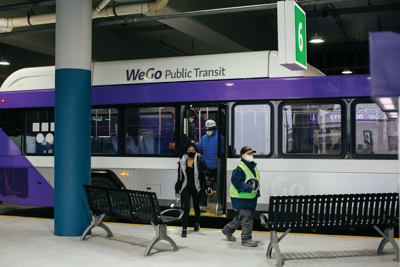


The pandemic has stressed all sorts of institutions and services around the city, and Nashville’s public transit system is no exception. Over the past year, WeGo Public Transit saw ridership numbers fall while at the same time having to implement new COVID-19 safety protocols — like running more buses to prevent crowding. What’s more, the pandemic forced these changes less than a year after service cuts to bus services.
Pandemic ridership habits have informed new service changes from WeGo, which are scheduled for April. Those are designed to improve frequency on some bus routes, expand or alter certain lines, and discontinue service on others.
“Obviously like most activities, [bus usage has] gone down significantly, although transit ridership certainly hasn’t dropped as much as things like air travel or Uber usage,” WeGo CEO Steve Bland tells the Scene.
Bland notes that the majority of public transit users have been essential workers.
“When all the rest of us were hunkered down at home, Zooming and Webex-ing, we had 12,000 to 14,000 people a day boarding transit vehicles in Nashville, going to those essential jobs,” Bland says. “And they were the folks keeping the hospitals clean, and stocking the grocery shelves, and a lot of construction workers.”
The 2020 annual report from Moving Forward, a transit initiative formed by the Tennessee Chamber of Commerce, found that ridership has been down about 55 percent for most of the pandemic. Even so, the routes that saw the heaviest usage pre-pandemic also saw the most riders since COVID-19’s arrival. About 65 percent of the bus stops on these routes were in low-income neighborhoods.
WeGo’s board adopted the ridership-informed adjustments on Feb. 25. A series of public hearings about the changes reached more than 200 public transit users and received 41 comments. Unsurprisingly, riders supported the service improvements along certain routes, like Route 52 — the Nolensville Pike line — but were unpleased with reductions and eliminations.
The bus routes that currently see heavier usage will receive more support, with either expanded hours or more frequent service. Routes that aren’t seeing as much ridership will be suspended until demand or funding returns.
“As time and resources allow [and] as the market starts to come back to some semblance of normal,” says Bland, “then our hope is we’ll be in a financial position to put most, if not all, of what we’re … eliminating back.”
Even before the pandemic, WeGo had been dealing with inadequate funding — a shortfall of $8.7 million in 2019 resulted in service cuts. When COVID struck, Metro withdrew $22.8 million in local funding for the public transit agency, which was replaced with federal CARES Act funding.
WeGo received a total of $55.1 million in CARES Act funding, some of which went to pandemic safety measures like plastic shielding for bus drivers as well as deep cleanings. Some was used to help absorb lost revenue. But according to Lindsey Ganson of transit advocacy organization Walk Bike Nashville, the reliance on CARES Act money is concerning.
“The idea of federal funding coming in is that you don’t have to reduce service and that you can match local funds to federal funds so that the system gets a boost,” Ganson says. She adds that waiting for an influx of federal dollars is “not sustainable.”
With budget hearings coming up, WeGo reps hope the city looks to not just restore funds eliminated by the one-time cuts at the start of the pandemic, but also increase the budget by a modest amount. The agency’s $51.6 million budget proposal is about 3 percent higher than the $50.1 million Metro slated for the organization at the start of FY2020. At the moment, WeGo anticipates a remaining $9.8 million in unprogrammed CARES Act dollars, which could help plug holes if Metro doesn’t fully restore the budget — or could be used to fund new projects if Metro does come through with funding.
In December, the Metro Council approved Mayor John Cooper’s ambitious transit plan, which aims to invest $1.6 billion into transportation projects. A common criticism of the proposal has been a lack of dedicated funding, as Cooper maintained that Nashville could and would pursue federal grants. Shortly after that plan passed, WeGo’s board noted in a statement that, while excited for the plan, “We’ll find ourselves further from our goals if we are asked to bear another year of funding cuts.”
“If we want to make a real commitment to transit and a commitment to supporting our essential workers,” says Ganson, “Metro’s commitment to transit should be seen in Metro’s level of funding.”



