

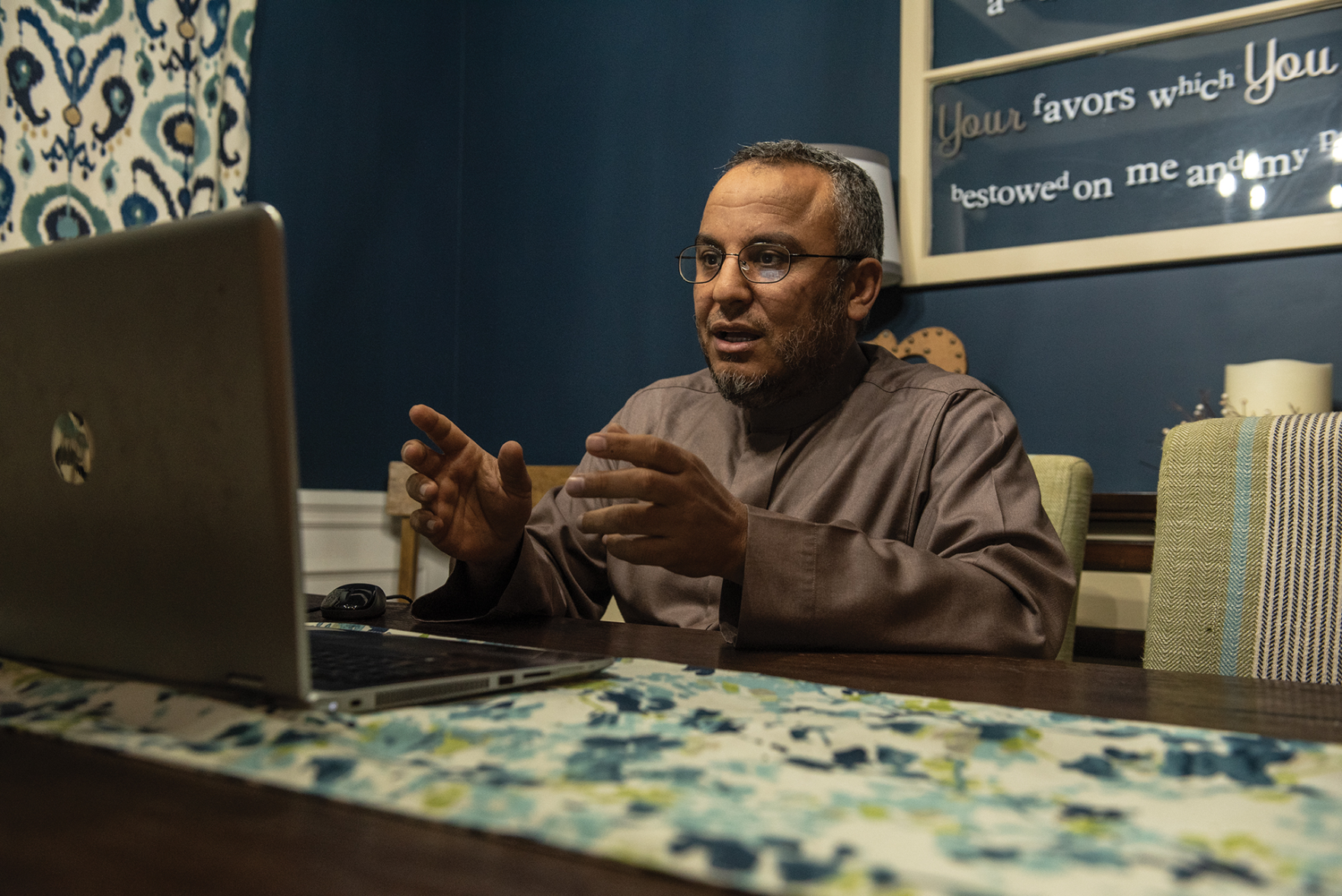
Ossama Bahloul at his home
The Prophet Muhammad was wise to the concepts of pandemic and quarantine.
“If you hear of an outbreak of plague in a land, do not enter it; but if the plague breaks out in a place while you are in it, do not leave that place,” Muhammad said more than a millennium ago, as recorded in the Hadith.
In Nashville, members of the Muslim community are heeding that advice — as well as that of contemporary public health officials and government leaders. Friday prayers and sermons have moved to Zoom. Weddings are delayed or conducted virtually. Funerals, a deeply significant ritual in the faith, are being stripped of their large crowds.
But with the holy month of Ramadan beginning Thursday, the Muslim community in Nashville is being deprived of the traditional activities of its “most special month of the year,” says Ossama Bahloul, imam at the Islamic Center of Nashville.
Each night during Ramadan, Muslims fast from dawn until dusk, and many gather at their mosque at sundown for a communal dinner and prayers. At ICN, 250 to 300 people gather to break their fast each night. But this year, the celebrations will take place in homes across the city, among small family units.
Aliya Aqeel, a kindergarten teacher at a local Islamic school and the wife of an imam, is among the parents trying to make Ramadan special despite the lack of large public gatherings. She has three kids — ages 5, 10 and 13 — and they have decorated their home and purchased food for the holiday. It’s her 5-year-old’s first Ramadan fasting (young children are not expected to fast), and she says, “We’re looking to see how that works with him.”
Fatima Nawaz, a board member at ICN, says she’s teaching her 4-year-old daughter the call to prayer. Her young daughter will issue the call from the landing at the top of their stairs rather than from a mosque’s minaret.
“We’re trying to ritualize as much as we can,” Nawaz says.
Her daughter is also a big fan of the Disney film Tangled, in which floating lanterns play a role. Nawaz is working with her daughter to build lanterns of their own for Ramadan. (Muslims around the world use lanterns to celebrate the holy month.)
The remote Ramadan won’t be entirely new for Sabina Mohyuddin, executive director of the American Muslim Advisory Council. She lived with her family for 16 years in Tullahoma, where there was no mosque. Ramadan meant breaking the fast and praying either in her home or that of a close relative who lived in the area.
“Being away from a mosque, I would always make sure my kids had a special experience,” Mohyuddin says. “We would decorate the house with … I called them Ramadan lights. That was a way of making the time special.”
Mohyuddin’s father, AKM Fakhruddin, was among ICN’s founders. But he’s now in his 80s, and faltering health prevented him from attending prayers at the mosque even before the spread of coronavirus forced it to close. The mosque’s closure has actually been a blessing for him, Mohyuddin says — at least once she was able to set up Zoom on her father’s phone. Now he can attend seminars and other mosque activities virtually. Bahloul, ICN’s imam, says attendance is up compared to the center’s physical gatherings — it’s what he calls a rare silver lining of the closures.
Another aspect of the new way of worship in which Muslims can take solace? The theological demand to prevent harm. Both Bahloul and Ibrahim Yousef, principal at the Nashville International Academy — an Islamic school on Charlotte Pike — point out that, according to Islamic teachings, it is more important to prevent harm than it is to seek beneficial experiences like those associated with communal gatherings.
“People’s safety, nobody getting harmed, reducing the spread, flattening the curve,” Yousef says. “Those are all theologically connected to Islam. If we’ve come to accept the duty of preventing harm and preventing the spread and securing human life as our priority in Islam, then that alone is fulfilling.”
The members of the Islamic Center of Nashville and other area mosques will not be able to gather in their traditionally large numbers for Eid, marking the end of Ramadan late next month. But Bahloul hopes the time of self-quarantine can lead believers to “a new way of reaching out to God and building a relationship with him.”



Post a comment as anonymous
Report
Watch this discussion.
(0) comments
Welcome to the discussion.
Log In
Welcome to the discussion.
Keep it clean. Please avoid obscene, vulgar, lewd, racist or otherwise abusive language. Comments featuring hate speech or threatening or violent content will not be tolerated.
PLEASE TURN OFF YOUR CAPS LOCK.
Be truthful. Don't knowingly lie or mislead.
Be proactive. Use the “report” link on any comment that violates our comment policy.
Share with us. We'd love to hear your feedback.