





This story is part of our two-piece cover package on ICE. See our second piece here.
Rapid Response

Stephanie Teatro, right, the co-executive director of Tennessee Immigrant and Refugee Rights Coalition
When Stephanie Teatro and Camila Herrera arrived in Morristown, Tenn., the first thing they had to do was account for the whereabouts of almost 100 people. Teatro and Herrera, both with the Tennessee Immigrant and Refugee Rights Coalition, left their Nashville offices for the East Tennessee town following an immigration raid at a meatpacking plant in nearby Bean Station, where many Morristown residents worked. More information about the raid would emerge a few days later — the IRS suspected the owner of the facility, Southeastern Provision, of owing back taxes — but as The New Yorker observed, the owners of the plant weren’t arrested on April 5. Instead, 97 people were swept up by Immigration and Customs Enforcement.
Hours after receiving calls about the raid, Teatro, Herrera and two other TIRRC staffers headed to the rural town to collect information to begin organizing a response. While TIRRC had responded to deportation cases before, this was a new challenge in terms of scope.
“I think that the biggest we had done was like nine people being picked up [by ICE],” says Teatro, who is TIRRC’s co-executive director. “So this was 10 times bigger than either of us had ever experienced.”
But that doesn’t mean TIRRC was unprepared. Donald Trump’s 2016 presidential campaign emphasized harsh immigration policies and promised more deportations, so TIRRC began an effort to scale up its organizing and advocacy significantly. The group started developing a curriculum for how to respond to ICE arrests by the end of 2016, and began training lawyers and advocates throughout 2017.
In Morristown, one of the first steps for Teatro and Herrera was intake: finding information about both the detained workers and the raid, through interviews with family members and witnesses. ICE released 32 people on the day of the raid, and TIRRC was able to interview them for more information.
Another important task was setting up a legal-services infrastructure. According to Herrera, the services director at TIRRC, the legal team had 10 to 15 core members but more than 80 volunteer attorneys over the course of three weeks. The idea wasn’t to get every family an attorney right away — some days might be focused on screening as many families as possible, for example.
“Everyone has a role to play,” says Herrera. “A lot of the attorneys that are taking these cases are non-immigration attorneys that have been trained and assigned with a mentor to help them represent the people. We are building infrastructures where people can provide or request representation with guidance and support.”
Teatro and Herrera lived out of a hotel for two months while working in Morristown. They were joined by eight other TIRRC staffers over that period of time, as well as community leaders they had previously trained from around Middle and East Tennessee. The experience in Morristown led to the development of a tool kit designed to help communities respond to ICE raids.
The tool kit includes a two-page list of 10 things to do when an ICE raid happens. The first step is to designate one physical location as the central base — churches are good candidates, since ICE considers them “sensitive locations” not suitable for carrying out enforcement actions.
“We just told people just come [to the church],” says Teatro. “We didn’t quite know what we were going to do with them at the time, but we were like, ‘Come at 9 a.m.’ And honestly, in the first couple of days I remember walking around the church and there were probably more than 300 people there. It felt like a Red Cross disaster zone.”
That sense of disaster relief went beyond searching for missing workers — people’s rents were due, and detainees had been swept up one day before payday. In some cases, TIRRC had to help detainees get their medication. Workers also helped members of the relatively conservative community better understand the immigration system and the challenges facing undocumented families in the area.
One year after the raid, 15 of the 97 individuals arrested in the raid accepted voluntary departure and left the U.S. Six were deported, and another five remain in federal custody. Today, 71 people are back in their homes, but still fighting deportation cases — the last hearing is slated for 2021, according to the Knoxville News Sentinel.
TIRRC trained hundreds of attorneys and volunteers with the tool kit, and soon put it to the test when ICE raided six worksites in Mississippi and arrested 680 people. Herrera and six other staffers from TIRRC went to help with response efforts. The sites in Mississippi were somewhat spread-out, so in addition to the protocols described in the tool kit, TIRRC also had to figure out how to bring its efforts to people who may be fearful of traveling. But even if the scale was bigger, the plan was the same: create an infrastructure of attorneys and volunteers.
“What we learned in the East Tennessee raid is that there are ways that you can prepare,” says Teatro. She says staffers also learned “that a really swift and comprehensive response can keep families together … and that the community, the non-immigrant community, will be ready to stand with families.”
Deportation Pipeline
TIRRC has also taken aim at what organizers call Nashville’s “deportation pipeline” — that is, the way the local sheriff’s department works with ICE.
There are two ways into the pipeline, says Mary Kathryn Harcombe, TIRRC’s legal director. One is when ICE directly arrests an immigrant; the other is when local police make an arrest.
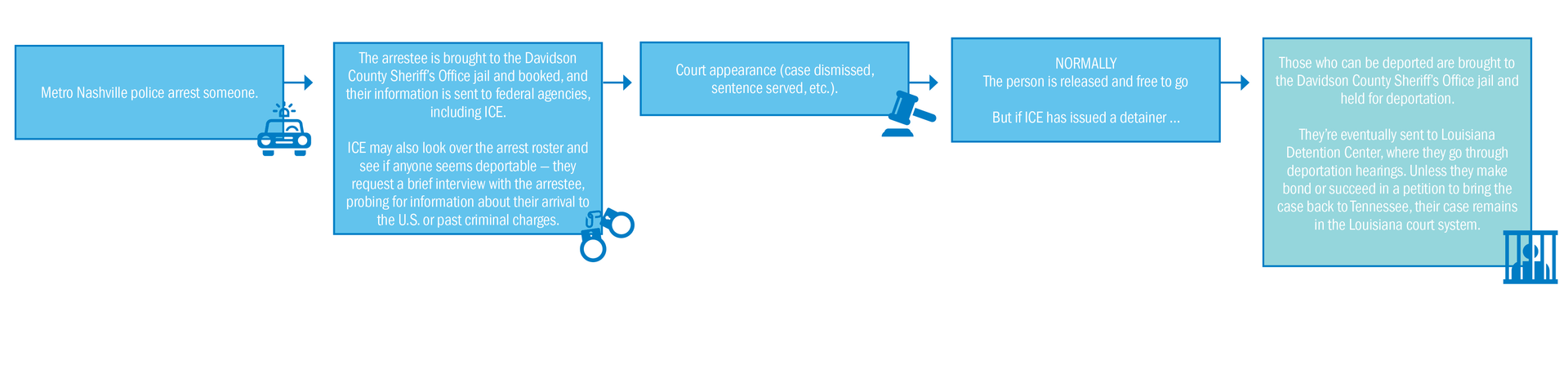
When police make an arrest and book someone, that person’s information is sent to federal agencies, including ICE. If they have something on their record like a prior deportation, ICE may take notice and reach out. Even without such records, the agency may still look over the roster of arrestees to see if anyone is deportable, and then contact the jail. ICE may then issue a detainer, which requests that the jail continue to hold the immigrant in custody.
“The way a detainer works is whenever the criminal hold is released for whatever reason, instead of actually being physically released, the person is held for ICE,” says Harcombe. Even if someone’s case has been dismissed, or if they already served their time, they remain locked up for another 48 hours, waiting for ICE to pick them up.
In the past, Davidson County Sheriff Daron Hall has said Nashville doesn’t honor ICE detainers, though more recent statements say the sheriff’s department will honor some cases. As of July 1, says the department, it will honor ICE detainers in cases during which someone has already been detained under a criminal charge. Additionally, the department will no longer hold individuals arrested by ICE, including those swept up in raids. However, an intergovernmental service agreement contract from 1996 still allows the sheriff’s department’s jail to house detainees for federal agencies, without the 48-hour hold. Back in 2017, in response to questions from Metro Councilmember Bob Mendes about whether the sheriff’s department works with the agency, the sheriff explained that the intergovernmental service agreement was used to hold ICE detainees.
ICE eventually brings detainees to a facility in Louisiana, where their odds of winning a removal case are significantly lower: They’re separated from their lawyers and their families, and placed in disheartening conditions that make it easier to give up.
Click to expand
Harcombe says there are many places where the city can stop the pipeline. Renegotiating the intergovernmental service agreement contract seems like an easy one, she says. After all, it’s more than 20 years old and existed before ICE was established in 2003. She also points to the sheriff’s department’s Steering Clear program, which diverts cases of driver’s license violations away from the criminal justice system.
But Harcombe also says some of Nashville’s local agencies are entangled with ICE. A recent example came to light in August, when WSMV-TV reported that Metro probation officers were actively working with ICE agents, handing over the home addresses of people who could be deported.
“The role of probation is to make sure the person complies with the court order, and if the person is either deported or afraid to report, they can’t comply with their court-ordered responsibilities,” says Harcombe.
After WSMV’s report, Mayor David Briley issued an executive order calling for the Nashville delegation to the state House to fight for the repeal of a state law that prohibits sanctuary cities in Tennessee. The order states that should the law be repealed, Metro employees would be barred from cooperating with ICE or giving them access to resources. The order also says that until then, Metro employees will not be disciplined for failure to comply with ICE.
TIRRC released a statement that commended Briley’s intent but argued that the order overestimated just how limiting the state law is.
“While we certainly agree that the state law should be appealed ... we disagree with the assessment that a lot of these measures can only be taken after a repeal,” Teatro tells the Scene. She also refers to a 20-page policy platform TIRRC penned called “Beyond Welcoming,” which includes steps to dismantle the deportation pipeline as well as recommendations to bolster affordable housing and workers’ rights, issues that also affect immigrants.
Know Your Rights
Legal representation makes a significant difference in immigration cases, according to the American Immigration Council. People with attorneys are four times more likely to win release from custody, and immigrants who were never detained are more than three times more likely to win removal cases.
Herrera notes that immigration attorneys face a daunting workload, and under Trump, the “rules are changing constantly.” In 2019 alone, the Trump administration has sought rule changes that would allow for the indefinite detention of migrant families and moved to end asylum protections for migrants who arrive at the southern border.
Meanwhile, Teatro notes that ICE has grown more unpredictable, and seems to favor raids in rural places that may lack the infrastructure to help immigrants — twice in 2019, raids planned for major cities failed to materialize. Courthouse arrests have also grown more common: Arrests in or near New York courts increased by 1,700 percent from 2016 to 2018. Harcombe warns this makes immigrants more afraid to show up to court appearances.
But it’s also important that immigrants know their rights, says Teatro. Many ICE warrants are signed by administrators and not judges, and ICE agents aren’t legally allowed to barge into homes or remove you from your vehicle with such warrants.
TIRRC has also hosted workshops and clinics to teach immigrants about their rights, which have helped people like Marina Ceron. The Scene previously profiled Ceron as she attended a power-of-attorney workshop to ensure her four children could stay with family should anything happen to her or their father.
“I had no idea what my rights were or that I even had rights,” says Ceron. The most important right, she says, is “maintaining my silence.”
She still carries in her purse a card from TIRRC that lists her rights when it comes to dealing with ICE, and she has all her important paperwork in a briefcase at home.
Ceron says there’s still the fear of being stopped by an officer. Even so, she continues with her life, going to work, paying bills, bringing kids to school.
“I have to continue living.”

Click to expand and print your own card



