
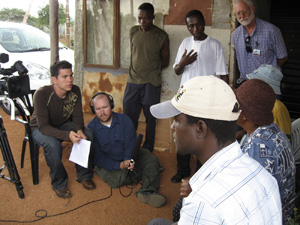

At the Nashville Film Festival, post-film Q&As are typically group hugs—occasions for actors and filmmakers to bask in the festival's hospitality. The few exceptions prove the rule—like the controversy surrounding a new film by a Nashville director, which made its contentious premiere at the NaFF just two weeks ago.
The movie is called House of Numbers, a documentary that bills itself as "an AIDS film like no other." The first film by Brent W. Leung, a Watkins Film School alumnus with a background in country-music video editing, it made its public bow at a packed Sunday afternoon screening downstairs at Green Hills, and it played there again the following Thursday.
In the intervening days, it caused a fracas at a screening in Boston, triggered pleas for the NaFF to cancel its second Nashville showing, and mobilized denunciation even from some of its own participants. The website aidstruth.org posted a lengthy rebuttal. The commotion came to a head on the festival's closing day, when a post-film discussion provoked fiery exchanges between audience members and panelists while security officers stood ready.
"You're a fucking liar!" a woman in the audience shouted at one panelist, possibly unaware that she sat next to director Leung's mother.
Since the festival, House of Numbers has become a lightning rod on the Internet, drawing scathing attacks, equally fervid support from partisans—and precious little in between.
"I didn't imagine the intense polarities that existed before the movie came out," says Leung, 29, via cell phone from a Starbucks in New York during a visit to his fiancée. "I was a little taken aback. All I did was put up information as spoken."
But members of the scientific and care-giving community that focuses on HIV and AIDS, both local and national, accuse the director of mounting a stealth propaganda campaign to give legitimacy—or at least "truthiness"—to a fringe agenda.
"He doesn't just 'put the information out there,' " says Joseph Interrante, CEO of the AIDS service organization Nashville CARES. "If he was Michael Moore and he was up front about what he was doing, you could take it or leave it. But he selectively packages the information to support a presupposed conclusion."
An ambitious and well-produced documentary, funded by sources all over the world that director Leung is hesitant to disclose, House of Numbers musters an array of talking heads to suggest that HIV/AIDS research is at best riddled with unresolved differences—in testing, in treatment, in causes, in the disease's very definition—and at worst a sinister tool of pharmaceutical conglomerates, whose cures are perhaps even the cause itself.
If all you knew about AIDS were what you saw in House of Numbers, you would probably be surprised to find these are not commonly held views, to put it mildly. Proponents call themselves "dissenters" or "rethinkers"—skeptics who charge that HIV is not directly linked to AIDS, and that anti-retroviral treatments actually prolong illness (and expand Big Pharma's customer base).
"The non-funding of non-conformists has not changed in the U.S.," writes biology professor Peter Duesberg, a panelist at the second Nashville screening, in the FAQ section on his website. "I assume it would be fatal for the current AIDS establishment if they were proven wrong, and that is why it will not change soon."
But the overwhelming balance of the scientific community regards Duesberg and his allies as "AIDS denialists"—dangerous cranks whose possibly deadly views can dissuade the infected from seeking life-saving help.
"The denialists capitalize on the flawed perception that all points of view are equal; they are not," says Harvard Medical School Professor Daniel Kuritzkes, a veteran AIDS researcher who appears in the film, and who served on a rebuttal panel at the movie's combative Boston screening. "Everyone is entitled to a point of view, but when there is a mountain of incontrovertible data on one side, and insinuation, distortion and falsehood on the other side, eventually one must stop listening to and giving press space to the cranks."
Giving their ideas an airing, says Richard D'Aquila, director of the Vanderbilt-Meharry Center for AIDS Research, creates an illusion of doubt where none exists.
"House of Numbers presents a very dangerous point of view, because it raises doubts that may keep those who need it most from seeking diagnosis and care," D'Aquila wrote in an email. "There is absolutely no doubt that HIV causes AIDS, that the diagnostic tests are as good (or better) than those used routinely for any other disease, and that the treatments now used are very effective and tolerable when prescribed/used correctly."
Many scientists find these views so beneath contempt (and so beyond debate) that they don't warrant a response. But they're responding to House of Numbers, perhaps because the potential of film to reach and persuade a broad audience is so powerful.
At the festival, Nashville CARES volunteers handed out a statement issued by 14 scientists who appear in House of Numbers. None had seen the movie at the time. Among them were Kuritzkes, Nobel-laureate biologist David Baltimore, Cornell immunologist John Moore, and HIV co-discoverer Robert Gallo—though absent is the name of Gallo's onetime rival, HIV co-discoverer and Nobel laureate Luc Montagnier, who caps the movie by suggesting a healthy immune system can defeat the virus.
"Mr. Leung was deceptive in his interactions with us," the two-page statement reads. "He informed us that his film was intended to present the true history of AIDS research, and an accurate summary of the science of HIV infection.... The reality is that his film does none of these things. Instead, it presents the AIDS denialist agenda as being a legitimate scientific perspective on HIV/AIDS, when it is no such thing."
Leung says he was disappointed the scientists listed on the statement attacked the film sight unseen, and counters that his only goal was "unbiased journalism." That's why, he says, he chose to present their views alongside "questioners" such as Duesberg without labeling.
"Nobody was taken out of context," Leung says. "There was no hidden agenda."
But online critics have seized upon Internet reports that as long ago as 1999, Leung was producing films about two controversial AIDS theorists, Boyd Graves and Len Horowitz. As the then 19-year-old son of a biology teacher, Leung says that he met with Horowitz during a Nashville appearance out of curiosity, "but it was not something I believed." As for Graves, whom he describes as "not a very credible person at all," Leung says any report that he was filming Graves' book is "completely inaccurate." But he bristles when asked if he feels his movie is being discredited.
"I don't think there's anything to discredit," says Leung, who describes his next project as a romantic comedy. "All we do is raise questions."
On the subject of the film itself, NaFF board president Stacy Widelitz agrees. "After watching the film, I didn't see the big deal," says Widelitz, who served as the Nashville panel's moderator just minutes after seeing it for the first time. "It certainly was not the incendiary propaganda piece I'd been led to expect."
But Widelitz says he was startled by the fury the movie roused on both sides. A Los Angeles web commentator bombarded Widelitz with "personal email attacks," accusing him of condoning everything from mass murder to Holocaust denial if the second Nashville screening wasn't cancelled. He refused.
"Raising questions is what a film festival does," Widelitz says. At the post-film panel, though, he says the filmmakers "didn't help their case," either with their handpicked panel (which tilted the opposite direction as Boston's) or their "aggressive" treatment of audience members who disagreed.
Asked what he hopes his film will accomplish, Brent Leung pauses for a moment as the hubbub in Starbucks quiets. "I hope that people will acknowledge that people are dying all over the world," he says, "and there are a lot of fundamental contradictions we need to examine."
As for the movie itself, Stacy Widelitz says it meets the basic standard for inclusion in a film festival.
"It's a well-made film," Widelitz says. "Triumph of the Will is a well-made film too."
Email jridley@nashvillescene.com, or call 615-844-9402.



