
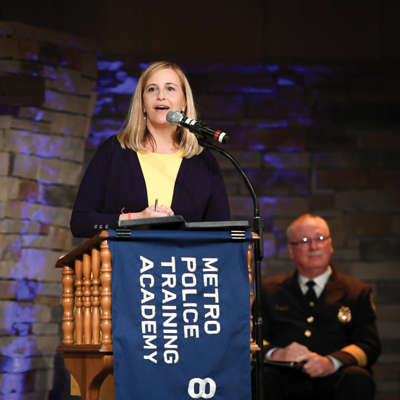


About a week before her victory in the 2015 mayoral election, Megan Barry sat down for a meeting with a delegation of prominent black leaders who presented her with an agenda. Among the things they wanted the next mayor to address was the issue of racial profiling, and other racial disparities, in policing.
Almost two years later, that issue — and others arising from the system’s myriad injustices that hit poor and minority Nashvillians the hardest — burns as hot as ever, and Barry’s record on criminal justice is decidedly mixed. Activists who have spent years pushing for reform and who hoped Barry would be a progressive champion for those goals describe disappointment at the administration’s largely passive approach to the issue, and the mayor’s deference to Metro Police Chief Steve Anderson. Still, some see optimism on the horizon — or at least, opportunities for the administration to bring about substantive change.
In hindsight, there was always reason to predict that criminal justice reform would not be a top priority in a Barry administration. The mayor herself does not have a background in the criminal justice system, nor do any of her top aides. Her transition team, empowered to install her administration after her election victory, was notably light in that area as well, save for the inclusion of Criminal Court Clerk Howard Gentry.
It’s no surprise, then, that rather than pursuing a proactive agenda of her own, Barry has largely let the issue come to her. And it has come, fast and furious.
A little more than a year into her tenure, the grassroots community organization Gideon’s Army, which focuses on issues surrounding policing and mass incarceration, released a report called “Driving While Black.” It detailed dramatic racial disparities in traffic stops and vehicle searches by police, and forced the city’s political establishment to acknowledge the issue. Four months later, Jocques Clemmons, an allegedly armed black man fleeing a traffic stop, was shot and killed by a white police officer in the Cayce Homes. Cayce, Nashville’s largest public housing development, had already been the site of confrontations with police and rising frustrations about the way they made their presence known in the neighborhood.
The mayor has supported some reform efforts, albeit ones initiated outside of her office. Both of her budgets, for instance, have funded Steering Clear, a driver’s license diversion program started by the Metro Public Defender’s Office, aimed at minimizing the arrests and debt that result from minor driver’s license violations. She also supported a Metro Council ordinance that created a civil penalty, as opposed to a criminal arrest, for simple possession of marijuana. (The ordinance was later nullified by the state legislature.) When she has approached the issue on her own, she has largely done so through broader gestures. After taking office she convened a Youth Violence Summit, and she has more recently been pushing Opportunity Now, her youth summer employment initiative.
One notable exception is body cameras — and a subsequent community advisory panel on them — which she committed to funding for every Metro police officer before the Clemmons shooting. That idea wasn’t coming from the police department, although MNPD did accept it. Still, some reform-minded insiders think the timing proves criminal justice and policing reform have not been at the top of the mayor’s to-do list.
“We might know for sure what happened in the Clemmons shooting if she’d thought body cameras were worth funding in her first budget,” says Daniel Horwitz, a criminal defense attorney, reform advocate and vocal critic of the mayor who says her actions have fallen far short of her rhetoric.
Most activists and Metro insiders who spoke to the Scene requested to speak on background, so they could be candid.
The most current example of tension between the goals of activists and the priorities of the mayor is the debate over a community oversight board for Metro police, a model that is in place in cities across the nation. Emboldened by the Clemmons shooting and the “Driving While Black” report, a coalition of activist groups have sketched out a proposal and been eagerly seeking support among the Metro Council. The police department, though, bluntly opposes the idea, and the mayor has declined to support it — a stance interpreted by reform advocates as effective opposition.
“Results are mixed nationwide as to whether or not a civilian review board can have its desired effect of promoting a more disciplined, professional police force,” Barry spokesman Sean Braisted tells the Scene in response to a question about why the mayor doesn’t support the idea. “In some cities they are largely ineffective, in other cities they actually result in fewer disciplinary actions against officers than the police-led disciplinary process (see Los Angeles Charter Amendment C). As chief of police, Steve Anderson has been focused on instilling discipline and has at times been accused of being too hard on officers in those matters. He has also been proactive in adopting progressive policies such as de-escalation and implicit bias training to improve the department.”
But while the Barry administration isn’t sold on community involvement in investigating and disciplining bad cops, there are signs that it might be open to a model that invites the community in on the front end. The administration recently invited author Barry Friedman, director of the Policing Project, to come to Nashville for meetings about his organization’s model of “democratic governance” of policing — in short, involving the community in the shaping of policing policies and working to improve community-police relations before incidents like the Clemmons shooting, rather than after. Representatives from criminal-justice-focused groups like Nashville Organized for Action and Hope were invited to the meeting with Friedman and administration officials. One reform advocate present for the meeting noted a welcome change in tone from the administration members who were present (which did not include the mayor) — a blunt acknowledgement of the issues Nashville faces.
If Nashville, led by the Barry administration, were to invite collaboration with a group like the Policing Project — an organization with a reputation for doing real work rather than papering over deep problems — it would be a substantive step. The fact that the mayor seems to be considering it causes some activists to be optimistic. And in a statement to the Scene, the MNPD says they support working with the project.
How the mayor proceeds in that area, as well as how she responds to efforts like those growing around the issue of bail reform, will tell advocates a lot about what they’re working with in the courthouse’s corner office — a partner or an obstacle.



