
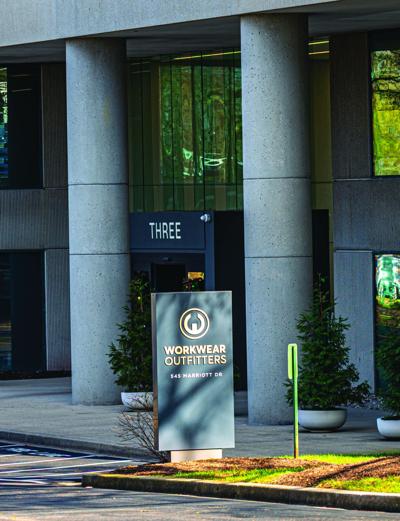

The average Nashville resident may not know Workwear Outfitters by name, but they’ve almost certainly encountered its clothing. The company bills itself as the “world’s workwear authority,” with global headquarters off Marriott Drive near the Nashville International Airport. Its portfolio includes some of the most recognizable brands in the industry. Red Kap is a century-old staple of workwear, while Bulwark FR is a leader in fire-resistant protective apparel. The company supplies work apparel and footwear to the manufacturing, automotive, oil and gas industries, along with many other sectors.
Workwear Outfitters is also a major supplier of uniforms to the federal government, particularly to the U.S. Department of Homeland Security. Federal spending data reveal nearly $120 million in contract awards to Workwear Outfitters since fiscal year 2022, with 92 percent coming from DHS. The company is a repeat high-dollar vendor for Customs and Border Protection, the Transportation Security Administration, and Immigration and Customs Enforcement.
For example, Workwear Outfitters secured a $1.4 million obligated contract amount from Homeland Security on Feb. 14 for “ERO Enforcement Jackets.” The contract runs through August 2026. “ERO” stands for “Enforcement and Removal Operations,” which ICE describes as managing “all aspects of the immigration enforcement process, including the identification, arrest, detention, and removal of aliens who are subject to removal or are unlawfully present in the U.S.”
Among the awarding subagencies, Customs and Border Protection is Workwear’s biggest customer, with contracts totaling $65.7 million since 2022. TSA contracts have totaled $34.9 million since then, while ICE contracts have been lower, at $4 million. Product service codes indicate that all the contracts are for either special-purpose clothing or men’s outerwear.
Workwear Outfitters is headquartered in Nashville, but the company’s reach extends far beyond Middle Tennessee. The company employs more than 5,800 people worldwide, including roughly 700 employees in the Nashville area and an additional 300 elsewhere in the state. Workwear Outfitters’ Nashville roots date back more than a century — the company was founded in Nashville in 1923 as Harlin Bros. & Williams, later renamed Red Kap Industries, which was acquired by VF Corporation in 1986. Nashville stayed the center of operations throughout VF’s ownership of the Workwear division. After that division was sold in 2021, the newly formed Workwear Outfitters retained its Nashville headquarters.
The company’s relationship with the federal government also has a long history. Bob Stallman, the company’s vice president of marketing, e-commerce and strategy, says the company’s history as a federal uniform supplier stretches back to the 1940s. Workwear has provided uniforms to the Department of Homeland Security since the agency’s creation in 2002, and it also supplies uniforms to the Department of Interior, including the National Park Service.

Rapid-response groups chase reports of detentions, but local and state law enforcement deny involvement
“Our company’s expertise includes the capability to design, make and deliver high-quality, cost-effective uniforms that meet the diverse needs of each department, along with the ability to manage the complex logistics of outfitting thousands of federal employees stationed all over the globe,” Stallman tells the Scene by email.
Workwear Outfitters’ Nashville location doesn’t much help or hurt its role as a federal uniform supplier, says Mark Borkowski, the former chief acquisition officer and assistant commissioner at Customs and Border Protection. “A congressman may try to influence these contracts, but the law doesn’t permit that, and it usually doesn’t happen,” Borkowski says.
However, Stallman says the company’s Nashville headquarters does offer operational advantages. “Tennessee is centrally located for fast distribution to a large percentage of the U.S. population, and we complement our Tennessee distribution centers with a network of other distribution centers across North America,” he says.
Winning these federal contracts can meaningfully benefit a company’s growth trajectory, according to Paul Middlebrooks, program manager at the Tennessee APEX Accelerator. His organization works with businesses across the state, helping them pursue and secure federal awards. “If you know you have that consistent revenue coming in over multiyear contracts, you can plan your operations much better,” he says.
As a privately held company, Workwear Outfitters doesn’t release financial information. But data from the Tennessee APEX Accelerator, provided to Tennessee’s U.S. Sen. Marsha Blackburn, sheds light on the statewide economic impact of federal contracts. According to the Accelerator, the total economic impact of federal contract awards across 753 of its counseled clients in Tennessee was nearly $2.17 billion last year.
Homeland Security’s expanding footprint has created abundant opportunities for federal contractors like Workwear Outfitters. U.S. Border Patrol staffing levels have fluctuated over the past decade, but in recent years the agency has consistently employed roughly 19,000 to 21,000 agents. Borkowski, the former CBP acquisition chief, notes that each agent typically requires multiple uniforms per year. A major 2025 federal law, commonly referred to as the “One Big Beautiful Bill Act,” also includes about $170.7 billion in additional immigration and border enforcement funding for DHS, including $8.3 billion for hiring and retaining Border Patrol agents.
Whether this bounty of uniform contracts represents an economic boost for a locally based employer or an unpleasant reminder of Homeland Security’s reach depends on one’s politics. But Stallman notes that Workwear Outfitters has supplied uniforms to the federal government for decades, across multiple administrations and frequently shifting political winds.
“We have provided uniforms to the Border Patrol through the last 11 presidential administrations and have provided uniforms to Immigration and Customs Enforcement through the last six administrations,” Stallman says. “As a federal contractor, our job is to provide required materials to support the missions of these law enforcement entities. Our company follows established laws and does not take political positions.”



Post a comment as anonymous
Report
Watch this discussion.
(0) comments
Welcome to the discussion.
Log In
Welcome to the discussion.
Keep it clean. Please avoid obscene, vulgar, lewd, racist or otherwise abusive language. Comments featuring hate speech or threatening or violent content will not be tolerated.
PLEASE TURN OFF YOUR CAPS LOCK.
Be truthful. Don't knowingly lie or mislead.
Be proactive. Use the “report” link on any comment that violates our comment policy.
Share with us. We'd love to hear your feedback.