

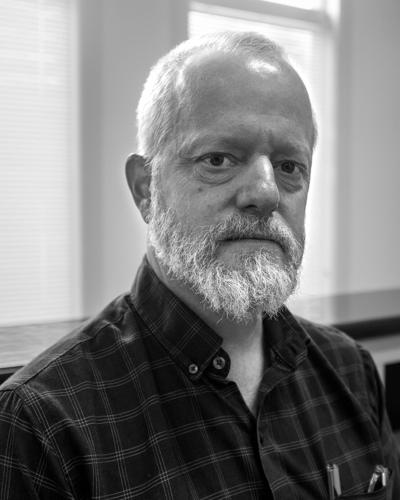

Pastor Kevin Burns (left) is ordained at a prison ceremony in 2018 by Franklin Pastor Kevin Riggs
Kevin Burns had bad luck twice. Thirty-one years ago, he got caught in a gunfight in Shelby County that killed two people — Damon Dawson and Tracey Johnson — and put three others, including Burns, in prison for murder.
Derrick Garrin, identified by a surviving witness as the “big man in glasses” who shot Dawson, was convicted for Dawson’s murder. At 6-foot-4, Garrin is a full nine inches taller than Burns. Garrin wears glasses. Burns doesn’t. Burns had short hair that night, not the shooter’s Jheri curl, as remembered by another witness.
Those arguments, which could have saved Burns from a death sentence, weren’t made at his 1995 trial. He was convicted for Dawson’s murder — after Garrin was convicted for the same murder. Garrin got life in prison and made parole in 2023. Carlito Adams, the third man convicted in the killings, got a life sentence and made parole in 2017.
You shouldn’t be able to receive the death penalty if you didn’t actually kill someone, argues Supreme Court Justice Sonia Sotomayor in her dissent (joined by Justices Jackson and Kagan) after her colleagues denied Burns’ appeal. Burns hoped higher courts would acknowledge the negligence and ineptitude of his trial attorneys, William Johnson and Glenn Wright, court-appointed lawyers who lost six clients to death row.
“The focus of the appeal was that trial counsel was ineffective for failing to show that Kevin Burns didn’t kill anyone,” says Richard Tennent, an assistant federal defender and Burns’ current counsel. “They’re the reason he got convicted. Real lawyers should’ve won this trial. We shouldn’t have been arguing over whether he deserved a death sentence — we’d be arguing over whether he deserved any punishment at all.”

Kevin Burns’ lawyer Richard Tennent
Today, Burns remains behind bars. In its June 20 order — a bimonthly update that lays out its docket — the United States Supreme Court declined to rehear Burns’ appeal, which it denied in April. One path remains: direct intervention from Tennessee Gov. Bill Lee, who has struggled to square his avowed Christianity with support for the death penalty. Through his first and second terms, Lee has criticized the inequalities of the state’s legal system but failed to deliver any substantive changes. Instead, he presides over mismanaged state facilities and constitutional challenges to Tennessee’s execution practices. Six months after the state botched the execution of Oscar Smith in May 2022, Lee brought on Frank Strada, a former prisons chief in Arizona, to bring Tennessee executions back online.
While he waits, Burns has built a church on death row.
From the offices of Franklin Community Church Pastor Kevin Riggs, the Scene spoke with Burns via phone. Riggs and Franklin Community Church are among Burns’ advocates on the outside. The Scene is joined on the call by Riggs as well as Tennent and a friend, Brad Davis, who is a Franklin church member.
“The stated purpose of that church is a church for the men of Unit 2, led by the men of Unit 2,” says Riggs, referencing the area in Nashville’s Riverbend Maximum Security Institution where all the state’s male death row inmates are housed. “As far as I know, that’s the only church on death row anywhere in the United States that’s set up that way.”
The Scene was not permitted to visit Burns in prison. The phone call to the prison disconnects at 30 minutes, and begins with an automated voice message notifying the callers that the line is being recorded. At times the call would distort and break up, seconds of silence interrupting Burns’ testimony about how his faith has kept him focused and hopeful, even as he runs out of options to avoid being put to death.
Davis has known Burns — also known to friends as KB, Pastor KB or just Kevin — since about 2014. Davis used to support capital punishment, but his personal relationship with Burns has changed that. Davis and his wife sent a wedding invitation to Burns knowing that he wouldn’t be able to attend, but they hope to introduce Burns to their 2-year-old and one day help him post-prison.
“I believe that God is able to touch the hearts of the governor or whoever he needs at that time when he sees fit,” says Burns. “I have patience in waiting on the Lord.”
Riggs ordained Burns in 2018, and Riggs now considers Burns his pastor. Burns serves at both Riverbend’s The Church of Life and at Franklin Community Church, where he preaches through recorded phone calls.
Riggs has written multiple letters to Lee asking the governor to step in and grant clemency for Burns and other death row inmates.
“My prayer is that he will take an honest look at the entire situation and see the injustice that’s been done in this particular situation,” Riggs says.
Burns says that in 1993, a little more than a year after his arrest, God spoke to him and called him to the faith. It’s an experience he says he initially doubted. But now he counsels other inmates, praying with them or for them and their families.
“I want people to know that people are not the same people as they were when they got arrested,” Burns says. “God has the ability to change people. There is that opportunity for salvation, for reconciliation, for God to restore lives.”
He describes a “gentle spirit” in Unit 2, calling it a “building of peace” where men of changed mind, heart and spirit live. He’s called on Lee to visit the prison and pray with inmates, “to fellowship as brothers and as Christians.”
“God is a god of justice … but he rejoices in mercy,” Burns says, just before an automated voice cuts into the line — “You have one minute remaining.”





