


Tennessee was set to kill Oscar Smith on April 21. The state tried and failed, thwarted by a breakdown in chemical testing mere hours before Smith’s scheduled execution, which has since led to a complete halt on Tennessee executions. Gov. Bill Lee and the Tennessee Department of Correction have remained tight-lipped about what happened that day, a chilling hiccup in an already secretive process that involved last-minute text messages and a botched protocol.
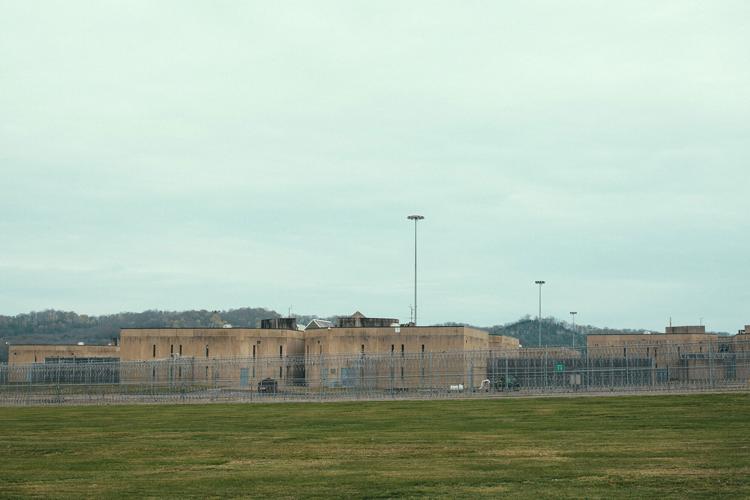
Now Smith waits. On May 2, the governor announced an “independent review” of TDOC’s lethal injection process. Pending that review, Lee suspended all 2022 executions, effectively a reprieve for six death row inmates: Smith, Harold Nichols, Byron Black, Gary Sutton, Urshawn Miller and Donald Middlebrooks. (Michael Rimmer’s execution had been stayed a few days before Smith was set to be killed.) Tennessee has 47 individuals on death row, all in Nashville — 46 men at Riverbend Maximum Security Institution and one woman, Christa Pike, at the Debra K. Johnson Rehabilitation Center, a women’s prison off County Hospital Road in Bordeaux. At 72, Smith is the oldest.

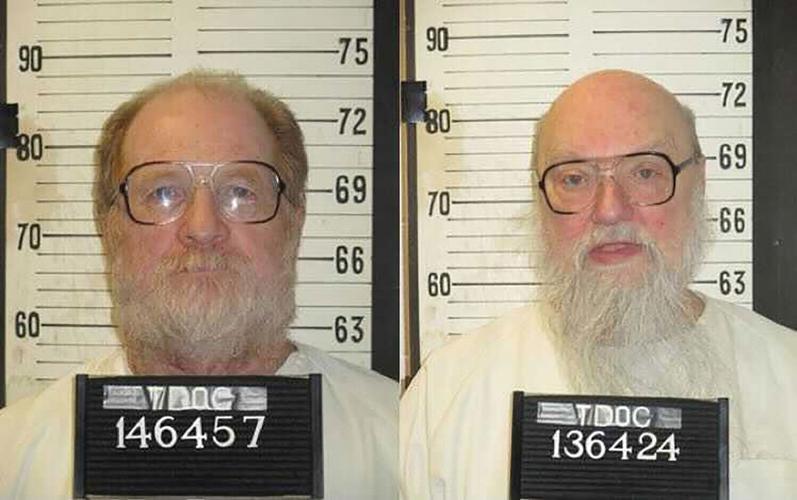
Harold Nichols (left) and Oscar Smith
The state relies on a three-drug cocktail to carry out executions: midazolam to sedate, vecuronium bromide to paralyze the body, and potassium chloride to stop the heart. A trickle of information from TDOC and the governor confirmed that the state had not tested for endotoxins, which could have caused unforeseeable side effects and potentially breached Eighth Amendment protections against cruel and unusual punishment. Lethal injection has been scrutinized by critics for decades, from procurement to testing to procedure. In Oklahoma, the state’s use of midazolam narrowly survived a constitutional challenge. Ohio Gov. Mike DeWine issued a similar supply-chain mandate in February, citing “problems involving the willingness” of pharmaceutical companies to supply execution drugs. The details and timeline of Tennessee’s investigation haven’t been made public. U.S. Attorney Ed Stanton — retained by the state to review the lethal injection process — did not respond to requests for comment, and the governor’s office directed the Scene to Lee’s May 2 press release.
“It is anticipated that after the review, the department will make changes to the execution protocol,” says Kelley Henry, chief attorney with the Middle District of Tennessee Federal Public Defender’s Capital Habeas Unit. Henry and her unit represent Smith, Middlebrooks and Black. “No executions can move forward until the new protocol has been put into place.”
While the state struggles to administer its death penalty, Tennesseeans on death row struggle with legal proceedings. Without a concrete execution date, Middlebrooks can’t schedule the competency hearing that could save his life. The Tennessee Court of Criminal Appeals is refusing another hearing for Black, a 66-year-old Black man convicted of murder in 1988, despite the state’s acknowledgment that Black has a severe intellectual disability. Even though today’s legal standards could protect Black from execution, the court is choosing to recognize legal proceedings that took place under now-obsolete standards in the early 2000s.
Tennessee is a national outlier in capital punishment, one of a few states clinging to executions despite constitutional challenges, logistical obstacles, and moral appeals from citizens, victims, politicians and clergy. Tennessee joins Texas, Arizona, Oklahoma and Ohio as states that still consistently put inmates to death, and was second only to Ohio in the number of executions planned for 2022. Arizona and Oklahoma have already executed inmates twice this year. Texas has killed once, with three executions pending and two stayed. Missouri and Alabama have each carried out one execution.
Writing about witnessing Tennessee’s execution of Billy Ray Irick in 2018, former Scene staff reporter Steven Hale described it as an “execution dressed up like a medical procedure.” Tennessee hadn’t executed anyone since 2009, and Irick’s killing was Tennessee’s relapse, preceding a new age of capital punishment under Gov. Bill Haslam’s and Lee’s administrations. Six more men have been executed since Irick — five by electric chair, one by injection.
The last time Tennessee executed inmates at this clip was in the Jim Crow Era: five each in 1955, 1948 and 1946; seven in 1943; 10 people each in 1937 and 1939; and 11 in 1922, the century’s one-year high. Most people put to death have been Black, convicted on charges of rape or murder — occasionally both.
From 1960 to 2000, Tennessee executed no one. The nation appeared to turn away from capital punishment after the civil rights era, and no executions took place anywhere in the country from 1967 to 1977.
During that decade, the Supreme Court wrestled with its own precedent, struggling to square the practice of state-sanctioned killing with Eighth Amendment protections against cruel and unusual punishment. In 1972, the court declared executions cruel and unusual punishment in Furman v. Georgia. A series of death penalty cases unwound that ruling over the next decade under Chief Justice Warren Burger, a period in which the court began skewing more conservative and issuing reactionary rulings to liberal gains of the 1950s and ’60s.
Nashville has a long tradition of opposing the state’s reliance on capital punishment. During the waning decades of the 20th century, Harmon Wray — a lecturer at the Vanderbilt Divinity School and clergy member who died in 2007 — organized and wrote extensively about what he described as the state’s twisted affinity for incarceration and punitive justice. Clergy remain at the forefront of the fight to end state-sanctioned killing — while lawyers invoke the Eighth Amendment, the Sixth Commandment leaves significantly less room for interpretation. With Tennesseans for Alternatives to the Death Penalty, Presbyterian minister Stacy Rector is a leading figure organizing and advocating against Tennessee’s embrace of capital punishment. With the No Exceptions Prison Collective, former Riverbend chaplain and abolitionist Jeannie Alexander has brought scrutiny to the many inhumanities of Tennessee’s carceral system, from overly punitive sentencing to the private prison industry and capital punishment.
Days after Lee issued his last-minute writ halting Smith’s execution, Rector joined Kelley Henry and other organizers, lawyers and clergy at a press conference calling out the governor. “There is nothing healing about the reprieve,” Rector said. “Only more trauma. Tennessee is a national outlier by continuing to hold onto a false narrative that the death penalty makes us safer.”



Post a comment as anonymous
Report
Watch this discussion.
(0) comments
Welcome to the discussion.
Log In
Welcome to the discussion.
Keep it clean. Please avoid obscene, vulgar, lewd, racist or otherwise abusive language. Comments featuring hate speech or threatening or violent content will not be tolerated.
PLEASE TURN OFF YOUR CAPS LOCK.
Be truthful. Don't knowingly lie or mislead.
Be proactive. Use the “report” link on any comment that violates our comment policy.
Share with us. We'd love to hear your feedback.