

Gov. Bill Lee, Tennessee Secretary of State Tre Hargett and Tennessee Coordinator of Elections Mark Goins took another court loss when a three-judge panel struck down Tennessee’s Senate map just before Thanksgiving. The same panel ruled the state House map constitutional as drawn, despite a challenge from plaintiff Gary Wygant, who disputed seemingly unwarranted county splits within districts.

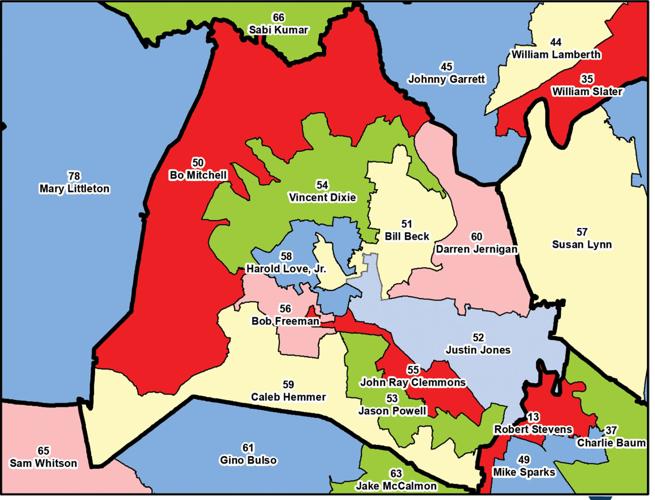
Davidson County's state House districts
The state legislature got to work redrawing maps after the 2020 Census. Republicans shepherded the process via overwhelming majorities in both chambers, and Lee signed the new maps into law in February 2022, alongside redrawn congressional districts that notably split Democratic-voting Nashville into three solid Republican seats. The maps turned out to be remarkably favorable to conservatives, particularly in battleground areas that could erode a 75-24 GOP majority in the House and 27-6 majority in the Senate — both of which, according to recent statewide voting totals, overrepresent Republicans in the state by 10 to 15 percent.
Democrats enjoy very little protections from gerrymandering, with the exception of a civil rights claim if a majority-minority district gets drawn out of viability. In this case, plaintiff Francie Hunt — executive director of Tennessee Advocates for Planned Parenthood — won a technical victory with a 2-1 ruling striking down the post-2020 Census maps. (The dissenting judge, Chancellor Steven Maroney, disputed Hunt’s standing in court rather than the constitutional argument against the new districts.) Republicans, the court ruled, violated the clear constitutional provision that districts in the same county be numbered sequentially. The provision aims to stagger four-year terms in the Senate between two election cycles, avoiding putting big geographic chunks up for a vote the same year.

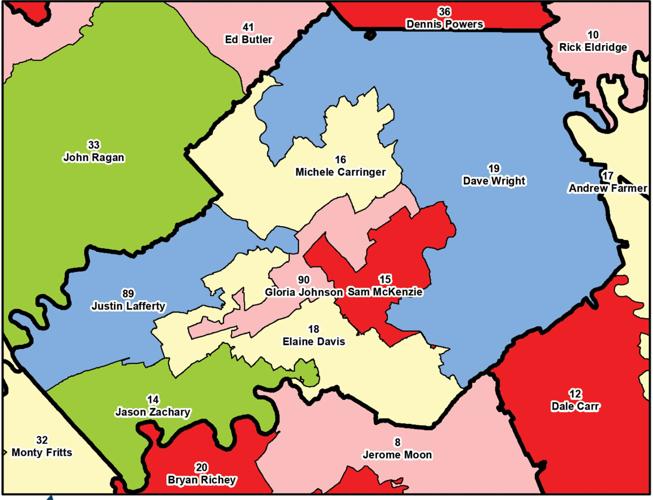
Knox County's state House districts
The House doesn’t have this protection, because every member is up for election every two years. While the court ruled that the new House map is technically constitutional, its own numbering system defies logic: In Knoxville, Republican Justin Lafferty and Democrat Gloria Johnson are seats 89 and 90, respectively, in a sea of teens and 20s. Nashville’s seats, a key Democratic base of power, are a kaleidoscope, with particularly random appendages for Reps. John Ray Clemmons and Harold Love Jr. In a system that ostensibly respects natural boundaries, major roads, contiguous neighborhoods and county lines, House seats don’t make sense, even if they are still legal.
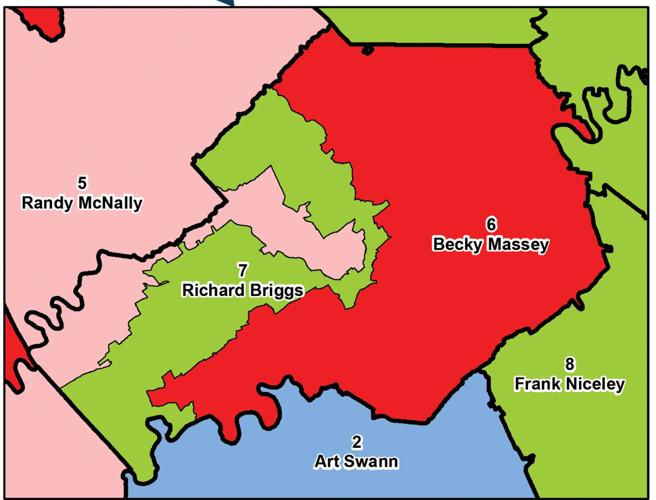
Republicans’ missteps in drawing Senate lines show clear concern for losing their supermajority in a few specific areas. Splits in Clarksville and Chattanooga eliminate districts that could be competitive for Democrats. Instead, pockets of blue votes are mopped up by neighboring rural districts for hard-line conservative Sens. Kerry Roberts and Todd Gardenhire. Rutherford County had to be carefully redrawn between Republican Sens. Shane Reeves and Dawn White to account for rapidly growing Murfreesboro and Nashville suburbs. Republican Sens. Richard Briggs, Becky Massey and Lt. Gov. Randy McNally (who leads the Senate) split duty in Knoxville, where Senate representation is solid red.

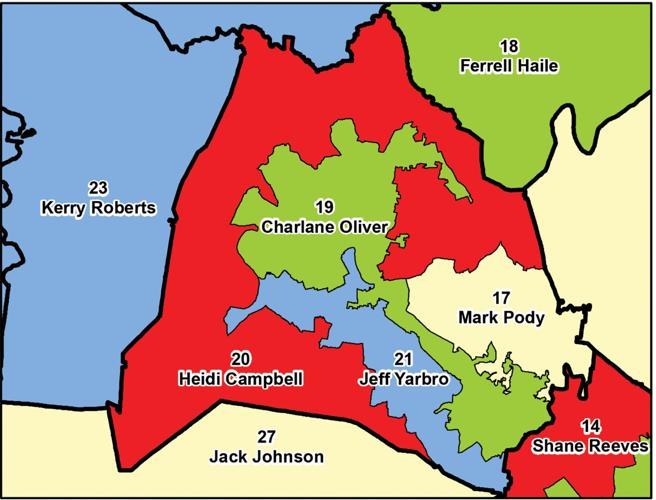
Davidson County's state Senate districts
It’s in Davidson County, though, where GOP plans to dilute votes became untenable in court. Republicans brought District 17’s Sen. Mark Pody, a conservative from Lebanon, into Hermitage and Donelson. He abuts District 19’s Sen. Charlane Oliver, who neighbors District 21’s Sen. Jeff Yarbro — all odd seats that ensure more than half of Davidson County would be up for election in the same November.
“The legislature decided, without any discernible substantive justification, not to number the Davidson County senatorial districts consecutively,” reads the ruling. “This was contrary to the plain language of [the Tennessee Constitution], the county-intactness value imbedded in the Constitution of Tennessee, and Ms. Hunt’s constitutional right to vote in a senatorial district consecutively numbered with Davidson County’s other three senatorial districts.”

Knox County's state Senate districts
Much of the defendants’ arguments focused on attacking the standing of Hunt, who resides in one of the odd-numbered districts stacked together between Nashville and Mt. Juliet. Rather than defend the maps on any constitutional ground, state lawyers may continue to attack Hunt’s standing as a plaintiff — a reminder that, in politics, you can be wrong and still win.



