

Six years after a blue-ribbon panel first proposed the idea, the $1.4 billion Recovering America’s Wildlife Act passed the United States House of Representatives June 14 on a largely partisan vote. Both of Tennessee’s Democratic representatives voted for the bill; none of the state’s seven Republicans were among the 16 GOP members who crossed the aisle.
The bill is lauded by conservation groups as the most substantial investment in species protection in decades. Collin O’Mara, president and CEO of the National Wildlife Federation, called RAWA “the most important wildlife conservation legislation in half a century.”
While the United States’ more than 1,600 endangered species are protected under the Endangered Species Act, states and tribal wildlife agencies have identified nearly seven times that many that are “threatened” — a designation below “endangered” — or that meet a state standard for endangered. While a 1937 law allows states to tax hunting supplies — including guns and ammunition — for wildlife and habitat protection, that law does little to address dwindling non-game species.
The bill has three dozen Senate co-sponsors, from both parties, including Tennessee’s Sen. Bill Hagerty. But supporters are worried that without a dedicated funding mechanism — as written, the House version relies on deficit spending — it may not be filibuster-proof.
The Tennessee Wildlife Federation says that under the version of RAWA passed by the House, Tennessee stands to receive more than $25 million annually to implement the state’s Wildlife Action Plan. State WAPs are produced every 10 years — Tennessee’s last review was 2015 — and approved by the United States Fish and Wildlife Service. WAPs are state- and tribal-level comprehensive plans that serve as the foundation for the United States’ strategy for protecting non-game species.
Tennessee’s 2015 report identifies 1,499 species of “greatest conservation need,” including, for the first time, 568 plant species. Plants, the report notes, are particularly susceptible to climate change and developmental pressures because the rare species so often thrive in highly specific soil conditions. The limestone glades — commonly called “cedar glades,” though the predominant species is red juniper rather than the similar cedar — of Tennessee’s Central Basin are particularly notable for flora that occur in tiny stretches of forest. Tennessee’s GCN list also includes a significant number of subterranean animal species, including bats and various cave-dwelling amphibians, because the state’s karst topography lends itself to extensive cave development. It’s also worth noting that Tennnessee’s Grand Divisions are like three wholly different states, in terms of geography and biological diversity.
The report features a dizzying amount of biodiversity and an appendix of imperiled species that reads like mysterious medieval bestiary. Neither the sterility inherent in spreadsheets nor the staid woodenness of bureaucracy can detract from the sheer delight of learning there is a fish darting about with the name “frecklebelly madtom,” or that some country byway provides the right soil conditions for “Linda’s roadside skipper,” or that somewhere a “Southern fatmucket” is in a stream bed doing whatever it is Southern fatmuckets do to pass the day.
Of course, what’s good for the rockpile liptooth isn’t always what’s good for the Alabama mantleslug. In other words, targeting the preservation of a specific species may not have a knock-on benefit for its confreres and, at worst, could be detrimental.
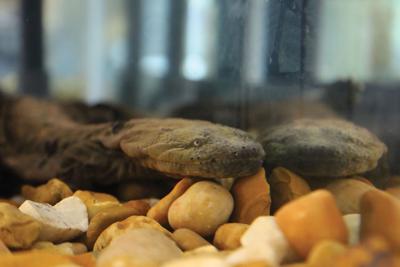
There are certain keystone species that can serve as indicators for the overall health of a habitat. The perfectly named hellbender — essentially a giant cousin of the salamander — requires pristine, free-flowing streams with water temperatures in a tight range. The amphibian is also a skin-breather (yes, the skin-breathing hellbender is a real thing and not a creature from the latest season of Stranger Things), so that clean water also needs to be action-packed with oxygen. As development and agriculture have led to more pollutants entering the state’s streams, and as climate change has shoved those water temperatures higher, the hellbender — once common in most of Middle and East Tennessee — has dwindled. In the Midstate, there’s just one relict population — a genetically distinct group in the Buffalo River.
Biologists monitor the hellbenders not just for their own sake, but because clean, cool, oxygen-rich water is also exactly what other species on the GCN list need (a shocking number of mussels and crayfish, for example).
All this makes habitat protection and restoration a key focus of the WAP, but it’s challenging. Tennessee, like most eastern states, has a relatively small percentage of public land. Roughly 90 percent of the state’s land is privately owned; contrast that with western states where the federal government is often the dominant land owner. That means the TWRA and other state agencies have to partner with private landowners whose primary desire for their property may not be species preservation. Urging, say, a farmer to restore a riparian environment or to manage his fertilizer runoff in a different way is often more carrot than stick.
Still, there have been successes in the seven years since the latest WAP hit the streets. Dam removal projects mean streams and rivers are flowing more naturally. The state has incentivized owners of woodlands to more naturally manage their forests — and yes, sometimes that means letting them burn.
There have even been successes using old-fashioned population restoration methods, where a species is simply reintroduced to its old habitat and nature takes its course. The reintroduction of elk to East Tennessee is the most visible of these successes. The population is doing so well now that the state issues hunting permits for the creature (an extremely limited number aimed at maintaining a healthy population). The lake sturgeon — a large freshwater fish that can live to be 150 years old — was once all but extirpated from the state’s waterways, but decades of stocking projects have brought them back to stability.
For now, it’s a waiting game. The bill’s prospects in the Senate look good on paper — the 16 Republicans who have signed on as co-sponsors provide more than enough cover to beat back a filibuster — but as ever, the devil is in the details. A funding fix may be available via a separate bill that would close a loophole allowing tax deductions to be claimed for conservation easements that are then turned around and sold for profit. The IRS estimates that more than $36 billion such deductions were made by bad actors between 2010 and 2018. Analysts estimate tightening enforcement procedures and tweaking the law would provide the $14.1 billion RAWA is expected to cost over the next 10 years.



Post a comment as anonymous
Report
Watch this discussion.
(0) comments
Welcome to the discussion.
Log In
Welcome to the discussion.
Keep it clean. Please avoid obscene, vulgar, lewd, racist or otherwise abusive language. Comments featuring hate speech or threatening or violent content will not be tolerated.
PLEASE TURN OFF YOUR CAPS LOCK.
Be truthful. Don't knowingly lie or mislead.
Be proactive. Use the “report” link on any comment that violates our comment policy.
Share with us. We'd love to hear your feedback.