
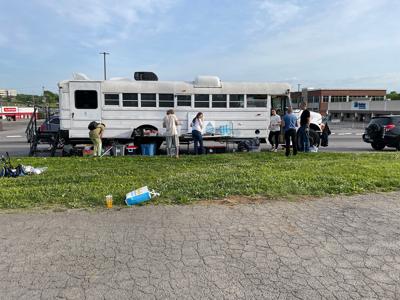
Nashville is in the middle of a record-breaking heat wave this summer, and it doesn’t look like things are getting much cooler anytime soon. On June 22, our city’s temperature topped 100 degrees for the first time in a decade, setting a new city record with a final temperature of 101 degrees. Among the most affected by the dramatic weather — our unhoused population.
Nashville’s Salvation Army and the Metro Homeless Impact Division have established cooling centers in the city, which are open whenever the heat index is predicted to reach above 100 degrees. Other cooling centers, like those run by Nashville’s Office of Emergency Management, have publicly stated that they will not open their doors until the heat index reaches temperatures as high as 110 degrees.
But even when cooling stations are open, they don’t immediately solve problems. Many unhoused people can’t make it to the cooling stations due to the required travel distance, and some avoid them out of fear that the belongings they’re unable to carry with them will be stolen. In an attempt to assist in the journey to these stations, the Metro Homeless Impact Division has been working to acquire transportation for their unhoused clients.
Such efforts include working with WeGo to provide bus passes, which ensure safe travel to a heat-relief site. MHID has also worked with WeGo to provide cool-off rides, which will allow unhoused clients free rides on the bus for an extended period each day in order to provide relief from the heat.
“I think that the biggest problem that I’ve seen in this heat wave is it exacerbates the problems that people are already experiencing,” says Cathy Jennings, executive director of The Contributor and a member of the Continuum of Care Homelessness Planning Council’s Shelter Committee. The Contributor is a Nashville-based social justice newspaper that employs unhoused and housing-insecure people as street vendors. This allows unhoused people to legitimize their income by establishing a legal and traceable pay history.
This legitimate pay history can be crucial when it comes to applying for housing. In our current heat wave, Jennings says the streets are less populated with vendors due to safety concerns. This can be devastating to those who rely on the income The Contributor provides.
“If they have a rent payment that’s a thousand dollars a month,” Jennings says, “then they can’t afford to miss a day.”
Other nonprofit leaders, such as Shower the People executive director Meredith MacLeod Jaulin, have different concerns.
“Honestly I’ve had a lot more concerns in previous years,” says MacLeod Jaulin. “In Nashville, especially because of COVID, we have done a much better job ensuring collaboration between nonprofits.”
Shower the People provides mobile showers and supplies to the unhoused, and MacLeod Jaulin says nonprofits like hers have actually been facing challenges from other Nashville residents. She says opposition to community outreach has established a strong foothold in West Nashville in particular. Some residents claim that unhoused relief centers could bring dangerous individuals into residential neighborhoods or drive down property values. A particularly outspoken group voicing these concerns is the organization Reclaim Brookmeade Park, which boasts more than 1,000 members on its Facebook page.
Due to this type of opposition, Shower the People has been forced to cease setting up their catch-and-carry mobile showers in certain areas. Instead, in some cases, they’ve had to limit their services to bringing water to unhoused people. MacLeod Jaulin says this sort of resistance to her organization’s relief efforts has made her and her fellow volunteers even more determined. “I think we have that motivation of, ‘Oh yeah? Watch me!’ ” she says with a laugh.
“Along with housing infrastructure support, especially here at the beginning, I feel like as a country … we didn’t catch this problem early,” says Jennings. “So there are people who have been out there homeless for a very, very long time.”
MacLeod Jaulin encourages citizens who want to help to send letters and emails to Metro Councilmembers and state representatives to advocate for affordable housing. She notes that for anyone who would like to donate, the supplies Shower the People needs most are bottled water, underwear and socks. Jennings says The Contributor could use more water, tents, handheld fan misters, food and tarps.



Post a comment as anonymous
Report
Watch this discussion.
(0) comments
Welcome to the discussion.
Log In
Welcome to the discussion.
Keep it clean. Please avoid obscene, vulgar, lewd, racist or otherwise abusive language. Comments featuring hate speech or threatening or violent content will not be tolerated.
PLEASE TURN OFF YOUR CAPS LOCK.
Be truthful. Don't knowingly lie or mislead.
Be proactive. Use the “report” link on any comment that violates our comment policy.
Share with us. We'd love to hear your feedback.