


When tragedy strikes, grief and the array of emotions that accompany it can be some of the most difficult subjects for anyone to take on — but especially so with children. Percy Priest Elementary School counselor Kristin Keiper-Berneman wants to change that.
Keiper-Berneman founded Good Grieve Nashville, a company that helps guide conversations with children about loss, and spearheaded an effort for Percy Priest to be recognized as what’s known as a Grief-Sensitive School by the New York Life Foundation.
Percy Priest is the first Metro Nashville public school and the first school in Middle Tennessee to receive this recognition, which comes with annual grief training for staff and a one-time $500 grant to support students in bereavement. Percy Priest is using that grant to create Heart’s Garden, where students and staff can decorate rocks in memory of their loved ones. The garden will be a part of Percy Priest’s new school building, which is set to open in the fall.

In seventh grade, John Christian Phifer told his parents that he wanted to be a mortician.
“Anytime a student or a staff member wants to create one, they can then paint it, put a name, put symbols, whatever feels important to them,” says Keiper-Berneman. “Then they have the option of either taking it home with them or putting it in Heart’s Garden. So it’ll always be a little collection of memories of the people and pets that were important to us.”
Keiper-Berneman says teachers and other school leaders are often not given proper training on how to discuss death with students. According to a report by Judi’s House/JAG Institute and the New York Life Foundation, 1 in 9 children in Tennessee will experience the death of a parent or sibling by age 18 — that’s compared to the national rate of 1 in 12 children.
“We never give them the tools to know what to say when a student has a loss, and pets die all the time,” says Keiper-Berneman. “Even if it feels like a loss that some people would say is maybe less important, that’s not how it feels to our students and our children.”
She says one of the most basic steps parents and teachers can take is using clear verbiage.
“Our words really matter, and so what matters is that we stop using the euphemisms like ‘gone to a better place,’ or that we ‘lost someone,’” she says. “Because the child hears that and thinks, ‘Well, let’s go to the lost and found.’ Or if we say ‘passed away’ they think, ‘Well, where is away? Let’s go find them.’”
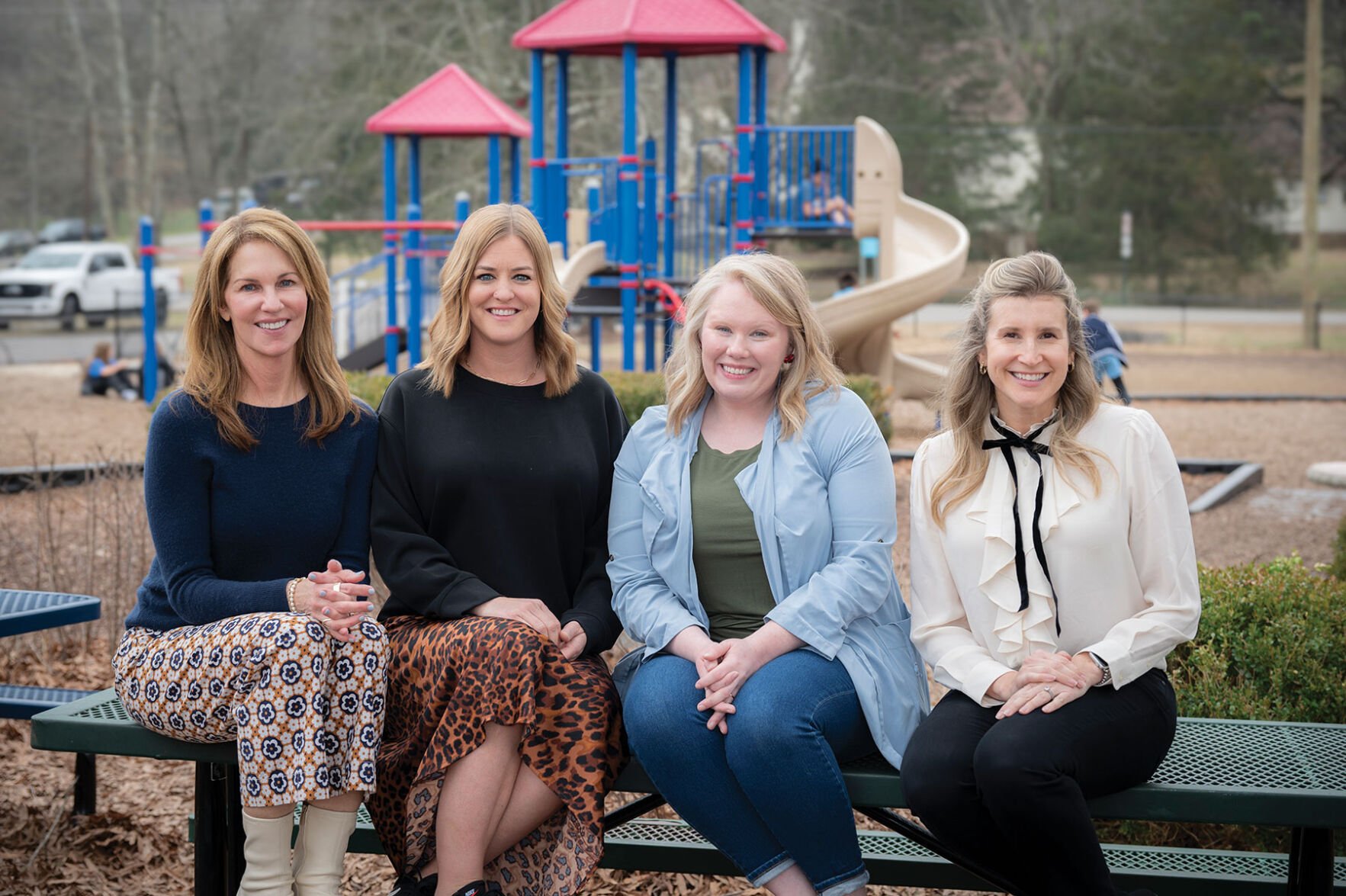
From left: Rebecca Bourlakas, Natalie Williams, Shannon Calzadilla, Kristin Keiper-Berneman
This can cause greater confusion in children who might be dealing with death for the first time. “I was really surprised to learn that the kind and clear word when we’re talking to young children is to use the D-word — it’s ‘dead’ or ‘died,’” Keiper-Berneman says. “It feels blunt or harsh to me as an adult, but to the child, that’s the less confusing word.”
She says the societal perception of how we should handle death has changed drastically in the past century, and people are often much further removed from it than in the past.
“One hundred years ago, we died in our homes, and that meant people saw the body,” she says. “People sometimes even helped prepare the body for burial. And then there was this hundred-year-plus gap of us dying in hospitals or out of the home, and it started to feel really separate. And in those moments, we removed the children because we thought it wasn’t appropriate. So no wonder we struggle with these things. We don’t know who to ask, and no one was modeling this for us. It feels very scary, and it feels so taboo. We can change that. It doesn’t have to feel that way.”
While she primarily tries to educate parents and teachers about how to handle grief with children, she says everyone can benefit from knowing how to decipher the topic.
“It’s also about being a good friend, it’s also about being a good co-worker, it’s about knowing when someone has a loss, what we could do that’s supportive,” says Keiper-Berneman, adding that many people don’t learn about grief until they are grieving themselves. “That’s the hardest time to acquire new information when we’re grieving. We have grief brain. So if we can learn this, if we can take in this information in a time that we aren’t actively grieving, we can be so much better at it for everyone in our circles.”



Post a comment as anonymous
Report
Watch this discussion.
(0) comments
Welcome to the discussion.
Log In
Welcome to the discussion.
Keep it clean. Please avoid obscene, vulgar, lewd, racist or otherwise abusive language. Comments featuring hate speech or threatening or violent content will not be tolerated.
PLEASE TURN OFF YOUR CAPS LOCK.
Be truthful. Don't knowingly lie or mislead.
Be proactive. Use the “report” link on any comment that violates our comment policy.
Share with us. We'd love to hear your feedback.