
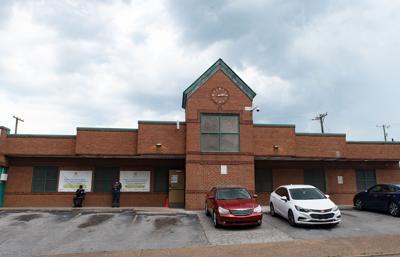

Neighborhood health clinics serving the neediest Nashvillians are struggling to remain in place as the neighborhoods they serve grow and change.
In September 2020, the clinic at Mercury Court quietly closed after eight years open. The building, constructed in the 1960s, was beyond repair, according to April Kapu. Kapu is associate dean for clinical and community partnerships for Vanderbilt School of Nursing, which managed and staffed the clinic. Urban Housing Solutions, which owns the attached complex, also broke ground to start redevelopment in March.
One-hundred-sixty units will soon become nearly 400 units of different income levels, from residents making 40 percent of area median income to those making 80 percent. A new clinic wouldn’t be in the cards until the second phase of development, slated to begin mid-2025, says Kelsey Oesmann, director of design and development at Urban Housing Solutions.
Vanderbilt’s solution to the clinic’s closure was to get patients acclimated to using telehealth instead, or to instead visit its West End location across town, Kapu says.
More recently, Vanderbilt School of Nursing partnered with Urban Housing again on a new primary care clinic, connected to the 26th and Clarksville development. But the new North Nashville Primary Care Clinic does not accept adults on TennCare or those who are uninsured — which is the case with many of the people who live nearby, says Oesmann.
“A lot of our folks across the board are either uninsured or underinsured,” Oesmann says. “A lot of folks rely on Medicare, Medicaid and TennCare. We do have a fair number of tenants employed full time and may be getting health care through their employer. But it’s definitely not the majority of our folks.”
Kapu says the clinic has started the process to become TennCare certified at that location, but the organization would have to raise money to accept any indigent population. According to its website, Vanderbilt requires preauthorization for patients on TennCare seeking primary care.
“Our hope is that we will very soon be able to see all patients, whether they’re insured on TennCare, or any type of patient we can see there at that clinic,” Kapu says.
“In terms of access to care of people who hadn’t seen a health care provider in years, maybe that’s because they didn’t have time to take off work, they didn’t have transportation, they couldn’t afford it, maybe it was something like they just didn’t trust that the health care system would work for them or their needs,” she continues. “That’s why it’s so important to make sure that you’re putting health care in the community where the patient is.”
Growing pains displaced another community clinic that has yet to reopen. The Neighborhood Health clinic at the Nashville Rescue Mission on Lafayette Street closed in April 2020 so the space could be used as a quarantine facility. According to Neighborhood Health CEO Brian Haile, the organization opted to keep the clinic closed due to staffing concerns and additional COVID-19 regulations around dental care. Now it cannot reopen, because since September 2021 the Nashville Rescue Mission has been using it as dorm space, while women’s campus guests stay on the main campus. The Nashville Rescue Mission’s new women’s campus started construction in the fall and is slated to finish in late 2023.
Community overhaul could also disturb Neighborhood Health’s clinic at Cayce Place, which has been in operation there since 1976. The Envision Cayce redevelopment plans for the neighborhood, led by the Metropolitan Development and Housing Agency, show a park in the clinic’s current location, though Haile says they’re working with MDHA to find a nearby location to rebuild. Funding for a new Neighborhood Health location in Cayce is in flux as well.
MDHA has confirmed that they’re working with Neighborhood Health to find a new location, though did not share a timeline for such a move.
As a federally qualified health center, Neighborhood Health has to present a plan to maintain access to the clinic without an interruption in service. The organization accepts commercial insurance as well as adult TennCare, and has a sliding scale for those without insurance. Only about 1 in 5 patients is on commercial insurance at Neighborhood Health, Haile says.
“Proximity is everything,” says Haile. “Proximity equals access. What you find is that we’re trying to locate and situate our clinics in spaces in the middle of or adjacent to areas where underserved populations are going to be concentrated.”



Post a comment as anonymous
Report
Watch this discussion.
(0) comments
Welcome to the discussion.
Log In
Welcome to the discussion.
Keep it clean. Please avoid obscene, vulgar, lewd, racist or otherwise abusive language. Comments featuring hate speech or threatening or violent content will not be tolerated.
PLEASE TURN OFF YOUR CAPS LOCK.
Be truthful. Don't knowingly lie or mislead.
Be proactive. Use the “report” link on any comment that violates our comment policy.
Share with us. We'd love to hear your feedback.