
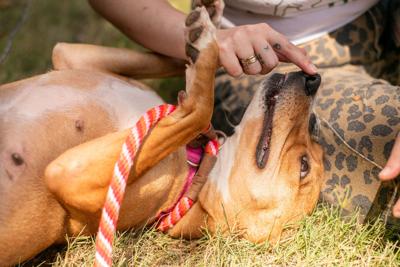

Nashville Humane Association, one of the city’s longest-running nonprofits, is celebrating 80 years in operation this month. And as it happens, the animal protection organization also needs some help. In early March, NHA put out a call for adopters and fosters as its shelter reached full capacity, meaning all 100 of the organization’s kennels are occupied.
Ahead of NHA’s 80th birthday celebration later this month, we spoke with executive director Laura Baker about what it means when the shelter reaches max capacity, the adoption and fostering processes, and resources for pet owners. This interview has been edited for length and clarity.
What does it mean when you reach max capacity?
We have a finite amount of resources, a limited amount of staff, a limited amount of space. Our building was built in 2004, and Nashville’s changed a lot since then, so we essentially utilize foster homes to expand our impact beyond our kennels. We take in animals in various ways. The first way we take in is owner surrenders. Right now, a lot of people can’t afford to take care of themselves, let alone an animal, and so we’re seeing an uptick in owner-surrendered animals. We have kennels to put them in, but we also need foster homes to go beyond putting animals in kennels.
And then the other way is strays. Our local partner shelter, Metro Animal Care and Control, is a government-run facility. Being government, they have limited resources, so they have also been full and unable to take animals. So we’ve been taking in strays more often than we have in the past. We have 100 kennels, and every single one of them is full. And we believe in providing wonderful care to the animals in our care, so we would never warehouse and put up pop-up kennels in hallways to house them. So once the kennels are full, we really try to put out a plea, because the need is there in our community. We just don’t have the resources to say yes always.
You have a thorough adoption process page online, but is there anything specific you want potential adopters to know before they get into that process?
Commitment is scary sometimes. We have so many ways that people can come and help an animal that isn’t adoption. I know when people think of a shelter, their first thing is to think about dog or cat adoption, but we also have the Doggie Dates and Rovernights program, which is essentially, you can come check out a dog or a cat for an hour or overnight, so you don’t have to make that commitment to adopt an animal. You can foster it for a short period of time, and it helps you get that animal fix. It helps us; it creates space. And it also helps socialize the animal.
I think my message to folks would be: We do need adopters, because that’s amazing. That’s a lifelong commitment. But if you’re not ready to make that commitment, there’s so many other ways that we can plug you in that can make an impact.
What do you look for in prospective pet fosters?
The majority of animals that need a foster home are because of medical [issues], behavioral [issues] or being underage. So [with] foster homes, we may be looking for a quiet environment. Let’s say we have a dog that’s really stressed — we would be looking for a home that’s quiet. On the other hand, we have a sorority right now that’s fostering a puppy. That’s an appropriate home, because that puppy’s getting socialized. … We have newborn kittens that are with us whose mom was hit by a car, and so we have a mom and daughter that are bottle-feeding kittens. Really, the needs run the gamut.
Our basic requirements are that you live within a 50-mile radius of Nashville Humane — in case there’s an emergency, we want to make sure that we can provide the care that’s required and the customer service — and then basically we just try to matchmake, to make sure we’re setting you up for success and the animal up for success.

Losing a pet can be an extremely stressful situation — for both the pet owner and their furry little friend. Fortunately, when a good Samarita…
What resources do you have for pet owners who are struggling or who may be in need of help?
It’s called our Pawsitive Impact Program. The bottom line is — we don’t want your animal; we want people to stay with their animal. That’s what’s best for everybody. … We have temporary fostering. So let’s say you are going to rehab, or you’re going into the hospital; we may have a program where we could put your animal into a loving foster home, and when you come out, you can have your animal back. … We have a weekly food bank. We know pet care is expensive, feeding your animal is expensive, so we provide cat litter enrichment, dog treats, dog food to help folks focus on their own care and still be able to provide food for their animals. We provide landlord pet deposits. We recognize that folks rent and that animals are part of their family. … We also have low-cost spay and neuter that we do every week, low-cost vaccines, microchips and low-cost behavior training. If there’s a need in the community, we will try to find a program to keep that animal in that home.
What do volunteers do for NHA?
Everything. We have folks who volunteer from home and do data entry for us. We have folks who come in every day and walk dogs. We have folks who work events and fundraisers. You have to be 16 years of age or older. If you are under 16, we do require that you come in with an adult; that’s just for safety purposes. But we have volunteers who are rescue readers, where they will sit with an animal and read books. That’s super vital, because shelters can be very stressful. We have folks who take them out for a doggy date. … Our volunteers are the blood, sweat and tears of our shelter. … If you’re passionate about giving back to your community, we will find a place to plug you in.
Tennessee’s animal abandonment laws were recently updated by the state legislature. As of July 2025, it is now a class-A misdemeanor for a first offense of abandoning an animal without reasonable care arrangements and a felony for a second offense. How is this affecting local shelters?
The bill has raised awareness. I don’t think it’s really deterred anybody. There’s a lot of human issues going on right now. Unfortunately, I think sometimes the animals get the short end of the stick. So we are actually seeing an increase in abandonment. And I don’t think that correlates with the law passing. I think it correlates with [the fact that] humans are just trying to survive right now.
You’re one of the longest-running nonprofits in the area. How do you last that long as a nonprofit?
I think we’ve lasted because we’ve ebbed and flowed with our community. We’ve changed to whatever [the community’s] needs have been. We started in 1946, and the core of our mission was to protect horses and children. In 1960, we started to do rabies control. … In the 1980s, we did animal cruelty investigations. … I think we’ve lasted because we’ve been able to try to step up and meet whatever the community’s needs are. Nashville is such an animal-loving community that will do anything for animals.



