
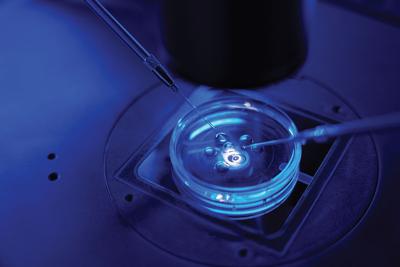

A bill making its way through the Tennessee General Assembly seeks to separate the definition of human life from that of artificial intelligence. But one clause in the legislation raised alarm for the group Tennessee Fertility Advocates: language asserting that life begins at fertilization.
“If ‘personhood’ passed — if any language passed with ‘personhood’ in there — IVF would be [over] in the state of Tennessee,” says Mollie Walker, co-founder of Tennessee Fertility Advocates, an organization supporting fertility care access and insurance coverage.
Last year, Tennessee became the first state to enshrine access to in vitro fertilization into law. However, several bills introduced in the Tennessee General Assembly this year — in their original language — would have complicated that access.
Language asserting life starts at fertilization was ultimately removed from the bill, to the relief of those in the IVF space — and this is despite the fact that many of these advocates are Christians who believe spiritually that life begins at conception.
Fertility advocates don’t want a repeat of what happened in Alabama in early 2024. After three couples sued a clinic that had accidentally destroyed their embryos, the Alabama Supreme Court ruled that frozen embryos are legally considered children. Because of this, several fertility clinics paused operations for fear of additional legal struggle. Alabama quickly passed legislation protecting IVF providers, allowing them to resume services in the months following.
Earlier in this year’s legislative session, another bill on fetal personhood failed in committee following intraparty division among Republicans and protests from dozens of out-of-state “abortion abolitionists.” If passed, that legislation would have applied fetal homicide charges to women who get an abortion.

Packed house of Christian leaders shows support for fetal personhood bill; maternal care legislation also fails
The National Embryo Donation Center, headquartered in Knoxville, provides another option for families with frozen embryos they did not use in IVF: embryo donation. The center, founded in 2003, facilitates 150 to 180 adoptions of those embryos per year. Currently, the center is storing 500 sets of embryos (each set containing two or more from the same donors) and more than 1,500 single embryos on ice. This is according to National Embryo Donation Center president Dr. Jeffrey Keenan.
Keenan expresses concern that the center could be charged with homicide or manslaughter were there a mistake in the lab, or if an embryo that could never fully develop were discarded.
“I do believe that life begins at conception,” Keenan says, citing his Christian faith. “However, I also understand that in normal fertilization, as well as in vitro fertilization, there are a large number of fertilized eggs and early embryos that never make it to birth, and could never make it to birth because of genetic and other abnormalities. To call every one of those embryos a human life is, I think, a mistake.”
He continues, “The problem is, if you treat these embryos as if none of them are human life, then you’re going to be potentially abusing or discarding a lot of human life.”
Another bill, Senate Bill 2461, before amended, would have limited genetic testing in embryos. That’s another issue Tennessee Fertility Advocates does not want to see legislated.
“It is just an entryway for the government to continue to get into the reproductive system with legislation, and we want it to be between a patient and their doctor, and not involved with the government,” Walker says.
SB 2461, as it stands, would require additional certification for fertility clinics, including becoming members of the Society for Assisted Reproductive Technology. The National Embryo Donation Center’s counterpart, Southeastern Fertility Clinic (where IVF procedures take place), is not a member, at least in part because it adds a “significant amount of cost to each patient’s cycle,” Keenan says.
Locally based author Karen Kingsbury explores the concept of embryo adoption in her Christian romance novel Someone Like You, which was adapted into a film in 2024. In the story, the protagonist finds out she was an adopted embryo and searches for her biological family, ultimately discovering that her biological twin sister had died. That kind of story is possible but not probable, Kingsbury tells the Scene.
Through her One Chance Foundation, Kingsbury provides scholarships for mainly domestic adoptions, but has also helped families with international adoptions and embryo adoptions. Her interest in the topic began with an article she wrote while she was a reporter for the Los Angeles Times in the late ’80s. During a custody battle over a frozen embryo, Kingsbury was invited into a lab to see an embryo in person.
“Everyone is going to come at it from their worldview and their level of faith or spirituality toward unborn babies,” Kingsbury says. “I think that’s going to be a personal thing they’re going to be thinking about. It was a big enough question that people were wondering about the morality of what to do with it, even back then.”
She continues: “My mindset on that is, it’s a life, this child. If that’s the situation, then you aren’t throwing them down the drain.”
Sen. Jeff Yarbro (D-Nashville) was the sole vote against SB2461 in the Senate Health and Welfare Committee.
“Almost everybody in Tennessee supports families’ right to seek IVF treatment, and yet in Tennessee, we continue to see year after year, new big efforts to overhaul the rules that apply to IVF clinics,” Yarbro said at a recent press conference. “That doesn’t provide the stability for these clinics to actually know that they can safely operate in Tennessee. It doesn’t provide the security that Tennessee families need to know that those clinics will be in place and have rules and be able to continue treating them over the course of their treatment.”



Post a comment as anonymous
Report
Watch this discussion.
(0) comments
Welcome to the discussion.
Log In
Welcome to the discussion.
Keep it clean. Please avoid obscene, vulgar, lewd, racist or otherwise abusive language. Comments featuring hate speech or threatening or violent content will not be tolerated.
PLEASE TURN OFF YOUR CAPS LOCK.
Be truthful. Don't knowingly lie or mislead.
Be proactive. Use the “report” link on any comment that violates our comment policy.
Share with us. We'd love to hear your feedback.