
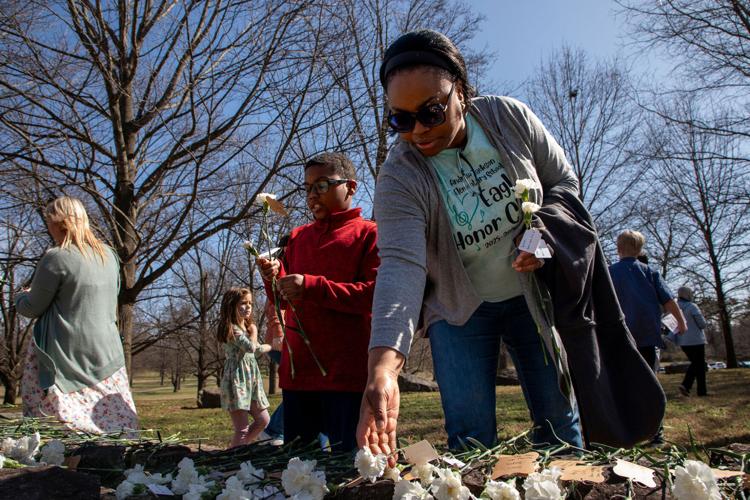
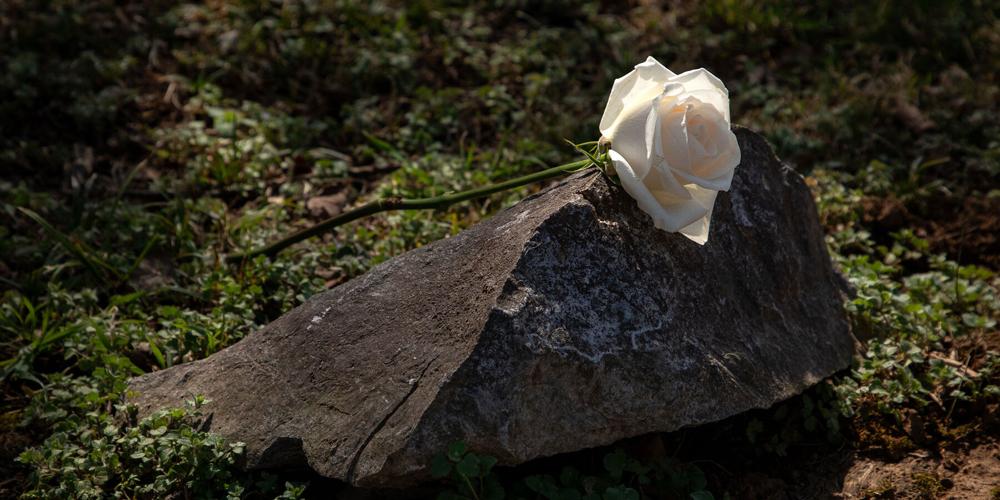
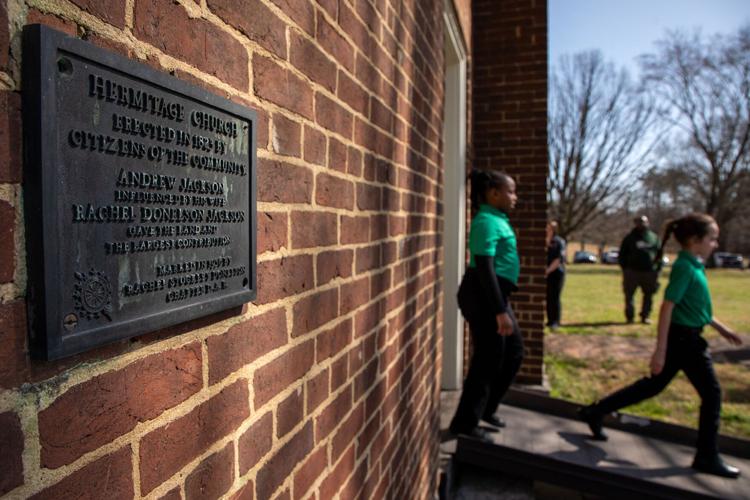

Each year, attendees of the Enslaved Memorial Commemoration at Andrew Jackson’s Hermitage lay carnations on a stone wall behind the Hermitage Church, among trees planted in the outline of the Big Dipper. The North Star would have been a beacon to people who were enslaved at the former president’s home — showing the direction to freedom.
At this year’s event, held Feb. 21, there were 325 carnations, each tagged with the name of someone who was enslaved at The Hermitage, nearby or at one of Jackson’s other properties. It’s the highest number yet of people recognized by the ceremony, and it’s still growing. Discovering just how many people the former president enslaved and their names is a difficult process. Genealogy and census data, bills, receipts and even calendar entries from Jackson’s archives give clues, historians at The Hermitage tell the Scene.
Historian Gary Burke performed an original poem inspired by Albert Jackson, who was born a slave at The Hermitage and stayed there post-emancipation, ultimately serving as one of the first tour guides at the site. He died in 1901 and was given a funeral at the mansion before being buried near Jackson in The Hermitage’s garden with a headstone reading “faithful servant.” Burke remembers learning about Albert when he visited The Hermitage as a child on a field trip 51 years ago. His story planted the seed in him to become a historic preservationist, he said. (Burke is also known for his work with the U.S. Colored Troops reenactors locally.)
“It’s great that they see a significance in telling the fuller story about what happened here, and that there were enslaved people that dwelled here,” he says. “Their stories need to be known as well as the Jackson family.”

In 2024, leaders at The Hermitage announced they had discovered a cemetery where at least 28 people were buried, all of whom had been enslaved on the property at their time of death. During Saturday’s event, The Hermitage’s chief experience officer Tony Guzzi led a group inside the gate surrounding the burial area, where stones had been placed at the approximate sites of headstones that have been covered by soil over the years. Historical interpreter Nathan M. Richardson, who traveled from Virginia for the event, presented two living-history shows as Frederick Douglass. He also joined the group on the walk to the cemetery, where he recited “Bury Me in a Free Land,” a poem by Frances Ellen Watkins Harper.
Richardson is part of The Hermitage’s living-history series and its Black History Month programming. The Hermitage is making an effort to continue such events throughout the year, explains newly hired chief marketing officer Jeffrey Freeman. A Harriet Tubman reenactor is coming to The Hermitage in June, for example.
The Hermitage is the home of the “people’s president” and a war hero, but also the home of the man who enacted the Trail of Tears and enslaved hundreds. There’s a lot to learn beyond a childhood field trip visit, Freeman says.
“We don’t shy away from these topics at all,” Freeman says. “If anything, I feel like we are leaning into them because it happened. It just is a matter of fact. When you come back in 10 years, how we’re talking about it then will differ from how we’re talking about it now. Honestly, I think that’s just how it’s meant to be.”
“You can say Jackson was horrible, Jackson was great,” adds public programs and outreach manager Tiffany Demmon. “And then there’s a space for that. We’re not trying to tell you how to think.”

The burial site of an enslaved person at The Hermitage
Keynote speaker Brandon R. Byrd, author and associate professor of history and African American and diaspora studies at Vanderbilt University, focused a portion of his address on an enslaved woman named Hannah. He explained that eulogies and biographies of Jackson portray her as content with her circumstances, but she escaped the first chance she got.
She was a devout Christian, he adds, and a nurturing midwife, caretaker and maternal figure to the Black youth of post-Civil War Nashville as well as to her own 10 children.
“Hannah was a casualty in the battle of the memory of the Civil War and slavery,” Byrd said. “In Nashville, the city’s papers eulogized Aunt Hannah as the trusted servant of the hero of The Hermitage. They remembered that she always ‘seemed pleased to talk of Master Andrew and his many experiences.’ Meant to conjure an image of slavery as a good, benevolent institution, the obituaries did a grave injustice to Hannah.”
Byrd helped read the 325 names in the roll call, before the Andrew Jackson Elementary School’s Eagle Honor Choir led the group to the stone wall singing “Follow the Drinking Gourd,” a folk song about following The North Star to freedom.
“To be sure, the members of this community envision a different way of being,” Byrd said. “They were slaves by law, but they struggled in the most mundane, the most ordinary yet spectacular ways, to be somebody else, to be somebody. They grappled with the realities, but never stopped hoping for something better, somewhere better.”

The Hermitage Church



Post a comment as anonymous
Report
Watch this discussion.
(0) comments
Welcome to the discussion.
Log In
Welcome to the discussion.
Keep it clean. Please avoid obscene, vulgar, lewd, racist or otherwise abusive language. Comments featuring hate speech or threatening or violent content will not be tolerated.
PLEASE TURN OFF YOUR CAPS LOCK.
Be truthful. Don't knowingly lie or mislead.
Be proactive. Use the “report” link on any comment that violates our comment policy.
Share with us. We'd love to hear your feedback.