
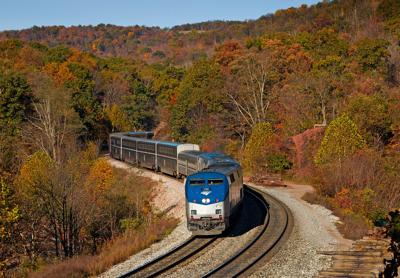

House Bill 2380 was among the Tennessee legislature’s least controversial pieces of legislation in 2022. A quarter of the chamber signed on as sponsors — 16 Democrats and nine Republicans. In the state Senate, the same bill was led by Republicans. Both passed easily.
In one page, the legislation tasked a state commission with producing a study on passenger rail connecting Tennessee’s three Grand Divisions. That study came a year later. In 70 pages, the bipartisan commission’s work — “Back on Track? Intercity Passenger Rail Options for Tennessee” — delivered two clear recommendations: Establish an office of rail and transportation inside the Tennessee Department of Transportation, and move quickly to get federal funding. The report listed dozens of mayors, industry reps, government administrators, professors, urban planners and local leaders as sources.
Chattanooga accomplished the first step of the passenger rail process in early December. Its successful application for the federal government’s Corridor ID program — established to expand American rail service — pitched passenger service between Atlanta, Chattanooga, Nashville and Memphis. The Federal Railroad Administration approved $500,000 in funding to support another study, a service development plan, that would inch passenger rail a little bit closer to reality.
Passenger rail in Tennessee has remarkable support among lawmakers and the public. Chattanooga’s application included letters from senators, members of Congress, commissioners, administrators and mayors (including former Nashville Mayor John Cooper) from Georgia to Tennessee. Documents outline two daily trips between Nashville and Atlanta that would run about six-and-a-half hours. Prices would largely depend on the size of state subsidies.
In January 2020, weeks before COVID eclipsed all nonessential legislative business, the Tennessee House Transportation Committee warmly received Ray Lang, an Amtrak lobbyist, who came before the body with a rosy rail pitch.
“If you looked at a map of the Amtrak system, it hasn’t really changed much since we were founded in 1971 — whereas the nation’s population has shifted pretty dramatically, and much of that growth has happened in the South,” Lang told lawmakers. Amtrak communications executive Marc Magliari clicked Lang’s slides. “We have very limited service in Florida, very little service in Texas, and no service in Nashville. We think that’s a problem, and we would like to change that.”
Behind the Amtrak team sat Jane Covington, a registered Tennessee lobbyist and Magliari’s PR counterpart for CSX. Nashville sits at the intersection of five key railways that extend to Birmingham, Chicago, Louisville, Memphis and Chattanooga. Middle Tennessee’s rail connections have been essential for the region since before the Civil War. For the past few decades, Nashville’s tracks have moved freight for CSX, which owns and operates the lines radiating from Middle Tennessee as well as its major sorting facility, Radnor Yard in South Nashville. When it was her turn to speak, Covington informed the body that new tracks can cost millions per mile, a subtle reminder of CSX’s power at the negotiating table.
“We take very seriously any activity that has the potential to disrupt freight service to the customers we are contractually obligated to serve,” Covington testified. “There is an established process for how a new passenger proposal is reviewed.”
Though Amtrak currently has Tennessee stations only in Memphis and Newbern-Dyersburg, at that 2020 hearing, Amtrak told lawmakers the biggest obstacle to further service is a lack of federal funding to help state transportation departments cover high overhead costs. Biden’s Bipartisan Infrastructure Deal took a step toward that, earmarking billions to improve and expand rail across the country. It established the Corridor ID program and several other avenues to help state and local governments fund passenger rail service.
Federal law gives preference — not priority — to passenger cars on American tracks. The state’s study on passenger rail found that comparable regions can get service online as quickly as seven years, but to expect more like 10. With the blessing of lawmakers and TDOT Commissioner Butch Eley, Tennessee trains are already proceeding through the slow bureaucratic process that began with Chattanooga’s Corridor ID award.
“Coordination with four major urban areas is currently underway for an initial meeting that the city of Chattanooga is organizing,” TDOT spokesperson Beth Emmons tells the Scene. “TDOT welcomes playing a role in the plan and working with CSX and other partners through this study.”
Amtrak has not been officially selected as the provider, but it’s hard to imagine anyone else. Lawmakers, fumbling for solutions to Middle Tennessee’s traffic congestion, appear to like the idea — though there was no mention of it in Gov. Bill Lee’s Transportation Modernization Act, which passed in 2023. The proposed passenger route, which includes stops in Murfreesboro and Tullahoma, unites cities literally and politically. The more contentious process will be how hard CSX fights to keep control of its freight lines. In 2024, Amtrak will resume service on CSX lines along the Gulf Coast after a protracted legal battle that began after Hurricane Katrina.
Magliari, Amtrak’s Chicago-based spokesperson, won’t discuss sharing lines this early in the process. He’s encouraged by Chattanooga’s Corridor ID grant but isn’t ready to picture Amtrak trains rolling into Union Station. Twenty years of Gulf Coast negotiations are still fresh on Amtrak’s mind.
“Why don’t you ask Jane Covington?” Magliari tells the Scene in December.
Jane Covington did not respond to the Scene’s request for comment.



Post a comment as anonymous
Report
Watch this discussion.
(0) comments
Welcome to the discussion.
Log In
Welcome to the discussion.
Keep it clean. Please avoid obscene, vulgar, lewd, racist or otherwise abusive language. Comments featuring hate speech or threatening or violent content will not be tolerated.
PLEASE TURN OFF YOUR CAPS LOCK.
Be truthful. Don't knowingly lie or mislead.
Be proactive. Use the “report” link on any comment that violates our comment policy.
Share with us. We'd love to hear your feedback.