
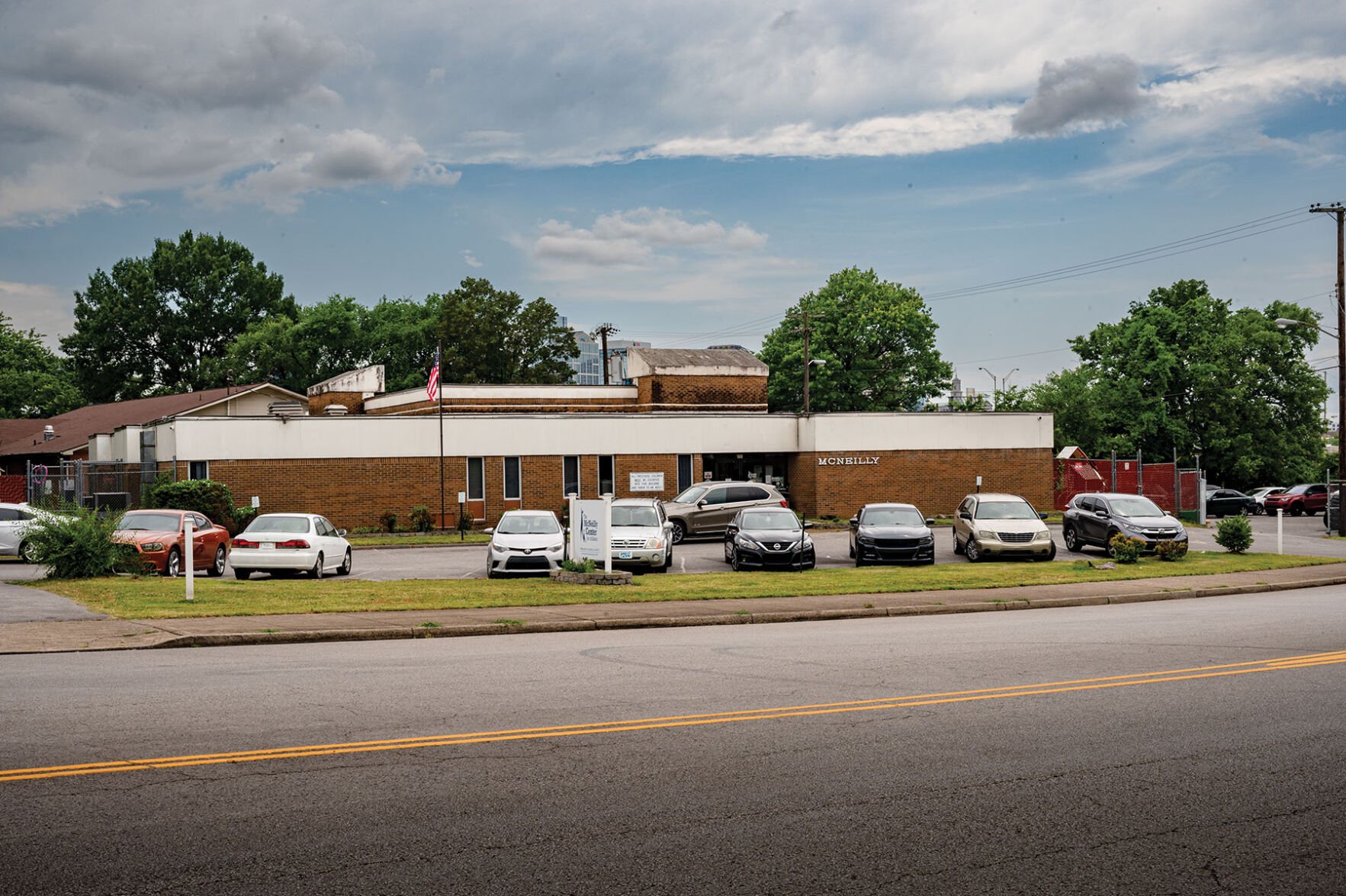

A few days after packing up her office at McNeilly Center for Children, the 107-year-old early childhood education center in McFerrin Park, Alyssa Dituro found out she had resigned. It was two years after she started as the site’s executive director and exactly a year since she learned about a board plan to sell McNeilly’s land — 4.16 acres of prime real estate near the booming East Bank.
“My email signature said, ‘I’m no longer with McNeilly. I resigned May 17, 2023,’ which was weird, because I didn’t write that,” Dituro tells the Scene in early June. “There was no letter and no process — my staff was told I resigned. No one had a straight answer.”
She had left McNeilly that day in May under the impression that the board — or rather, a chosen subset of the board, led by chair Adam Jarvis — had given her a 30-day suspension from her duties as McNeilly’s executive director. The move by Jarvis and his colleagues followed almost a year of friction with Dituro, who managed the center’s day-to-day work. McNeilly has an annual operating budget of $2.6 million and provides low-cost child care to a client base that is almost entirely low-income families of color in East Nashville.
Jarvis did not respond to a request for comment by the Scene. Board member Tommy Bethel, along with several other members of the board, declined to comment on Dituro’s departure or plans for a site redevelopment. Board member Marty Mayer could not be reached. Instead, the board offered a statement.
“There are no current plans to sell the McNeilly Center for Children,” the statement reads. “Unfortunately, very preliminary conversations about development opportunities were incorrectly shared with you. Ms. Dituro provided her resignation at the May 17 Board of Directors meeting. The Board accepted her resignation, and we have named an interim director while we begin a search for the next executive director.”
The board’s statement conflicts with documents reviewed by the Scene, including a PowerPoint presentation on real estate options. The board did not provide details about any ongoing real estate conversations or a letter of resignation from Dituro, both of which were requested by the Scene.
McNeilly is one of the city’s nonprofit crown jewels. It operates with funding from the city’s top charitable institutions, which see it as an example of what nonprofits should do: provide direct, critical services to people who need them. Dituro’s abrupt departure has left unanswered questions swirling among the city’s major funders as well as her own staff, who now field calls from those same funders curious about the future and stability of the organization.
Sitting just across from RiverChase Apartments, McNeilly used to provide child care for many RiverChase families until the complex was razed last year following a prolonged fight between developers and community members wary of the displacement of low-income families. McNeilly still serves lots of families who live nearby in Sam Levy Homes, an MDHA property.
The center owns its own land, which was appraised by Metro at $5.6 million in 2021. Since then, area real estate value has climbed to new highs. A massive revamp of the neighboring East Bank — centered on a new domed $2.2 billion Titans stadium — and in-progress plans for surrounding land, like for the former RiverChase site, have developers sizing up every parcel in the neighborhood.
“McNeilly is prime real estate,” says a board member who spoke to the Scene on the condition of anonymity. “That whole block where McNeilly Center is located, you probably have every property owner being courted heavily or solicited to sell. But we’re talking about a child care center that has been there over 100 years. Losing that would be to the [detriment] of the entire community.”
Jarvis, the board chair, sent out nondisclosure agreements to his board regarding Dituro’s departure. Some have signed, some have not. Many are still confused about what exactly has gone on between board leadership and their executive director.
A year ago, Jarvis, along with fellow McNeilly board members Bethel and Mayer, took Dituro to see Salama Urban Ministries’ new home on the ground floor of Hillside Flats, a mixed-use income-restricted project developed in 2021 by local real estate giants Elmington Capital Group. The same group could take over McNeilly, Dituro was told, and leave room for a child care center while also exploring apartment units and retail space.
She urged the board to consider other options, like working with Pillars Development, a Black-led real estate firm, and going more slowly, and keeping McNeilly’s mission at the center of any plans. Bethel, Mayer and Jarvis, all white, kept pushing the Hillside Flats vision and seemed to favor Elmington Capital. They asked Dituro to show up during non-working hours to show developers their land or to give them a key so they could access the building themselves.
“I have never heard of a board member having a key to the building in 10 years of nonprofit work,” says Dituro. “What they needed and wanted didn’t make sense for us, nor did it make sense for us to move so quickly. We had discussed some rejuvenation and revitalization initiatives with the people who bought RiverChase. We had begun working with local developers, like Pillars, to come up with some plans that would preserve the center. My development director was considering a capital plan. We were trying to keep McNeilly’s mission and feedback from our families at the center of everything we do.”
At three more quarterly meetings through the fall and winter, the board formed a real estate committee — headed by Bethel, Mayer and Jarvis — to explore development options. The committee took another field trip to Hillside Flats in March. Few if any updates came back to Dituro, who realized some potential developers had connections to board members via Ensworth, a private school in West Nashville. She contacted the Center for Nonprofit Management and the Nashville Center for Conflict Resolution and pushed for anti-bias and conflict-of-interest measures, as well as guidelines to address what Dituro considered racist language and actions directed toward her, a Black executive director, by the majority-white board.
Dituro says Jarvis dismissed her suggestions and cast her approach as evidence of harassment and bullying, prompting his own investigation, which he carried out on behalf of the board. The tensions built to a closed-door board meeting on May 17, attended by a fraction of the board’s 26 listed board members.
After handing down Dituro’s suspension, Jarvis followed her to McNeilly, where she gathered personal items from her office.
“When I saw the police outside of McNeilly, I thought there must be an active shooter in the area,” Dituro recalls. “They told me someone had called in a disturbance. I realized they were there for me.”



Post a comment as anonymous
Report
Watch this discussion.
(0) comments
Welcome to the discussion.
Log In
Welcome to the discussion.
Keep it clean. Please avoid obscene, vulgar, lewd, racist or otherwise abusive language. Comments featuring hate speech or threatening or violent content will not be tolerated.
PLEASE TURN OFF YOUR CAPS LOCK.
Be truthful. Don't knowingly lie or mislead.
Be proactive. Use the “report” link on any comment that violates our comment policy.
Share with us. We'd love to hear your feedback.