
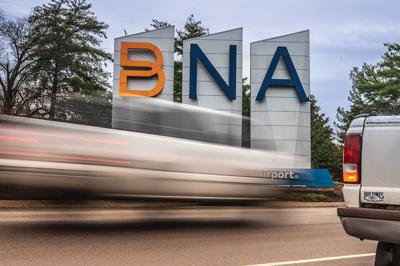
The Nashville International Airport’s Department of Public Safety has used a controversial artificial-intelligence-powered facial recognition system since May 2020, according to a spokesperson for the Metropolitan Nashville Airport Authority. The company providing the technology — Clearview AI — has faced intense legal scrutiny since around the same time airport public safety began working with it.
“Identifying suspects or persons of interest can be a challenge during an investigation,” MNAA spokesperson Charlotte Weatherington tells the Scene via email. “Clearview AI was adopted as a tool to help generate investigative leads, allowing DPS to identify individuals more efficiently and support its commitment to safety and security for the community.”
Procurement records obtained by the Scene in a public records request show the airport’s Department of Public Safety renewed its contract with Clearview AI for three years and $17,600 in January 2024. The contract will expire on Dec. 31, 2026, and will automatically renew for one year unless BNA or Clearview AI cancels it.
Records reviewed by Knoxville’s WUOT 91.9 FM and the Appalachia + Mid-South Newsroom from earlier this year show BNA police have run more than 1,600 facial recognition searches since the start of 2025. WUOT reported that BNA public safety conducted searches for several other federal, state and local law enforcement agencies, including the Metro Nashville Police Department, Franklin Police Department, the U.S. Secret Service, Tennessee Highway Patrol and the Tennessee Bureau of Investigation.
BNA public safety’s use of Clearview AI isn’t exactly a well-guarded secret. Clearview AI has a case study on its website about how BNA public safety used the software to help investigators at Kentucky’s Louisville Muhammad Ali International Airport solve a rental car theft case. The case study is undated and does not indicate when Clearview AI was used in the investigation.
Based in New York City, Clearview AI was founded in 2017 and uses a proprietary algorithm that matches faces to a database of more than 70 billion images scraped from the internet. Many of the images, including those from social media, have been collected without users’ consent and used to train the company’s AI. The company kept a low profile until 2020, when The New York Times published an exposé on the firm, unleashing a wave of lawsuits. In July, a federal appeals court overturned an approved $51.75 million equity-based settlement against the company to resolve nationwide privacy claims. The panel returned the case to the federal district court in Illinois that approved the deal, where the parties can seek approval for an amended settlement.

Looking at how real-life Metro employees are keeping these tools safe and accurate
While it’s often unclear which law enforcement agencies use Clearview AI, the company has claimed at various times that it provides its software to more than 3,100 law enforcement agencies in the U.S., including local and state police and federal agencies like the FBI and U.S. Immigration and Customs Enforcement. A separate 2022 legal settlement with the ACLU prevents the company from selling its software to most private companies and individuals. Law enforcement and government agencies are still permitted customers under the settlement’s terms.
Jake Laperruque is deputy director of the Security and Surveillance Project at the Center for Democracy and Technology, a nonpartisan civil liberties nonprofit. Laperruque says local police departments use facial recognition in several ways, though some of the more frightening uses — such as real-time video facial recognition monitoring used by New Orleans police through an organization called Project NOLA — are rare in the U.S. A more common use, which is what Clearview AI provides, is identifying suspects in a search-engine-like database.
“You have a crime scene photo of someone — you don’t know who they are, so you run it to get leads,” Laperruque tells the Scene.
Weatherington says only authorized airport public safety personnel may use the facial recognition system. They must comply with the Clearview AI user agreement and acknowledge its terms each time they sign in.
“Investigators ensure that images and data produced through facial recognition technology are used only as investigative leads to help identify an individual,” Weatherington says. “Investigators are required to use all available resources to validate investigative leads, including government‑issued or regulated photographs and identification systems. They also consult additional databases to find corroborating or exculpatory evidence when working to identify suspects in criminal cases.”
When asked why airport public safety ran searches on behalf of other law enforcement agencies such as MNPD, Weatherington says DPS supports partner law enforcement agencies when appropriate and as resources allow.
“Different agencies have access to different tools and databases, and sharing information is a routine part of modern policing,” Weatherington says. “These requests are handled as professional courtesy and collaboration. There are no formal agreements in place.”
Laperruque says most people today encounter facial recognition in their daily lives, like unlocking their phones or at TSA security screening at airports. “But I think there’s still a lot of opacity about which police departments use it and how they use it for law enforcement,” Laperruque says. “A lot of that is by design. Police departments try to keep its use hidden, not disclose it to defendants, and avoid having it debated in court or in the public square. So it’s important to get clear answers from cities and police departments about whether and how they’re using this tech, because it’s just as invasive and powerful as license plate readers. Probably more so.”



Post a comment as anonymous
Report
Watch this discussion.
(0) comments
Welcome to the discussion.
Log In
Welcome to the discussion.
Keep it clean. Please avoid obscene, vulgar, lewd, racist or otherwise abusive language. Comments featuring hate speech or threatening or violent content will not be tolerated.
PLEASE TURN OFF YOUR CAPS LOCK.
Be truthful. Don't knowingly lie or mislead.
Be proactive. Use the “report” link on any comment that violates our comment policy.
Share with us. We'd love to hear your feedback.