

Bedford County’s Zoning Board of Appeals held a contentious meeting on Sept. 17 that could have come from a Grisham novel. At three hours and 20 minutes, it ran 30 minutes longer than Christopher Nolan’s The Odyssey. At issue were two plots of former farmland — one on Fairfield Pike and one on Tennessee State Route 64 — each containing industrial-scale limestone excavation. In defiance of local zoning law, Hawkins and Price, a construction company, and Matthew Allen, owner of a trucking firm, had run unpermitted quarries on these properties for two years.
How did they manage this? By calling their operations “farm ponds.”
They relied on the Tennessee Right to Farm Act, a 1982 law designed to stop citified neighbors from using zoning laws to block normal farm activities. The act allows owners of A1 agricultural property to make farm improvements without pesky zoning or permits. One allowable improvement is a “farm pond” for livestock. Hawkins and Allen both run cattle on properties elsewhere (among other business interests).
“By completely bypassing the standard public rezoning process, residents were stripped of their right to due process and a fair voice in what happens in their own community,” Jenny McKee, one of two local residents leading a fight against these quarries, tells the Scene.
Although not a courtroom, the meeting room of the historic courthouse on the Shelbyville square was packed. Aggrieved residents gave impassioned speeches, saying the blasting damaged their homes and rock dust damaged their lungs. They complained of heavy trucks damaging local roads. Lawyers spoke for both sides, presenting visual displays and complex legal arguments.
Nine days before the meeting, I ventured to one of the “ponds” in person. Tall gravel mounds blocked casual highway views, but McKee and I caught a wild ride to the backside of the Fairfield Pike quarry for a close look. The concerned owner of a nearby forested tract drove us in his Gator side-by-side. Bouncing down rutted trails, we passed limestone outcrops and at least one cave entrance before stopping at a fetid pool. The owner said the water leaked out of the quarry, and he was awaiting tests on it from the Tennessee Department of Environment and Conservation.
We hiked toward the roar of machinery, pushing through brambles to barbwire at the edge of the property. Beyond giant rock slabs, we saw an excavator scooping gravel to dump into awaiting trucks. An industrial rock-crusher the length of three 18-wheelers spewed a steady fountain of water, evidently needed to crush rock. The water pooled in a stream that flowed toward the property where we stood.
“What am I looking at?” I asked McKee.
“It’s not a pond, and it’s not a lake,” she said. “That is a quarry, and it’s completely unregulated.” Citing a Tennessee Supreme Court ruling, she also said industrial rock-crushers are illegal on land zoned A1 agricultural.
As we bounced back through the woods, our guide said his property eventually discharges into Garrison Fork, a tributary of the Duck River — Tennessee’s most biologically diverse waterway. Like other quarry neighbors I spoke with, he did not want his name in print. Few in Bedford County seem willing to cross the Hawkins family.
Think the Duttons of Yellowstone or the Ewings of Dallas — on the scale of a Middle Tennessee county with a population of 50,000. Chuck Hawkins runs Hawkins and Price LLC with his brother Chris in what the company website lists as commercial and residential construction, excavation, asphalt paving, underground utilities installation, real estate and several other services.
“Allen, Hawkins, Price and [Greg] Curl are all related,” McKee says. “Four branches, one tree. This granddaughter married that grandson.” She explains that Greg Curl sits on the board of a political action committee supporting county candidates willing to back Hawkins.
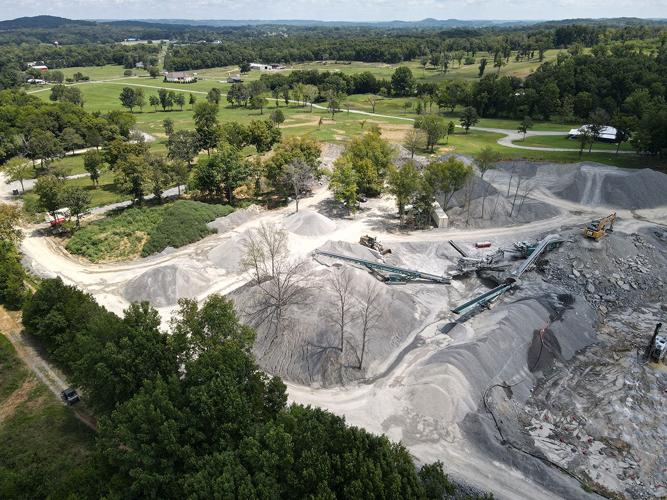
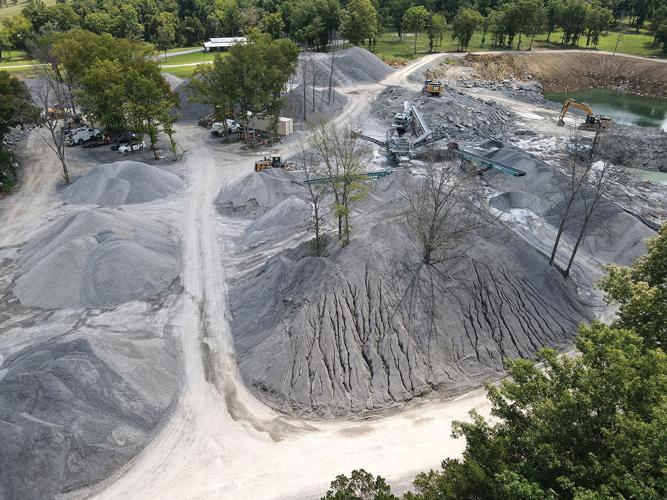
McKee and I took cellphone photos and videos. She would blow up some of these for meeting displays. Tonya Austin, a lawyer representing the pond owners, implied that McKee’s photos — along with drone shots taken from a neighboring farm — were all months old, taken before the ponds were “completed.”

Fairfield Pike drone shot
Austin passed photos to the board on Sept. 17. “This is what it looks like as of yesterday, and it very much looks like a pond.” She held up shots of cattle drinking what she called “water trucked from the Fairfield pond” the day before.
She appeared surprised moments later when Jason Holleman, the lawyer for three neighbors challenging planning director Chris White’s decision that the quarries were ponds, stepped to the podium to say these images were less than two weeks old.
Beyond the three named clients, others spoke against the quarries that night, including some who had been hesitant to be quoted a week earlier. Among them was 80-year-old Charles Shoemake, who suffers from both leukemia and prostate cancer. He said the rock dust “was killing him.” Kerry O’Brien, a nearby resident running a cow-calf production herd, said, “Our house was shaken by a violent force we thought was an earthquake.” He said his next water bill revealed usage had jumped from 13,000 gallons a month to 50,000 due to a crack in his swimming pool.
Three hours and 19 minutes in, zoning commissioner Greg Vick requested a 30-day pause to let Hawkins and the rest investigate claims made that night. He received no second. The board voted 4-1 to overturn planning director White, meaning the quarries are no longer ponds. White sent out a stop-work order the next day.
Hawkins and Price LLC did not respond to requests for comment. McKee and Holleman expect the quarry operators to appeal.



Post a comment as anonymous
Report
Watch this discussion.
(0) comments
Welcome to the discussion.
Log In
Welcome to the discussion.
Keep it clean. Please avoid obscene, vulgar, lewd, racist or otherwise abusive language. Comments featuring hate speech or threatening or violent content will not be tolerated.
PLEASE TURN OFF YOUR CAPS LOCK.
Be truthful. Don't knowingly lie or mislead.
Be proactive. Use the “report” link on any comment that violates our comment policy.
Share with us. We'd love to hear your feedback.