
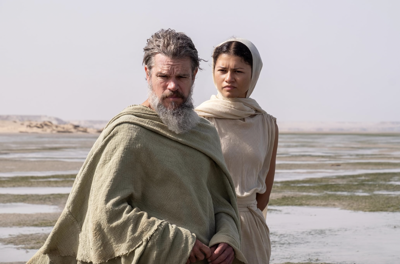

Christopher Nolan knows only one mode of operation: gigantic.
But this hasn't always been the case. Hollywood’s biggest current name brand at the box office broke through with small, noirish puzzle boxes like Memento and Following. But ever since he helped kick-start the gritty-reboot movement with 2005’s Batman Begins, Nolan has had a fascination with large-scale cinema, the bigger the better. His latest, The Odyssey — opening wide this week, including on 70 mm IMAX at Regal Opry Mills and on 35 mm at the Belcourt — is his biggest swing yet.
After sweeping the Oscars and earning just shy of a cool billion with 2023’s Oppenheimer, Nolan was handed a blank check, which he decided to cash by making a nearly three-hour adaptation of Homer’s epic (with elements of other ancient Greek mythology texts sprinkled in). For a filmmaker so forward-thinking and original, adapting one of humanity's most familiar stories was a curious decision. But once you see The Odyssey on a big screen, you’ll understand why Nolan was called to the text. The scale is truly staggering; there’s no one left making movies of this size in this way.
We have indeed come to expect this epic brand of storytelling from Nolan. The only surprise here is how horror-tinged and ... weird it gets. Despite his reputation for cold formalism, Nolan has dipped into the weird on occasion in the past, sneaking a bit of oddness into his precise matryoshka dolls — think the Freudian psychology of the dream levels in Inception or everything David Bowie does in The Prestige. He’s also dropped in touches of horror here and there, as with Interstellar's jump-scare or the momentary hallucinations in Oppenheimer.
But The Odyssey turns both those dials up significantly, often at the same time. Spoiler alert (if you're unfamiliar with the ancient text): There are witches, sea monsters, Sirens, dead soldiers rising from Hades and a giant cyclops. This is Nolan by way of Sam Raimi. When Samantha Morton (Minority Report) shows up as Circe, buckle in. I didn’t know Nolan had that level of gnarliness in him.

Christopher Nolan’s thrilling historical epic opens wide Friday
But the journey isn’t a nonstop thrill ride. The first 30 minutes are dense, as Nolan packs in as much backstory as possible. (There’s a reason Homer’s epic was considered unfilmable.) As always, there are framework and timeline machinations to digest. It takes a good 40 minutes for the story to really find its groove. But once it does, the set pieces are relentless.
There's an immense amount of talent on display here. Oppenheimer had a similarly stacked cast, but its handful of major stars was balanced out by one of the deepest character-actor benches of all time. Though every scene in The Odyssey features multiple Oscar winners or A-listers, many of them are on screen for only a few minutes.
Matt Damon leads the charge as Odysseus himself. In his third outing with Nolan, Damon proves capable of shouldering an outsized story. Tom Holland makes the most of his best non-Spiderman role yet as Telemachus, Odysseus’ son. And Anne Hathaway (also in her third Nolan feature) plays Penelope, Odysseus' wife, with vigor. The rest of the cast is a red-carpet role call: There’s Robert Pattinson, scuzzing things up as Antinous. Oh, and there's Charlize Theron, perfectly cast as Calypso. Wow, it’s Zendaya as Athena! Is that Lupita Nyong'o playing two different characters?
But a trio of performers stands out among the overqualified crowd: John Leguizamo as Odysseus' faithful servant Eumaeus, Himesh Patel (in his second Nolan film) as Odysseus' right-hand man Eurylochus and Elliot Page (back with Nolan for the first time since Inception) as a loyal Greek soldier named Sinon. These three add a level of pathos that could easily slip through the cracks as the fantastical sequences and narrative tricks interweave.
It’s fascinating that Nolan decided to follow up Oppenheimer with another story about a “great man” who, despite his best intentions, grows to regret what he has unleashed upon the world. The way Nolan brings these ideas full-circle makes for an emotional knockout, and a clever subversion of what audiences have come to expect from stories like these. Despite its gigantic scope and familiar trappings, The Odyssey leaves room for hope.



Post a comment as anonymous
Report
Watch this discussion.
(0) comments
Welcome to the discussion.
Log In
Welcome to the discussion.
Keep it clean. Please avoid obscene, vulgar, lewd, racist or otherwise abusive language. Comments featuring hate speech or threatening or violent content will not be tolerated.
PLEASE TURN OFF YOUR CAPS LOCK.
Be truthful. Don't knowingly lie or mislead.
Be proactive. Use the “report” link on any comment that violates our comment policy.
Share with us. We'd love to hear your feedback.