
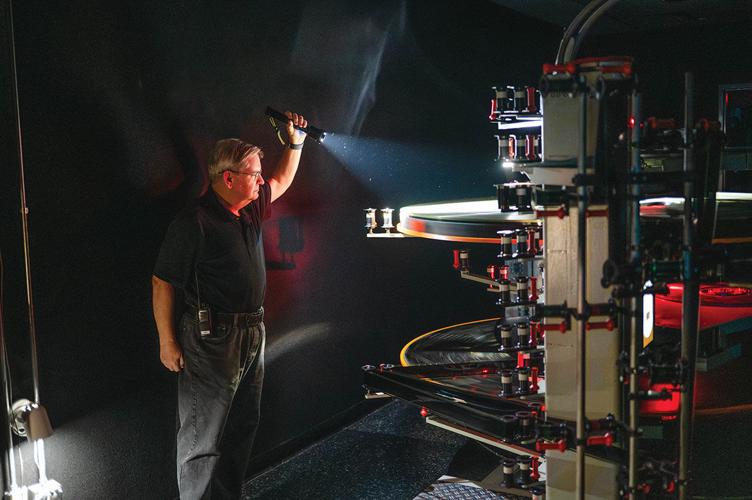

If you’ve had trouble securing a ticket to The Odyssey in IMAX, you’re not alone. Regal Opry Mills is one of roughly 25 theaters in the U.S., and 41 worldwide, with the capability to show Christopher Nolan’s blockbuster epic the way it was meant to be seen: in IMAX 70 mm.
The Regal Opry Mills was the fifth-highest-grossing IMAX 70 mm theater in the country during The Odyssey’s $124 million opening weekend, bringing in the biggest haul outside of Los Angeles or New York City. The theater has responded by booking showtimes as early as 7 a.m. and as late as 3 a.m. (Or as early as 3 a.m., if you’re a nauseatingly early riser.) But because shooting — and screening — movies on celluloid fell out of fashion for decades prior to its recent resurgence, 70 mm projectionists are hard to come by. Regal Opry Mills had to fly in two specialists to run the projector in 12-hour shifts.
“There was a period there of a decade or two when film was kind of going by the wayside,” says projectionist Dean Fick. “But now it’s coming back.”

Dean Fick
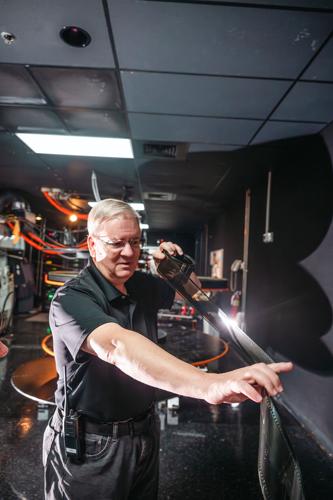
Fick has run IMAX projectors at locales ranging from The Smithsonian to the amusement park Cedar Point. Now the Ohio native has found his skills in demand thanks to the box office success of films like The Odyssey and Denis Villeneuve’s Dune series — so much so that he was “voluntarily” pulled out of retirement by Regal.
“It’s a great opportunity for me, because I get to come here and share my expertise that I’ve developed over the decades,” says Fick in the projection booth at the Regal Opry Mills prior to another nearly sold-out screening. “Some people like boats, some people like trains. … For some reason, of all the things I saw as a kid, film projection just clicked with me.”
While the whirring sound of a physical film reel might send movie enthusiasts’ hearts into a flutter, Fick thinks of the process less romantically.

Christopher Nolan’s big-screen fantasy adaptation opens Thursday at the Belcourt and Regal and AMC locations
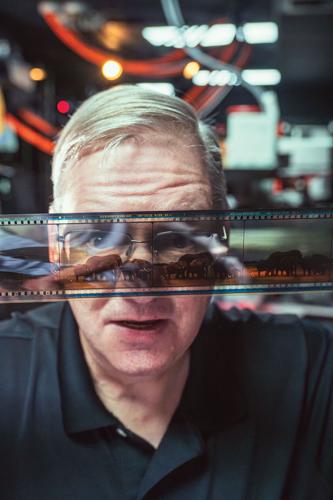
“It’s sort of like a trade,” he says. “I’m a film fan, but I’m more interested in the mechanical and technical side than I am the artistic side. … I like making the equipment work to the absolute best that it possibly can, whether that’s cleaning lenses, making the picture as sharp as it can be, as steady as it can be — that’s the part I like knowing how to do.”
The reel itself weighs roughly 500 pounds, and the film spooled on it stretches more than 10 miles from end to end. When the lights go down and the film begins to wind through the projector, being in the booth can feel as though you’re inside a submarine or a spaceship.
In the early 2010s, DCP (digital cinema packages) replaced traditional 35 mm film prints as the go-to format for theaters across the country due to its cheaper production. Nashville’s Belcourt Theatre is currently showing The Odyssey on 35 mm. Meanwhile, 70 mm has an even higher resolution and a wider aspect ratio, making the picture clearer and larger than the typical digital format. IMAX 70 mm pushes things even further, and The Odyssey is the first movie in history to be shot entirely in that format.

It takes a skilled practitioner to keep the train running, so to speak. With roughly six showtimes a day for the nearly three-hour movie, there hasn’t been a lot of time for Fick to explore Nashville.
“Maybe I’ll stay an extra week or so and look around, because it’s a really great town,” says Fick, who also served as the projectionist at the Regal Opry Mills for March’s IMAX 70 mm screenings of the charming Ryan Gosling space adventure Project Hail Mary. “I love it here.”
Fick might have another opportunity to spend some time in Music City — the highly anticipated Dune: Part Three will begin screening in IMAX 70 mm in December. He’s not sure yet whether he’ll be back in the projection booth at Opry Mills.
“We’ll see. If I am invited, I will certainly come back.”



Post a comment as anonymous
Report
Watch this discussion.
(0) comments
Welcome to the discussion.
Log In
Welcome to the discussion.
Keep it clean. Please avoid obscene, vulgar, lewd, racist or otherwise abusive language. Comments featuring hate speech or threatening or violent content will not be tolerated.
PLEASE TURN OFF YOUR CAPS LOCK.
Be truthful. Don't knowingly lie or mislead.
Be proactive. Use the “report” link on any comment that violates our comment policy.
Share with us. We'd love to hear your feedback.