
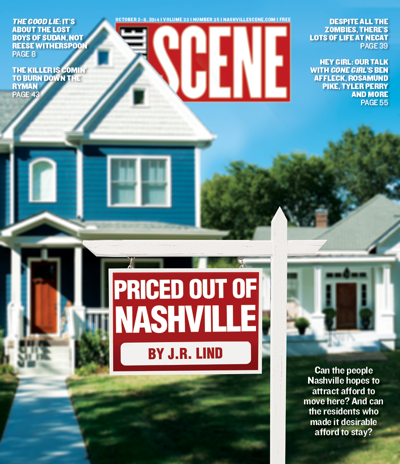

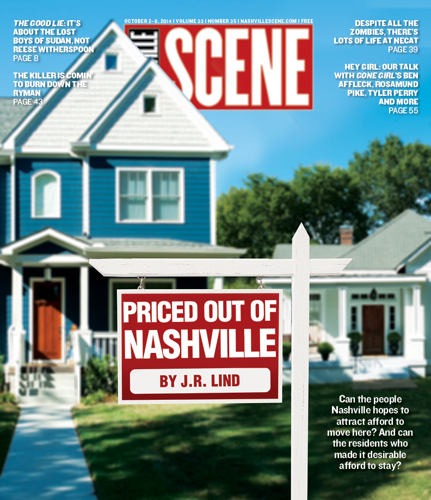
Nashvillians of a certain age know there's a "right side" of Gallatin Road. It's the side that's closer to the river, the side that's historically had higher property values. It's the side that's closer to parks and views of the Cumberland than to what used to pass for amenities across the busy thoroughfare — an old asylum, a prison facility.
There's a charming cottage at 3922 Baxter Ave. Built in 1926, it's a 1,310-square-foot cube of cuteness. But it requires a left off Gallatin Road at Inglewood Baptist Church — and thus it's on the wrong side of Gallatin. "The other side of Gallatin," as natives would have said two decades ago, their voices dropping to add the italics. In the old days, that would have left poor 3922 Baxter Ave. forsaken, clutching its wilted corsage at the dance.
But the home sold this summer. That in itself isn't surprising: This particular part of town has been on the verge for years. As part of the broader East Nashville construct — and the even broader Fashionable Nashville construct — Inglewood is one of the city's hottest neighborhoods. The house at 3922 Baxter sold for $67,500 in 2005. One year and a significant renovation later, in 2006, the most recent seller bought it for $114,000.
Just weeks ago, however, 3922 Baxter sold for $219,000 — smack in the middle of prices for home sales in August. Real estate developers and house flippers are learning that when it comes to Nashville's booming housing market, there are fewer and fewer "wrong sides."
The problem is, those hoping to find appealing, affordable shelter on either side of the river are finding it just as scarce.
Nashville's hottest neighborhoods are hotter than ever. That includes Inglewood, even on what was once the Other Side of Gallatin. Those lucky enough to own property there — or in Sylvan Park, or any of the other enclaves that have benefited from Nashville's sudden onset hipness — can very literally just throw open the doors and wait for offers to land in their laps.
The home at 3922 Baxter is a recipient of that good fortune. The cottage had four days of showings, and the seller then reviewed all offers at once. It listed for $199,000. The winning bid was $20,000 more.
The price, of course, is still affordable for a solid middle-class earner looking for a starter home. But in less than a decade, the price of 3922 Baxter jumped by nearly $150,000. It jumped $20,000 before the ink was dry on the "For Sale" sign.
Nashville is coming to terms with its newly desirable status. With that maturity come tough questions that have to be answered. Affordable housing and low rents were common bullet points on coastal publications' lists of reasons why Nashville is a great place to live. But those cool, affordable neighborhoods are becoming less affordable. And as they get less affordable, they get less cool — priced out of range of the street-level creative class, the urban pioneers and the working families who gave them their initial energy and character.
Now a delicate balancing act is underway. Longtimers are starting to wonder if there's a place in Nashville for them, or if they're victims of their hometown's success. Newcomers, meanwhile, lured by the siren song, are feeling crunched by low vacancy for rentals and spiking asking prices.
The very thing that made Nashville a desirable destination — its accessibility to all — is far from secure. Eventually, the pressure to house people is going to come to bear, and languid suburban neighborhoods on Metro's fringes will face tough questions about their future too.
Sometimes being It City is a bitch.
If we're looking at the side effects of Nashville's newfound popularity — including people never shutting up about it — it's best to start when the Awful It-ness was first appended. The Scene, in February 2013, made a sort-of-serious, sort-of-not attempt to pinpoint the moment, though no one else seems to have arrived at the same conclusion (roughly, the time of the Mound Builders). By and large, though, it's generally agreed that It Zero was an article in the Jan. 8, 2013, issue of The New York Times.
Since that time, the median home sales price in Nashville has shot up 20 percent.
Granted, that's a very macro view of the market. And it isn't totally out of sync with the national market over the same time frame — the S&P National Home Price Index shows an increase of 15 percent across the U.S. since the beginning of 2013. But the price pressure in Nashville is on a neighborhood level rather than citywide.
The real pressure is in the rental market. Back in January 2013, according to Zillow, the median rental listing for a house in Davidson County was $890 per month. In September 2014, it was $1,300 — an increase of 46 percent.
That blows the national number out of the water. In major cities, house rents are up just 4 percent since the beginning of 2013.
Apartment rentals have shown less staggering increases, but they are climbing nonetheless. The average monthly rent is up $45 from the beginning of last year, according to real estate research group Reis; the median is now $812.
Even more troubling is that while rents are skyrocketing market-wide, incomes aren't keeping pace with the increase. Despite what the smiles-and-thumbs-up gang at the chamber and in the mayor's office proclaim, real median incomes in Nashville have been essentially flat since 2010. As rentals increase, the rent check takes bigger and bigger bites out of the paycheck, but the check isn't growing to meet them.
Sometimes conventional wisdom is conventional because it's right. Ask 10 relatively well-informed Nashvillians where the city's hottest neighborhoods are, and you'll probably get a fairly accurate reflection of what the data shows. The list of neighborhoods with the biggest increases since 2013 on Zillow's Home Value Index is pretty much what you'd expect from a paratrooped Esquire dispatch.
In East Nashville: Eastwood is up 18 percent, Lockeland Springs 15. On the West Side: Sylvan Heights and Charlotte Park are up 14 and 12 percent, respectively. (It's important to note that the Charlotte Park stats include the Charlotte Park neighborhood — i.e., the streets named for Ford models — as well as The Nations, known to revisionist strivers and hustlers as "Historic West Town.") Germantown — like Lockeland Springs, already fairly expensive for a neighborhood close to downtown — is up 13 percent.
Eastwood — a floppy parallelogram formed by Eastland Avenue, Porter Road, Douglas Avenue and Gallatin Road — is near the top in the city in rental increases too. It's up 15 percent for the It City period (though the biggest increase was 17 percent in Shelby Hills, wedged between Shelby Avenue and the river). Greenwood, Eastwood's mirror image across the old mental barrier of Gallatin Road, is up 14 percent, as is Cleveland Park, the next neighborhood across Ellington Parkway.
All of these numbers tell a story — and that story is repeating across the city.
Say you're a person who wants to live in East Nashville. Homes in Lockeland Springs are too expensive to buy, so you look one neighborhood away in Eastwood. If you caught the market right, you might be able to find a home in your price range. If not, though, there's always another option — renting.
But as more people are forced up Gallatin and down market, homeowners look to sell — even ones who have rented out their homes for years with success. That has the dual effect of goosing sales prices and rental rates. Fewer places to rent in desirable neighborhoods raises the rent on available places. Meanwhile, quick-selling houses get ever pricier — until the market settles down, or the bubble bursts.
So our hypothetical home-seeker looks across Gallatin Road to Greenwood, where things are heating up enough that landlords feel comfortable raising rents (and that echoes across Ellington to Cleveland Park). Eventually, it will make more sense to sell in Greenwood. Rents will then go up there, then in Cleveland Park, then in, say, Talbot's Corner and beyond. The process will repeat until the housing stock is exhausted — or until suburban sprawl takes over, even though it's not nearly the problem in Nashville that it is in other Southern cities (hello, Atlanta!).
On the West Side, as Sylvan Park made the same transformation Lockeland Springs made, similar ripples were seen in Sylvan Heights, The Nations, and even as far afield as the Ford-model-named streets of Charlotte Park proper.
For now, this is working out. The neighborhoods undergoing the price and rent spikes are, frankly, fairly similar to the neighborhoods next up the chain. They tend to be stocked with either pre-war cottages or post-war industrial housing. There's little difference between the house you'll get at 38th Avenue and Dakota in Sylvan Heights, for example, and Robertson Road and Annex Avenue in Charlotte Park. It's fungible stock, and the amenities and access to the city are similar.
But eventually, what happened in already transitioned East Side neighborhoods and Sylvan Park will happen to the next wave. And demographers say Nashville is going to keep growing. That's an inevitability, we're told.
The problem is, they aren't making any more East Nashville, and they aren't making more Nations. People have to go somewhere — be they people who already live in these accessible, relatively affordable neighborhoods, or people who want to live there but won't be able to either because of low vacancy or high prices.
Eventually — it seems — those who relocate are all going to live in Bellevue or Antioch or Rivergate or Donelson. The in-county suburbs are already the beneficiary of value-seeking families and working-class singletons alike who can't afford to live close to downtown. Overcrowded schools, taxed roads and traffic snarls are already facts of life along the I-24 East corridor and I-40 West.
Or look at it from this angle. Last year, the average rent in Sylvan Heights was approximately $1,350 — roughly where Charlotte Park is today (and it was only two summers ago that a small two-bedroom in Sylvan Heights with a large fenced-in yard could be rented for $850). A year ago, the average rent in Charlotte Park was around $1,150. To get that value today, a renter would have to look farther up Briley Parkway near Brick Church Pike.
A year from now, it'll be somewhere else — likely North Nashville, which is already seeing spillover as Germantown and Salemtown fill up and price up. Those trendy neighborhoods are likely to seem even trendier, once the ballpark is complete in Sulphur Dell.
Interestingly, the largest increases in home prices are actually in neighborhoods north of the river around the TSU and Fisk campuses, such as Osage/Fisk, Elizabeth Park and Cumberland Gardens. In part, however, that's because prices were so low to begin with. The median price in Cumberland Gardens, north of Buchanan between 28th Avenue and Clarksville Highway, is up 20 percent — but only to $76,300.
The local market is starting to respond to a tighter world for renters. The cranes dotting the city bespeak a boom in apartment construction. Forecasters at Colliers say more than 5,600 units will be added to the city's supply by the end of 2014.
That's good, as Nashville's apartment vacancy rate has fallen from 6.8 percent to 4 percent in less than three years. To meet that demand, in the first few months of 2014, the city added 266 units at 23Hundred of Berry Hill and 64 units at Village Green Hills, a substantial increase to Nashville's supply of apartments.
Despite this, however, the second quarter of 2014 had the largest quarter-to-quarter rent increase in nearly two years. The city is indeed adding apartment supply, but almost all of it is in the luxury bracket — aimed specifically at high-earners, typically young and single, who'd likely not need more than two bedrooms and are happy in a studio, if the complex offers a sexy location and the right mix of amenities. A studio in The Flats at Taylor Place in Germantown rents for $1,200 to $1,340; a two-bedroom could set you back twice that per month.
Steve Cunningham, a 33-year-old junior developer who moved to Nashville six years ago, had been living in "a tiny 450-square-foot-ish apartment built into a house on Belmont." The only reason he was "enduring it," he says, was because the rent was only $650 per month, which included utilities. Plus he notes that he's a single musician and doesn't need much space.
Having finally landed a "real job" instead of just freelancing, Cunningham decided to look for something bigger. What he found was that anything in his price range — $900 per month — was gone by the time he saw the listing.
"I only ended up getting to look at three or four units out of the dozens of people I communicated with, not to mention others who were presumably too swamped to even respond to all inquiries," he says.
Eventually, he lucked into a place. After he inquired about one availability that fell through, the landlord told him there was something ready for immediate move-in that hadn't been listed yet.
"It has some bug problems (and had a leaky roof, I discovered after moving in), but is near Hillsboro and only taking about a third of my take-home pay instead of closer to half," Cunningham says.
As Cunningham discovered, there are still affordable options even in the core. But they are few, far between, and as hotly waitlisted as an Ivy League school.
Take Laurel House in the Gulch. A 13-year-old, 48-unit development at 11th Avenue and Laurel, it's operated by The Housing Fund specifically as affordable work-force housing. There are maximum income restrictions, and rent is tied to the resident's paycheck.
One of the first important projects in the redevelopment of the Gulch, Laurel House now sits near some of the priciest real estate in town. Just up the hill at the roundabout is the nearly complete 1505 Demonbreun, where the cheapest one-bedroom apartment will cost $1,450 — nearly three times what they cost at Laurel House. Down 11th Avenue is 11 North, where rents are similar.
Rent control isn't the only affordable option. Tony Giarratana's 22nd & State project is the first microhousing project in Nashville, featuring 145 tiny units — averaging 665 square feet, but some as small as 400 — complete with Murphy beds.
But while that's a great solution for a young person with few possessions and a steady paycheck who can't afford the upper-echelon apartment, it does nothing for a young family with a child. That demographic — families, particularly lower-middle-class working families — will feel the tightest squeeze in a post-It Nashville.
Nashville's median household income approaches $46,000. Using the classic 30 percent rule, that's $1,200 set aside for rent. That, as we've seen, is tough to find. A median family income of $56,000 puts the ideal rent at $1,400, which is more or less where Sylvan Heights is today — with its host of two-bed-one-bath, six-decades-old houses. But if the pattern holds, things will be higher there soon.
"Eventually we're going to run out of rich people to buy all the new luxury condos, right?" Cunningham asks wryly. "Nashville was appealing because of its relative cost of living, and attracted lots of transplants from other 'desirable' cities because they could live an urban life without being priced out. Once that goes away, so will likely go It City status."
People are moving back to the city, and that's good. A vibrant, bustling urban center has benefits both tangible and aesthetic. But high demand can homogenize a city into a glistening walled palace only for the wealthy, forcing workers to chase inexpensive living far from the benefits they helped make possible. If prices continue to rise, without a proportional raise in income or affordable housing, Nashville may learn there are more desirable things to be than It.
Email editor@nashvillescene.com.



