
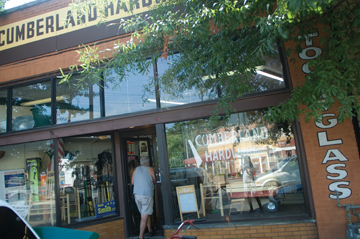

Step inside Cumberland Hardware, a small storefront facing onto the brick sidewalk that runs along Woodland Street, and the clock seems to have stopped sometime around 1950. A bell above the door sounds a bright ping! as you enter, immediately followed by the timeless smell of sawdust, oil and nails. Fraidy, one of the two store cats, barely lifts a white-booted paw as co-owner John Varallo consults with a customer about upkeep on the man's 80-year-old house.
It gets even more picturesque. The cash register, a bulky, ornate contraption that takes up much of the front counter, looks like something used to tally grubstakes in the Yukon. A vintage platform scale could be decorating a set on Mad Men. Row upon row of screws and bolts of all sizes take up the wall behind the counter—all for sale individually, Varallo says, "whether you need one screw or 100 screws." A movie set couldn't concoct a cozier hometown hardware store.
And yet, to translate this warm feeling into stark economic terms: Cumberland Hardware—a fixture of East Nashville for more than a century, a literal mom-and-pop enterprise, a single, independent, locally owned and operated store—is precisely the kind of business that consumers have been told is going to die.
For the past decade and longer, the steady drumbeat has gone something like this: Small business, the backbone of American commerce, is dying. Holding the smoking guns are the national chains and category killers, the Wal-Marts, the Home Depots, the Starbucks. They're sucking the life's blood out of communities and turning America into one colossal featureless, cultureless outlet mall. Right?
"Actually, [they've] been good for us," Varallo says, pausing between customers. "People can be in and out of here in five or 10 minutes." With old homes making up much of the surrounding neighborhood, he adds, he has lots of customers leaving their cars at home and walking the few blocks to his store.
One of those is Davilyn Cagle, a child therapist who lives a street over on Forrest Avenue and stopped in on a walk. Asked why she didn't just go to one of the several chain hardware stores in the Nashville area, Cagle says she thinks it's important to "keep the mom-and-pops in business."
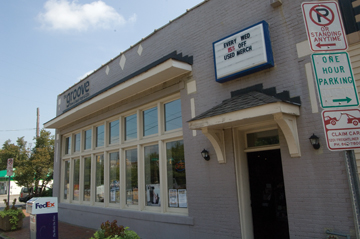
She's evidently not alone. East Nashville's Five Points, where Cumberland Hardware has resided for more than 100 years, teems with the kind of independent local enterprises imperiled by mass-market retailers and restaurants. Look east, across 11th Street, and there's The Groove—part of what is almost considered a dying breed, the independent local record store (see the story on p. 16). Around the corner, Jenny Piper's behind the counter at The Pied Piper Creamery, dishing out homespun alternatives to Baskin-Robbins. Across Woodland is Margot, where chef Margot McCormick has won a devoted following by focusing on local ingredients and suppliers (see the story on p. 18). A block away on Woodland stands the Turnip Truck, the independent health-food grocery that served as first home to the East Nashville Farmers Market.
That these businesses, and others like them from 12South to The Nations, have managed to weather a bust economy so far is remarkable enough. But there are signs that consumers in Nashville and elsewhere are making a conscious effort to buy local—to steer more and more of their business toward locally owned restaurants, boutiques, farms, clothing stores and music shops.
Of late, it's the big-box dinosaurs that have started to look vulnerable. Former Media Play and Linens 'n Things locations dot the landscape, once big boxes, now empty crates. Single-roof malls like Bellevue Mall and Hickory Hollow are flailing as mall customers gravitate toward less cumbersome shopping centers at Nashville West and the Avenue at Green Hills.
Meanwhile, independent local businesses are proving surprisingly adaptable to the scorched economic earth, zeroing in on neighborhoods and clienteles that aren't being served. The gaps between major retailers are leaving space for venues ranging from farmers' markets to Nashville-centered green boutiques that emphasize the environmental benefits of buying close to home (see story on p. 15).
"It's another form of voting with your dollar," says Eric Patrick of Foggy Hollow Farm in Joelton. His wife Audrey is active in Good Food for Good People, an organization that helps to make nutritious food available to underserved communities; together, they participate weekly in the new West Nashville Farmers Market on Saturdays in Charlotte's Richland Park. By bringing food closer and fresher to consumers, he says, the savings in transportation, storage and chemical treatment more than offset the slightly higher price.
"You can buy the cheap produce," says Patrick, who left his accounting job at Dell to start his family farm last December. "But there's a cost you're paying that's not in the cost of that food."
To be sure, none of these enterprises is going to drive the Walton family into bankruptcy anytime soon. Nor would anyone want them to: Local economies depend also on big employers, and working families depend on the discounts that volume-buying permits, for all the hidden costs that shore up those specials. Varallo readily admits that patrons can save a few bucks on certain items if they go to, say, Lowe's.
"Paint I can't touch 'em on," Varallo says. "They've got what you call 'loss leaders,' and I don't have enough room. I've got five aisles in here." But to hear his customers tell it, saving a few bucks isn't their only concern.
"My view on it is, this place has been through rough times when East Nashville wasn't booming the way it is now, and they stuck with it," says Mike Huffaker, a budget analyst who stopped in to check out Cumberland's display case of pocket knives. "We're sticking with them now."
The Internet, which dealt a crippling blow to entertainment retailers such as Media Play and Tower, has proved to be a useful organizing tool for supporters of independent local businesses. One Facebook page, Be Local, Buy Local Nashville, exhorts its 482 members to "spend our dollars supporting our Nashville neighbors instead of chain stores and restaurants."
"A lot of products we sell are things people could get cheaper off the Internet," says Elise Tyler, co-owner of the Halcyon Bike Shop in 12South, which repairs and sells used bikes, teaches a pro-bono bicycle-repair workshop with the Oasis Center and carries a widening array of Nashville-made music and products. "Our customers will research parts online, then come into our store and buy them or special-order them, knowing they're going to be paying more. They just want to help us out."
Halcyon Bike Shop is one of 13 Nashville businesses listed on the website for the 3/50 Project, an Internet meme that surfaced in the national media over the summer. Started by Minneapolis resident Cinda Baxter, the project encourages people to spend $50 of their monthly budget among three brick and mortar businesses in their hometown—on the assumption that if half the working U.S. population followed suit, the results would pump more than $42.6 billion in revenue into local economies.
But Tyler, 25, a native Nashvillian who opened her (first) business during the financial frostbite of last fall's plunge toward recession, believes that the benefits of buying local go beyond keeping dollars close to home. It preserves the things that keep Nashville unique—the historic hardware store, the heirloom tomatoes and beans specific to local soil, the music made and enjoyed every night in Nashville studios, clubs and honky-tonks.
"When I was a kid, there seemed to be this romanticism of giant retailers," Tyler says, chuckling. "Cool Springs—it was so fancy! So modern! Now a lot of West End is just one giant corporate street, and I think it's encouraged people to pay attention. Nashville is a small-town city, but the thing I've learned since opening the shop is that the variety of Nashvillians is unbelievable. Local businesses are fundamental to that."



