
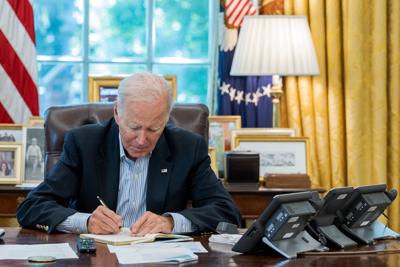

As the leader of the free world, one of the greatest challenges facing President Joe Biden is supporting our allies while encouraging humanitarian aid at the same time. At some critical junctures, the two are not mutually exclusive — that’s the tightrope walk Biden is currently navigating with his firm support of Israel, one of our greatest allies, and also his encouragement for humanitarian aid for the innocents caught between the Islamic terrorist group Hamas and the nation of Israel. Yet Biden is finding a way to accomplish both goals. This is unquestionably the mark of a strong and capable leader.
President Biden addressed the nation recently to inform American citizens of the challenges facing Israel and his intentions to fully support our ally, while also cautioning against the temptation to rush headlong into battle. He likened the situation facing Israel, after a horrific assault on their nation, to the United States’ response after the terrorist attack on Sept. 11, 2001. As President Biden said in his address to the nation on Oct. 19, 2023, “We’re facing an inflection point in history — one of those moments where the decisions we make today are going to determine the future for decades to come.”
Biden’s resolve to both support Israel and to deliver aid amid the growing humanitarian crisis in Gaza is commendable. In fact, Fox News analyst Brit Hume, whose conservative news media organization certainly is never one to rave over Biden’s addresses, stated that the president’s speech “may be remembered as one of the best, if not the best, speeches of his presidency.”
The challenges were many, and the risks were great — yet President Biden made his address only after first traveling to Israel to show unequivocal support for Israel’s right to defend itself against attack. At the same time, a second goal was to use the strength of the United States to help relieve suffering, negotiate for release of hostages and encourage an intentional and well-planned response. Biden compared the Israelis’ understandable shock and grief with the United States’ collective outrage after 9/11. He encouraged Israeli Prime Minister Benjamin Netanyahu and the people of Israel to learn from the United States’ experiences in seeking justice following an unprovoked and violent attack never seen on U.S. soil before or since. He reiterated the importance of remaining objective and focused in the midst of grief and the desire to seek justice. “When I was in Israel yesterday, I said that when America experienced the hell of 9/11, we felt enraged as well,” he said. “While we sought and got justice, we made mistakes. So I cautioned the government of Israel not to be blinded by rage.”
“Worry” is too weak a word to use in describing the rest of the world’s concern over the prospect of a war in the Middle East. You don’t have to be very old to know all too well that this region has been a powder keg for generations — the birthplace of Judaism, Islam and Christianity. Uneasy peace has been more common than outright war in the Middle East for a few decades, yet we are now standing on the precipice of a war between Israel and Hamas. In fact, as of this writing, Israel has now begun a full ground invasion of Gaza — marking the official beginning of war. Time will tell what the ripple effects will be of Israel’s understandable desire to respond to the unprovoked attack on their innocent civilians, but history will surely show that President Biden’s support of Israel and his equally strong support for humanitarian aid have been steadying and measured.
People of Jewish faith sometimes say the Hebrew phrase, “Shalom aleichem,” meaning, “Peace be upon you.” The irony is not lost that the same phrase in Arabic is nearly identical: “As-salamu alaykum.” Let us pray that the entire world will have peace upon us all as we stand at the precipice of war.
Bill Freeman
Bill Freeman is the owner of FW Publishing, the publishing company that produces the Nashville Scene, Nfocus, the Nashville Post and The News.



