
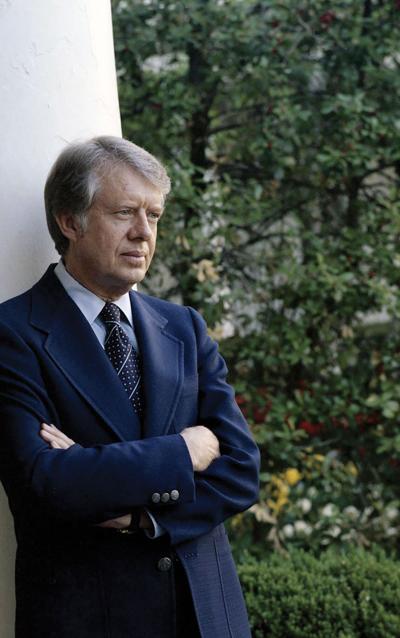


President Jimmy Carter in 1977
I was reflecting on the accomplishments of former President Jimmy Carter recently, as I saw the news of his attendance at last month’s Plains, Ga., Peanut Festival with his wife Rosalynn. He is the oldest living former president and a stalwart man of faith and practicality, and so I thought I would take the opportunity to review his accomplishments in office and honor his principles and the humanitarian work he has undertaken in the decades since.
President Carter was a rare breed of politician at the time he was elected — a Southern evangelical man of faith with progressive Democratic political ideals. Since his time in office, he has risen to be a global humanitarian with a reach that has benefited millions around the world.
His personal faith guided his decisions and his daily living, but he was careful to emphasize the importance of separating church and state. He was adamant about the danger of tying political ideals to personal faith. During his 2002 Nobel Peace Prize lecture, he quoted a teacher from his small elementary school in rural Georgia. He said his beloved teacher, Miss Julia Coleman, taught him this principle: “We must adjust to changing times and still hold to unchanging principles.”
America was undergoing rapid change and challenging economic times during Carter’s administration in the late ’70s and early ’80s. That era was marked by energy and economic woes. In many ways, the years of Carter’s administration bear similarities to today and our current challenges — the necessity of adopting alternative energy sources and our efforts to stabilize and grow the economy.
While President Carter faced domestic challenges greater than most of America’s post-war presidents, it’s the humanitarian work undertaken during office and significantly expanded after his presidency that is most impressive.
The Carter Center, which is President Carter’s greatest professional legacy, has operated since he and his wife Rosalynn first founded it in 1982 — wasting no time in beginning their humanitarian efforts after his years in office ended. The center’s mission is simple yet profound: “Wage peace, fight disease, build hope.”
The Carters and The Carter Center have worked diligently to fulfill that mission. They have worked to eliminate the devastating Guinea worm disease, making it “likely to be the first human disease since smallpox to be eradicated.” Their efforts to support democracy and fair elections are unheralded: They’ve supported 114 elections in 39 countries in the past four decades. These are just two items that The Carter Center can list among its many accomplishments. President and Mrs. Carter have devoted their lives to improving living conditions and bringing hope to the downtrodden.
I’d like to leave you with these profound words from our longest-living and longest-married former president. They sum up his personal mission as a man, a husband, a father and a public servant: “I have one life and one chance to make it count for something. … My faith demands that I do whatever I can, wherever I am, whenever I can, for as long as I can with whatever I have to try to make a difference.”
Those are truly words to live by. If we all could try just a little harder to be like President Carter, the world would undoubtedly be a better place.
Bill Freeman
Bill Freeman is the owner of FW Publishing, the publishing company that produces the Nashville Scene, Nfocus, the Nashville Post and The News.



