


"Nothing in this Constitution secures or protects a right to abortion or requires the funding of an abortion."
This is the first sentence of a proposed amendment to the state constitution. Known as Amendment 1, it is one of four items that you, as a Tennessee citizen, will vote for or against on the Nov. 4 ballot.
If you're wondering why you haven't heard much about Amendment 1, the drumbeats are coming. Opposing campaigns will soon flood the state with their respective messages just weeks before the election. While it's unlikely that either campaign will sway committed voters to switch positions, the opposing sides are instead reaching out to the undecided — through the filter of their differing points of view — about what the amendment really means and what could happen if it passes.
Proponents of "Vote No on 1" say that this is a privacy issue, and that the passage of Amendment 1 would create a dangerously slippery slope, enabling government interference into our private lives. Supporters of "Yes on 1" argue that this is a safety issue, and that current Tennessee law does not properly enforce the regulation of facilities that provide abortions in our state.
A political maneuver more than a decade in the works by anti-abortion legislators and community groups, Amendment 1 is a direct reaction to the outcome of the 2000 state Supreme Court case Planned Parenthood v. Sundquist. In that case, the court ruled in favor of Planned Parenthood, stating that the Tennessee Constitution guarantees the right of privacy, including a woman's right to terminate her pregnancy.
Thus far, the ruling has prevented the passage of many recently adopted restrictions on abortion — such as waiting periods, government-scripted counseling and stronger regulations on facilities — that other states have enacted. While the number of abortions performed in the state of Tennessee actually decreased by 6 percent between 2000 and 2010 — echoing a national trend — the number of abortions sought by women from other states, primarily the eight states that touch Tennessee borders, increased by 30 percent.
While the two camps argue whether the dispute is about privacy or safety, many Tennessee citizens are caught in the crossfire, conflicted over their personal beliefs regarding abortion and their desire to keep politics out of their personal decisions. As the debate escalates, this conflicted segment of the population may be the one that swings the vote on election day.
Once the ballots are cast, the Tennessee Constitution could be forever changed, along with a woman's ability to access safe, legal abortion in the South. For that reason, it's worth looking at the case law that has shaped the current legislative climate, what exactly is being determined in the vote, and the confusion that exists on both sides.
Forty-one years ago, the U.S. Supreme Court established a woman's right to access an abortion procedure in the landmark Roe v. Wade ruling. In 1992, the U.S. Supreme Court upheld this right in Planned Parenthood v. Casey, but the latter case gave states an expanded ability to enact specific legislation regarding abortion procedures within their own borders.
Today, U.S. states have varied and distinct laws on gestational limits, public funding, private insurance coverage, parental consent, mandated counseling and physician and hospital requirements. In Tennessee, a minor must have parental consent before an abortion can be performed; public funding for an abortion is available only in cases of rape, incest or life-threatening situations; and health care plans offered through the state's exchange via the Affordable Care Act do not cover abortion.
More than 200 restrictions surrounding abortion procedures were enacted in the U.S. in the past three years, resulting in the closure of many facilities that provide abortions. Depending on which side of the argument you're on, this is either ridding communities of unsafe clinics or prohibiting women from a judicially upheld right.
Amendment 1 continues:
"The people retain the right through their elected state representatives and state senators to enact, amend, or repeal statutes regarding abortion, including, but not limited to, circumstances of pregnancy resulting from rape or incest or when necessary to save the life of the mother."
If this passes, voters will give elected officials the power to make changes that haven't even been conceptualized yet. Jeff Teague, president and CEO of Planned Parenthood of Middle and East Tennessee — and a director of Vote No on 1, the campaign opposing Amendment 1 — says those changes would likely echo the legislation that nearby states have enacted, from increased strictures on facilities to extended waiting periods.
"The surrounding states have been passing a lot of really severe restrictions on abortion that have limited access to safe, legal abortion in those states," Teague says. "We saw what happened in Texas after they passed all the severe regulations there — it forced the closure of almost every abortion-providing facility in the state."
On the other side, Lorene Steffes, a coordinator and board member for Yes on 1, the campaign supporting Amendment 1, argues that Tennessee is out of sync with the region. While Tennessee has no waiting period, she points to the tightening regulations in neighboring states such as Missouri, which passed a 72-hour waiting period earlier this month.
"There are eight states that touch Tennessee, and all of them have a short waiting period," Steffes says. "Most of them, I think, are 24 hours. That's an example of where we're inconsistent with our neighboring states."
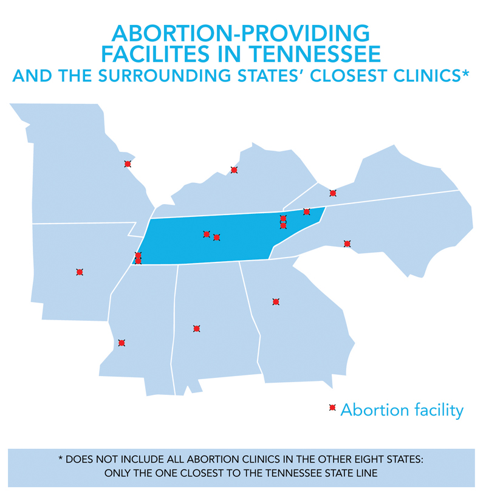
From the recent Esquire piece about the lone clinic providing abortions in the state of Mississippi, to the furor over newly crowned Miss America Kira Kazantsev's status as a former Planned Parenthood intern, the topic that nobody wants to talk about is suddenly on everybody's lips. But that's hardly making the procedure easier for women to secure. Teague says Alabama went from five abortion-providing facilities to three, and Kentucky now has only two facilities.
"The really severe restrictions and regulations they're putting in place don't do anything at all to improve the quality or the safety, or anything to protect the woman's health," Teague says. "They are solely designed to make it really difficult for women to access safe, legal abortion, or to make it difficult for providers to provide women with safe, legal abortions."
Tennessee has already passed some legislation along those lines. In March 2012, lawmakers passed the Life Defense Act, mandating that all abortion-providing physicians in the state have admitting privileges at a hospital within the county or the adjoining county.
"Despite the fact that they kept claiming that it was impossible for them to pass any regulation or restriction on abortion, the Tennessee General Assembly did pass an admitting privileges bill," Teague says. "At the time, we had nine abortion-providing facilities in the state. When that legislation went into effect and became law, two closed."
If performed during the first trimester, fewer than .05 percent of abortion patients in the U.S. experience major complications that would require hospital care, according to the nonprofit reproductive health organization the Guttmacher Institute, though the risk rises with the length of the pregnancy. Steffes says while she doesn't have data on how many life-threatening incidents have occurred at Tennessee facilities that provide abortions, she believes such facilities should be prepared for emergency circumstances.
"If there were an emergency, an ambulance could come an transport a patient easily, getting through the doors and around the corner, and so forth," she says. "I know that, sadly, if an abortion clinic does have to call an ambulance, it's very likely a life-threatening situation. So, to me, it's so important to be able to transport a patient to the hospital, should she need that."
Teague counters that "abortion is one of the safest medical procedures. In fact, according to the Centers for Disease Control, abortion has more than a 99 percent safety record." But Steffes says that the supporters of Amendment 1 are driven by concerns beyond just the safety of the mother. They mean to restore three regulations — "protections for women and the unborn," she says — that were passed by Tennessee lawmakers in the late 1970s but vanquished after the Planned Parenthood v. Sundquist ruling.
"First was informed consent, where it was required that they tell the woman specific things to be sure she had all of the facts in making such a critical and important decision in her life," Steffes says. "The second one was the 48-hour waiting period — after the initial consultation, the requirement to wait 48 hours before actually doing the procedure. I know when I want a medical procedure done, I can't just walk into a doctor and have him do the procedure the first time I meet him. There's always some time after you get some information, and then come back and schedule a time for the surgery."
The third "protection" involves licensing and regulation. And it confuses even people who keep watch, as the Scene found when we put the same questions to both sides.
Case law has done little to clarify matters. Planned Parenthood v. Sundquist was influential in that it led to the proposed amendment, but just as important (though less known) is a 2002 lawsuit, The Tennessee Department of Health v. Gary Boyle. Its roots were in the mid-1990s, when the state department of health approached Boyle, the owner of two private practices in Nashville and Bristol (both named The Women's Center) that provided full gynecological services including first-trimester abortions. The health department wanted to inspect his facilities and issue a license, arguing that his clinic was not a private practice but an ASTC — an ambulatory surgical treatment center.
That's a major distinction. At the time, Tennessee law defined any place or building where pregnancies are terminated as an ASTC. This status comes with many more equipment and design guidelines to meet the standards of emergency personnel — expensive guidelines that can shut down small clinics.
"That's the kind of thing — hallway width, ventilation systems, things they say are necessary to increase safety for women," Teague says. "They don't do anything to increase safety for women." Regulations also demanded that said centers obtain a "certificate of need" showing they provide a critical community service. When Boyle's Women's Centers continued to operate without one, the health department sued.
Boyle argued that department's demand for a certificate of need and, ultimately, an ASTC license not only bypassed the constitutional right of due process, but hinged upon a statute that lacked clarity. His defense zeroed in on an exemption to the regulations in the Tennessee Code. The only pregnancy-termination facilities that wouldn't qualify as ASTCs, it said, were "private physicians' and dentists' office practices, except those ... in which a substantial number of medical or surgical pregnancy terminations are performed."
The trouble is, it didn't specify what counted as "substantial." A quota? A limit?
The Tennessee Court of Appeals found the wording just as vague. It eventually ruled in Boyle's favor, stating that a private practice could bypass being classified as an ASTC only if the facility in question did not perform a "substantial number" of surgical procedures (i.e., abortions). And since the word "substantial" is certainly open to interpretation — the legal documents note the "vagueness" surrounding the issue — it suggests the court's inability to determine how many would require a private practice to be designated as an ASTC.
Those distinctions can be tough for advocates and adversaries alike to grasp. In an interview with the Scene, Steffes blamed the Boyle decision for removing "the right to regulate and inspect facilities that do surgical abortions," noting that "some of them are licensed, but they don't have to be, and half of them are not licensed to practice in our state." But after speaking with Brian Harris, president of Tennessee Right to Life and a coordinator for Yes on 1, Steffes called back to explain that the abortion-providing facilities in Tennessee that do operate as ASTCs — four in all — in fact require a specific license from the state department of health, the very license in question in the Boyle case.
Teague, meanwhile, says his Nashville Planned Parenthood facility is licensed by the Tennessee Department of Health. When asked if other abortion-providing facilities are regulated, inspected and licensed by the Tennessee Department of Health, he says, "That I don't know for sure. I don't know exactly what [the Yes on 1 camp is] referring to when they say 'unlicensed' and 'unregulated.' "
But while medical doctors must be licensed by the Tennessee Board of Medical Examiners to practice in the state, according to Shelley Walker, assistant director of communication and media relations for the Tennessee Department of Health, "[there] is no requirement for their private practice locations to be licensed or inspected."
In addition to providing licensure for and monitoring of ASTCs and health care facilities such as nursing homes and hospitals, the department of health inspects facilities such as restaurants, public swimming pools and tattoo parlors, all places where cleanliness should certainly be next to godliness. But with all private medical practices in the state of Tennessee operating autonomously — with no requirement from the department of health for licensure or inspection unless they perform a "substantial" number of surgical procedures — the department can't interfere with any of them until a complaint is filed.
Much of the information available online about abortion services is out of date. Currently, there are seven — or eight, depending on whom you ask — facilities in Tennessee that provide abortions. Both Teague and Steffes list clinics in Nashville, Memphis, Knoxville and Bristol, but Steffes includes a facility in Elizabethton, Tenn., northeast of Knoxville called Abortion Choice Clinic. The Scene's attempts to verify this seemingly easy-to-check detail show how difficult obtaining reliable information can be.
At press time, calls to that facility were met with a recording stating the number was disconnected. After calls to Abortion Choice Clinic were unsuccessful, the Scene tried calling an area hospital, Sycamore Shoals. Our call was perplexingly routed to the emergency room, where a staffer provided the same disconnected phone number we'd already called.
The staffer suggested we try nearby cities Johnson City or Bristol, but was not aware of any specific facilities we could contact. She also suggested calling the local office of the health department. When we asked whom we could try if that effort failed, she suggested we contact an OB/GYN office — though she cautioned, "I don't know if they'd be against it, but I would think they'd at least give you information."
A call to the Carter County Health Department eventually led to a staffer who told the Scene that an abortion-providing facility in Elizabethton is in operation — the province of one Edgar E. Perry, M.D. Additional searching revealed a practice associated with Dr. Perry called Applachan (sic) Ambulatory Surgery Center, listed at a physical address that could not be verified on a map.
But if you Google a different address — the one that still appears under outdated listings for Abortion Choice Clinic — you'll find the "family practice" of "Perry E E MD," with the same phone number. It leads to a recording that does not allow the option to leave a message. (That, and the Google Earth image of a Pizza Inn, located in Elizabethton's West Towne Plaza Shopping Center.)
Shortly before press time, the Scene tried the number again. This time a woman answered, "Dr. Perry's office." When asked if someone could schedule an abortion procedure, she replied, "No, we don't do that here anymore." Told that the county health department had given out their number with the understanding that they did, she said, "I don't know why they're all telling you that. We have not done abortions here since 2009."
Does anyone else in Elizabethton? To her knowledge, she said, no.
The Scene called both Boyle's Nashville Women's Clinic and the Nashville Planned Parenthood branch to see if we could visit each facility. The woman who answered the phone at Boyle's clinic declined, explaining that they "don't do that" there.
But Planned Parenthood readily opened its doors. The Planned Parenthood facility — a licensed ASTC — looks like any other doctor's office, maybe even a bit nicer. Located just off Charlotte Avenue on Dr. D.B. Todd Jr. Boulevard, the building was renovated earlier this year. The floors are covered in brightly colored tile; the walls bear the same informational posters you'd see at any gynecologist.
Downstairs, the facility offers women's health services, including routine physicals, pap tests, breast exams, STD testing and treatment. Upstairs, it offers a service that is becoming increasingly difficult to procure elsewhere: surgical and medical abortion procedures, the latter being the non-surgical RU-486 pill, administered by a health care professional. The spaces designated for surgical procedures look exactly as you'd expect: clean and utilitarian.
Nearby rooms offer private areas for counseling, including the one-on-one delivery of medical consent, in which a health care professional explains to the patient the details, risks and outcomes of the procedure. A recovery room is lined with comfortable chairs and blankets. Before women leave the facility, they are asked to make a follow-up appointment and are given a phone number providing 24-hour access to a nurse practitioner, should any questions or concerns arise.

Anyone who can get to downtown Nashville can get to Planned Parenthood. But with most abortion-providing facilities located solely in metropolitan areas throughout the South, there's already an access issue for rural and low-income women. Enacting waiting periods will incur more time off work and more funds spent on travel, lodging and child care, and Teague says the passage of harsher restrictions could also have much larger geographic repercussions.
"Right now Tennessee is the only state in the South that has any sort of constitutional protection for abortion," Teague says. "If [Amendment 1] passes, we're likely to see what's happened in other states happen here, where we have so many regulations pass. I think the concern for a lot of people is that we're creating a situation in which there's an entire region of the country where women are not going to have access to safe, legal abortion."
Additionally, the passage of Amendment 1 could create a gateway for government interference into an individual's privacy — which, as Teague notes, is an issue that opens fissures within party lines.
"If we allow the government to move into private medical decisions, where exactly does that stop?" Teague asks. "I do think it has the possibility of creating a slippery slope to where we're moving into government interference into all aspects of our private lives. Voters absolutely are conflicted about it, and the research that we've been conducting clearly shows that there are people who don't like abortion — who consider themselves pro-life — but they feel very strongly about privacy.
"They don't want the government or politicians coming in and telling women what they can and can't do. They don't like the idea of government interfering with private medical decisions. They realize that women and doctors know what's best, and they appreciate that a woman in consultation with her family, her faith, her physician, should be making the decision, and that the government and politics shouldn't be involved in it."
Vanderbilt professor John Geer is co-director of the university's Center for the Research of Democratic Institutions, which conducts a semi-annual poll to gauge voter opinions on political topics. In May, the center's poll showed an even split between pro and con on the question of abortion — but on the question of the government making decisions on private matters, a more than two-thirds majority said no. (See the sidebar on p. 13.)
"The way they worded it, it does seem like it's a grab by government power in a way that I don't think is necessarily productive," Geer says. "The public likes to choose. Ask the public who's better able to make a choice — the public or the governor, or the governor and the state legislature — it's people all the time."
Steffes counters that the core issue isn't about privacy or government interference, but about safety.
"I don't understand what that has to do with privacy," she says. "We may fight about, argue about and debate about a regulation, but I can't believe anyone would debate licensing and inspecting these clinics, or even that they should meet these minimal health standards. ... Originally, there was a discussion that abortion should be rare and safe. And boy, I'm all in on that safe side. I don't want women walking into dangerous situations."
Steffes believes the passage of Amendment 1 would not only require facilities to adhere to stronger safety regulations, but restore the state constitution to an objective place regarding abortion.
"Bottom line, I think pro-choice people, if they really understand what this amendment is intended to do — which is to make our constitution neutral on the question of abortion and return the regulation of this industry back into the hands of people, the rights of the people, restoring our rights — I think they would vote yes for this," she says.
According to Teague, if Amendment 1 passes, this would mark the first time in Tennessee history that the word "abortion" is added to the state constitution. That move is, one might say, substantial — considering that the state's Health Services Development Agency doesn't even note abortion among its categories for a certificate of need, let alone provide a clear description of what a "substantial number" of abortions actually means.
"It would also be the first time that a constitution anywhere in the country would be amended to take away an already established right," he explains. "What [proponents of Amendment 1] really want is to create a situation where abortion would technically still be legal in Tennessee — it would be legal as long as Roe v. Wade stands — but to create a situation in which it would be nearly impossible for women to access safe, legal abortion because there will be so many restrictions and regulations in place."
Proponents and opponents of Amendment 1 both claim their side is actively protecting the citizens of Tennessee, though their definitions of "protection" differ. Nebulous outcomes from old lawsuits dictate that our state health department has more power to monitor a restaurant like the Pizza Inn than a doctor's private office, a place where one could have a mole removed — or a first-trimester abortion performed. The confusion surrounding licensure and other regulations has driven the campaigns in opposite directions, masking the possibility that the solution lies somewhere in the middle.
Whether Amendment 1 is about privacy, safety or a woman's ability to access a safe, legal abortion in the state of Tennessee, the choice now rests with you. By Abby White
Convoluted Questioning
Standing at the voting booth, Tennesseans will be asked whether to change what the state constitution says as it relates to abortion. The question includes a series of buzzwords and phrases that will ring familiar, but could confuse the question at hand. It reads:
Nothing in this Constitution secures or protects a right to abortion or requires the funding of an abortion. The people retain the right through their elected state representatives and state senators to enact, amend, or repeal statutes regarding abortion, including, but not limited to, circumstances of pregnancy resulting from rape or incest or when necessary to save the life of the mother.
[ ] Yes
[ ] No
Drafted by anti-abortion legislators, the statement makes the Tennessee Constitution silent in relation to abortion and gives that voice to the state legislature to pass laws it sees fit. Rights protected by the federal constitution would remain in effect. By Andrea Zelinski
A Complicated Majority
Regardless how badly you want to weigh in on this amendment, your vote won't matter unless you also vote in the governor's race.
Per the Tennessee Constitution, editing the state's guiding document takes majority approval of all people voting for governor in the November general election. But with the gubernatorial race a shoo-in for the popular sitting Republican, and a virtual unknown leading the Democratic ticket, little attention is on that race this year.
"Except for maybe a race or two here or there, the constitutional amendments are going to be the only thing that's interesting on this ballot," says John Geer, a Vanderbilt University professor and political analyst. "That's a complicated dang amendment." By Andrea Zelinski
Poll Work
Although the legislature has grown more Republican over the years, Tennesseans are slowly leaning more pro-choice, according to surveys conducted by Geer's Center for the Study of Democratic Institutions at Vanderbilt.
In May, 1,505 Tennesseans participating in the semi-annual study were statistically split whether they consider themselves pro-choice or pro-life, at 47 percent each. That's a shift from a year ago, where 56 percent of respondents considered themselves pro-life compared to 37 percent leaning pro-choice.
Almost half of those questioned said abortion should be legal only in cases of rape, incest or when the life of the mother is in jeopardy. Approximately 24 percent said abortion should be legal in all cases, and 22 percent said the procedure should always be outlawed.
Yet despite the fact voters are split on abortion, 7 in 10 adults said they oppose giving the legislature the constitution's power to regulate abortions. Twenty-three percent said they favor the move, with 6 percent undecided. The poll phrased the question differently, however, from how it will show up on the ballot. By Andrea Zelinski
Upcoming Rallies
Yes On 1
6 p.m. Sunday, Sept. 28
"YES on 1 Care and Share"
City of Refuge Baptist Church, Morristown, Tenn.
Information to be provided about the importance of Amendment 1 and engaging the church in committed prayer for the passage of this constitutional amendment.
7 p.m. Oct. 14
"For the Sake of Life: A Pro-Life Forum on TN Amendment 1"G.M. Savage Memorial Chapel, Union University, Jackson, Tenn.
Featuring speakers including U.S. Rep. Marsha Blackburn.
Vote No On 1
1-5 p.m. Saturday, Sept. 27
"Lady Parts Justice Vote No On 1 Concert"
Pavilion East, Nashville
Concert featuring Bebe Buell, Cheetah Chrome, Warren Pash and Tristen. Part of "V to Shining V Palooza," a national movement spearheaded by Lizz Winstead, former head writer of The Daily Show.
Oct. 11-12
Early Vote Kickoff weekend including phone banks, canvassing, community open houses and faith sermons on Amendment 1.
The Story Behind Amendment 1
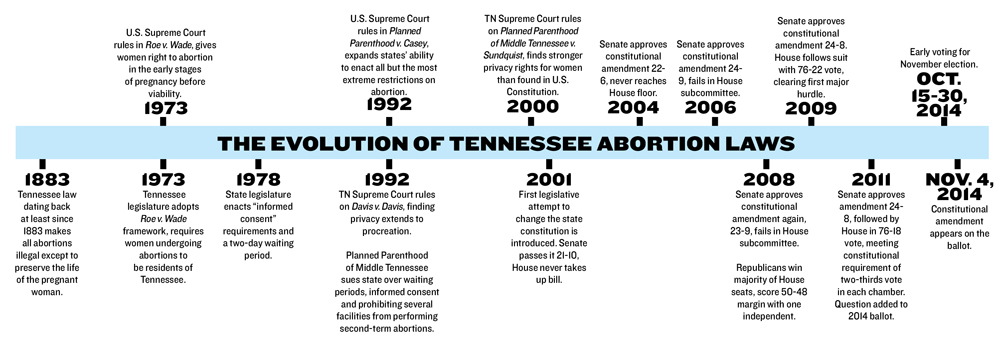
Which direction Tennesseans want to take on abortion might be a new question to voters this fall. But it's a question lawmakers have wanted to ask for nearly 15 years.
Some legislators have wanted to impose waiting periods and government-scripted counseling before a woman could undergo an abortion. Women from outside the state should be banned from the procedure, they believe, and any patient wanting one should have to see an ultrasound of the fetus she's about to abort and hear the heartbeat. If women refuse to look, some legislators want the technician to describe the visible organs, arms and legs to her.
Lawmakers here have tried to build these into law. What has stood in their way is a 2000 Tennessee Supreme Court decision holding that any such strategy would invade a woman's right to personal privacy.
According to the state's highest court, the Tennessee Constitution implies stronger privacy protections than the U.S. Constitution. But you won't find a passage in the 24-page state constitution reflecting that — it's more a result of "the creative part of lawyering," says Hedy Weinberg, executive director of the Tennessee ACLU.
It all started with the Davis family in the 1980s. Fraught with fertility problems, the couple enlisted the help of a Knoxville fertility clinic to help them get pregnant. The marriage didn't last, however. Although they managed to divide up their assets, they couldn't agree who should have "custody" of their seven frozen embryos stored at the facility.
The lawsuit made its way to the state Supreme Court in 1992, and the court had little to no case law to use as a guide. The ex-husband didn't want to father children with a woman he was no longer with, so he wanted the embryos destroyed. While the ex-wife had initially wanted the embryos, to have the option of becoming pregnant, she had since remarried and wanted to donate the microcellular organisms to a childless couple.
"Our analysis of whether the parties would 'become parents' turned on the exercise of the parties' constitutional right to privacy," the court later wrote. Tennessee's notion of individual liberty is "so deeply embedded in the Tennessee Constitution," it reasoned, that the crafters of the 1796 document "foresaw the need to protect individuals from unwarranted government intrusion." When all was said and done, the court found itself in a corner. It ruled in the ex-husband's favor — saying the party wishing to avoid procreation should prevail, assuming the other party has other options in getting pregnant.
Later that year, the American Civil Liberties Union of Tennessee recruited Planned Parenthood to sue the state over a series of laws it argued were suffocating privacy rights of women seeking access to abortion, pointing to the Davis ruling. The case worked its way up to the state Supreme Court, which then built its decision stressing the protection of procreative autonomy.
The court ruled that the right to privacy was fundamental, finding "a woman's right to terminate her pregnancy is a vital part of the right to privacy guaranteed by the Tennessee Constitution." The ruling struck down the state's two-day wait period for abortions, requirements that women be given information about the effects of an abortion, and legislation prohibiting doctors' offices, outpatient clinics and freestanding surgical centers from performing second-term abortions.
One justice wrote in a dissent that the court's decision was not grounded in legal precedent, giving opponents reason to argue the ruling had fallen victim to judicial activism.
The legislature, picking up more Republicans and conservative members every year, filed dozens of bills to tighten the state's grip on abortions. But the key was finding a way to overturn the Supreme Court's ruling by getting an amendment on the ballot specifically addressing abortion. Democrat leaders for years kept any such legislation bottled up in House committees, never letting the bills see the light of day for fear anti-abortion Democrats would approve it on the floor.
All that changed in 2009. Republicans, hot off winning a narrow majority in the House and a stronger foothold in the Senate, fed the constitutional amendment to the floor — where it passed with more than a two-thirds majority.
"I think it's important for us to get back to square one, to allow people to determine whether, and if so to what extent, they want some guidelines imposed on that procedure," said Mark Norris, the Senate majority leader elected shortly after the 2000 state Supreme Court ruling. "Let's be specific about it, is the thinking."
The final two-thirds vote needed to secure the question as Amendment 1 on the ballot came in 2011, giving strategists on both sides more than three years to assemble a plan. They've formed committees to raise money, which this fall will be put to use via campaign ads, mailers and other campaign activities pushing voters to the polls on election day.
Both camps have multimillion-dollar fundraising goals leading up to November. Anti-abortion activists have formed the "Yes on 1" camp, with a goal of raising $2.1 million. As of July, they've raised $518,000, with the help of a quarter-million dollars from a fundraiser headlined by GOP Lt. Gov. Ron Ramsey. Its other contributions have come from churches, local Knights of Columbus and individual donors. "No on 1 Tennessee" has pulled in more than $359,000, largely from Planned Parenthood groups across the state and nation, including California, Kansas, Massachusetts, and Seattle. Its goal is to raise $4 million. Updated fundraising totals are due out in October.
Deciding whether to make the state constitution silent on abortion rights is the first of four edits voters get to weigh in on this year. The others include how to choose judges; deciding whether a state income tax should be deemed unconstitutional; and allowing veterans' organizations to hold charitable gaming events. By Andrea Zelinski
Email editor@nashvillescene.com.




