
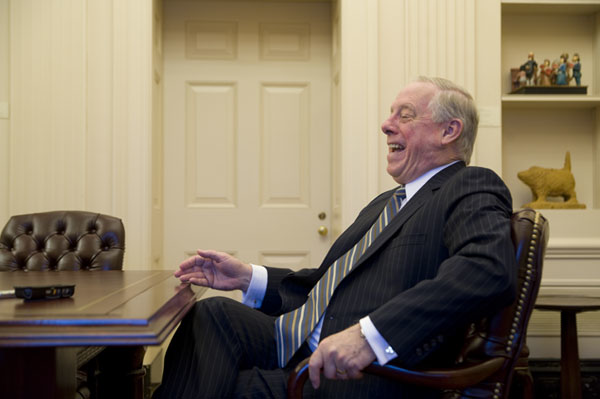
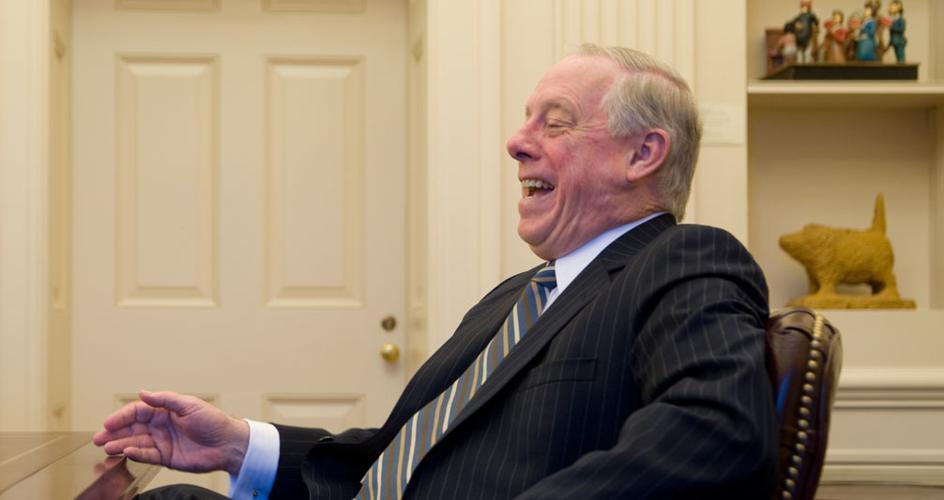

Governor Bredesen laughs during the interview with Stephen George.
Phil Bredesen looks tired. The skin under his eyes is soft and baggy. Over and over at the beginning of a recent interview with the Scene, during his rhetorical windup, the state's chief executive rubs his face — heavily, like a child fighting sleep.
But Bredesen will soon rest — if by "rest" you mean something like the post-officeholder career of Al Gore. When the Scene spoke to Bredesen, in his office at the Capitol just before the holidays, he was nearing the end of a 16-year run in elective office. He started that period as Nashville's mayor, an outsider who ushered in years of progress and prosperity. He will end it as Tennessee's governor, a fiscal gatekeeper who guided the state through years of growing rancor and austerity.
Over the past eight years, Bredesen proved to be a figure in increasingly short supply: a moderate. He struggled to balance funding for public health care and education, while pacing most of the country in economic development. He played adult to a catty General Assembly, during a time when extremist political rhetoric made headlines more than legislative substance. Yet even at his lowest ebb of public support, he remained one of the few political figures in any state to enjoy broad popularity with voters of both parties. He leaves a reputation as a temperate and practical leader.
His future plans, so far as he will discuss them, include a tour for Fresh Medicine, his forceful treatise on health care reform in America. He will not answer, even coyly, the question of his future in public office. He will only say that he is excited to remember what private life is like.
Scene: You came into office as Nashville's mayor at probably as low a time as the city's had in recent memory. Can you talk about what it was like to walk into that kind of mess?
Phil Bredesen: I came into the job as mayor at a time when Nashville was really ready to take some very different directions. I think the what was called at the time "the Good Ol' Boy Network" approach to politics had pretty much played itself out down at the courthouse, and people were looking for somebody, I think, something different in city government. So from my standpoint, it was a great opportunity to move things forward. What I thought needed to happen was very similar to what I felt I faced in state government, which is to start giving people confidence that decisions were being made based on a genuine attempt — sometimes wrong, but a genuine attempt — to figure out what the city needed to grow as opposed to managing one group or another, or working for your re-election, or any of those kinds of things.
One of the measures that I have of how people's expectations had changed was when I proposed the arena. In one of the interviews, I mentioned that we would design it so that someday we'd have a chance at having a major-league professional sports team in it. And people were just derisive. A few years later, we had two of them. And actually, when I exited the mayor's office, some of those same people were mad at me because we had a baseball team that wanted to come, and I was unwilling to go do the stuff, the stadium, for the baseball team, really on the basis that we were not a big enough city to support three teams.
That difference between "We could never have that" to "Why isn't that idiot trying to get us a third one" is a nice measure for me of how much the city changed [over] eight years.
Q. How did you respond initially, in your own head, when you were pursuing these big-ticket items and you kept running into a lot of provincialism?
It's like any persuasive thing that you do, you just try to — it's not about arguing individual points. It's about creating a worldview of what the city can be like, and how this fits into that vision for the city. And I certainly had a feeling that you could not be a great American city in the decades ahead without having a vibrant downtown. Downtown Nashville had lost most of its retail, and the more I looked at it, the more I thought that wasn't coming back. But that as an entertainment district, and of course being Music City USA, that's a natural kind of connection, that had real potential.
One of the things that I think has really helped me over the years — I want to be clear: I've really enjoyed these jobs, but I don't want them so badly that you're sort of afraid to do anything to shake it up. If I had been not re-elected as mayor, I would've been unhappy for two weeks, but life would've been just fine. And in a way, it sort of frees you up to go ahead and do things, and what I discovered over the years is that might even be better politics than all this time spending worrying about what people are thinking.
Q. You sparked in Nashville what has become the biggest investment in education ever. You started a lot of capital projects, [former Mayor Bill] Purcell came back with more funding of services. What are your thoughts on the state of Nashville public schools right now?
When I was mayor, there really were two phases to what I was doing. No. 1, there were a lot of physical problems with the schools, and a lot of people told me there were just schools that needed replacement, we need expansions and those kinds of things. So we put a lot of money into just that.
The second piece that I really worked on was, Nashville was a city that really, an overwhelming facet of the school system was the busing program. And what we really did was to dramatically reduce that and get out of the court, settle out in the court statement. That doesn't mean it's gone away as an issue, but it's very different today than it was in 1994, 1995.
And then third of all, toward the end of my time, I concentrated more on the innards of the schools and put in place the core curriculum, the E.D. Hirsch idea of a tough core curriculum, which in a way for me is a predecessor to what we've done now with standards at the state level.
The lesson out of all that for me was the importance of, when you want to do something as large and as longstanding as that, the importance of getting it out of personalities and getting it out of party. The mistake with core curriculum was it was "Bredesen's Reform." Purcell had been there maybe six months before it got thrown out and put away. So what I've tried to do now in the state, which takes a lot longer to do, is to embed it more deeply. There's a lot of stuff going on in the state now, but because of the fact that the business community is behind it, Bill Frist is behind it, we got lots of Democratic and Republican votes for all those issues of reform in the legislature, nobody thinks of it as "Bredesen's Reform." It's much more "Tennessee's Reform." Tennessee is on a good track, and that's what makes it possible for the incoming governor to sign on and say, "Yeah, I'd like to continue this in the future." That, to me, is the really important thing.
Q. What did you want to do with education when you got into the governor's office?
I really wanted to put in place a universal pre-K system, optional but universal, and I just ran into a buzz saw once I got outside of [providing for] disadvantaged children, underprivileged children. There's a substantial contingent of conservative members of the legislature who really didn't want that, and that's something I really feel like I had to abandon to get some of this other stuff done.
If I could do it the way we wanted it, I would put much more [money] into information technology in the schools. That's got two problems with it: No. 1, you have to put money into teachers, this kind of stuff. And second of all, to be honest with you, in government the procurement process for that is, I never had any confidence I could actually produce the results I wanted. The problem you have with state government is — it's not crazy, because of things that happened in the past, nobody trusts anybody to do anything — so when you put something major out to bid, you may get the right company or you may get Acme Donut Company and Education Reform, or something or other, and I think that's an issue.
I think we've taken some good, solid steps to put a lot more accountability in the system, and if over the next five years that proves to have been used well and intelligently, then people will be ready for stuff with a little more teeth to it, and we'll begin moving things in the way that they need to go.
Q. You look at getting the Race to the Top money, and obviously a big part of that is the quality of the application and all these things you've mentioned. But it's also suggestive of the direness of the situation, no?
I think in Race to the Top, it was a good application, although I think that the two real elements of that that made a difference were, first of all, the data system that we have, which goes back to [former Gov.] Ned McWherter, the value-added system. Tennessee was, at the end of the '80s, at a place where a lot of states are trying to get now in terms of their data systems. I think that was really important.
I think the changes that were made in the legislature and the process of making those changes really helped us a lot. First of all, we got to a place that they were comfortable with. We weren't promising to do something in the future if you give us some money, we presented the application with it done. And I also think the fact that I was out front on the subject, and that it was passed with good, strong bipartisan majorities, that the approach was signed onto by all the candidates for governor, gave them a lot of confidence that this was not a one-off thing that was going to get trashed the next time there was a change in control somewhere, but something that has some broad appeal.
Q. But you acknowledge that our public education system is in a pretty low spot.
We're in a low spot, but not necessarily in the ways that I think it could be measured. Most of these measures that compare states educationally compare the amounts of money that are going into education, and there we're not up real high. But on the other hand, the places that are at the top of the list are among the most troubled school systems in America, so it's not necessarily indicative of anything. Our standards were very low. We fixed that, now we've got to stick with it and so on, but we fixed that. I think we're starting to see some real progress.
You say we're in a low spot, but the pre-K program we have — which is about half the kids that age — is constantly regarded as one of the best half-dozen in the country, OK? And second of all, I was just up in Washington two or three weeks ago, and Colin Powell and Secretary [of Education Arne] Duncan honored two places — one of them was New York City and one of them was Tennessee, and what we got honored for was having the best-improved graduation rates in the country. You may have a bunch of issues that arise out of the fact that we're an agrarian state that's changing very rapidly right now, and attitudes are changing. But in terms of the direction that we're going, I think we're doing very well, and I think Race to the Top really recognized that.
Q. Do you think Tennessee should have an income tax?
Not particularly, no. We happen to [have] relatively low taxes, very low taxes, I think we're 48th or something like that, and relatively low services; there's things we don't do in Tennessee that they do in California. But if you can meet the needs in education and health care for children, I don't mind paring back some of that other stuff. And I don't think that's necessarily a bad place to be. I don't think our future lies in trying to get halfway between us and California.
There are very sweet spots. I'm originally from Massachusetts, and they've figured out a way — they've got relatively high taxes, but it's also a successful state. They've got good things happening there. I just think, for Tennessee, where we are now is a good competitive position. I've always thought it's far more important to put in place the processes by which you can live within the revenues that you have.
What I found over the years is, anti-tax feeling is more — it's not so much about "I don't like any kinds of taxes and will never pay any of them." It's more about, "You're not doing your job very well. And instead of you doing your job better, you're just asking me for more money." Where people get mad is, I'm sitting up here and they think everyone in the legislature has got two of their relatives on the payroll and now revenues go short and so we say, rather than us deal with anything, we'll just have more of your money. Revolt over that is what's going on.
It's all a way of saying, look, I don't think an income tax is in some theoretical sense bad or good. I just think that a relatively low tax environment is a strong place to be, and if you can combine that with the ability to adjust your spending as these things go up and down in a sensible way, then it's a perfectly healthy place to be and may in the long run prove to be a lot healthier than these much higher tax, higher services environments.
Q. You said that if you have enough revenue to cover health care for children and education, then you should be in a pretty good spot. Do you think we're covering that here?
Let me be clear: That was not, "I've thought this through carefully, and here's the two things I most care about." I guess what I'm saying is: health care for children, we have never cut a person off of the TennCare children's rolls. None of that stuff we did ever applied to any of the children we've got on the rolls. We have the CoverKids program in place, which still has money in it. We actually have had trouble signing up any more people in that. And I'd say for children in this state, if you're uninsured and there's no place to get insurance, that's getting to be kind of a rarity. If you live in a family up to 250 percent of poverty, you can just walk in and get CoverKids, and that's getting well up there. So yeah, I think kids' health care is being done.
We've got public health issues in the state, which I'd put in a little different category. The obesity issues, and smoking's getting better but it's still an issue.
The challenge for me has always been as governor, everybody wants low taxes, everybody wants Tennessee taxes and Massachusetts services. You're just trying to explain why, "Yes, I know our college tuitions are going up faster than you want them to, and I can fix that — but you've got to pay more taxes if I'm going to fix it." And when faced with that choice, most people I think are happier with where we are.
Q. Tell me about a low moment you've had in the governor's office.
The least pleasant times I've [had as] governor are executions. I don't like them. I believe in the death penalty — [but] I don't like them. So that is something I dread. As you know, some have gone forward under me, a couple haven't.
In some ways the hardest times were the stuff surrounding TennCare. You've got people in wheelchairs camping out in your outer office, disrupting things and this kind of stuff. It's just a lot of shouting going on; I mean that not in a sense of them shouting, but the papers are all doing one thing and the advocacy groups are doing another and your supporters — it's just a very noisy environment. That's not pleasant, but I think it's also an environment in which my basic personality, which is, "OK everybody quiet down, let's think this thing through," has really helped me a lot.
Q. With TennCare, you had a real moment of morality coming up against the reality of a political situation.
I was very critical of myself at the time for letting the thing develop to the point with these advocacy groups that I really had no choice but to do some difficult things. And those are things I just think, to this day, if I'd just been smarter 18 months before that and recognized the realities of the world, I could've handled it better. You don't like doing that, but on the other hand, just the attitude was, I got elected to run the government. As I told members of the legislature, if you want to go pass some new tax to keep all these people on, I think you're crazy, because you've got so many inefficiencies in the system you ought to sort out first — kind of an early version of the way I feel about the national reform — but I'm fine with that. But we're not going to bankrupt the state here. I raised my hand and swore to uphold the constitution, but I'm obviously not going to just run the state into the wall and hope that somebody will come in and fix it. Those are difficult occasions.
Q. What do you think of "No Labels," with Michael Bloomberg and Joe Scarborough and these folks who are moderate Democrats and Republicans saying they're going to form their own team? That seems like natural territory for you.
That's the way I wish things were in the parties. I wish when a Democratic or Republican president came in, they immediately started working on, "OK, how do I start working across the aisle? How do I find some common ground here from this side?" But the dynamics of partisan competition have really almost driven things the opposite direction.
I think if all it does is scare the two major parties back into a more sensible place, that kind of thing could be interesting. Obviously, the whole electoral process is very stacked against that. But there may be people out there — and Bloomberg may be a good example of that — who just say, "Look, you can believe in the party system, but there are times when it becomes dysfunctional and needs some challenging from the outside."
Q. What about your party here in Tennessee? It's not functioning at an optimal level.
For anybody who's running for public office, Democrat or Republican, the party structure — it's one piece of the puzzle, but it's not the puzzle. And today, the process of doing that has a lot of other components besides the party. It's not like it was 50 years ago, where the party became the vehicle by which you got elected. To start with, you have to run in a primary, and in a lot of cases — think about the current governor — that was the election for them. Well, the party's got no role to play in that, so you start out with your own organization and your own coalitions to do that with. I think that the Democratic Party in Tennessee is going to have to do a little soul-searching about what it's about, but they can certainly do that well.
Email editor@nashvillescene.com.
The Underachiever



Post a comment as anonymous
Report
Watch this discussion.
(0) comments
Welcome to the discussion.
Log In
Welcome to the discussion.
Keep it clean. Please avoid obscene, vulgar, lewd, racist or otherwise abusive language. Comments featuring hate speech or threatening or violent content will not be tolerated.
PLEASE TURN OFF YOUR CAPS LOCK.
Be truthful. Don't knowingly lie or mislead.
Be proactive. Use the “report” link on any comment that violates our comment policy.
Share with us. We'd love to hear your feedback.