

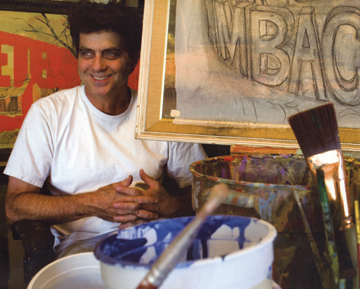
Like a lot of people in the art world, Wayne White has a big head. A really big head. Fifteen feet big, to be exact.
The nose alone, sculpted from a mound of Styrofoam, runs close to 5 feet. Tubular hairs sprout above the massive brow like giant French fries bursting from a box. The hinged nutcracker mouth creaks open, capable of swallowing watermelons whole, while eyes the size of basketballs rotate in their sockets.
But the face isn't White's. It's a likeness of George Jones, commissioned by Houston's Rice University Art Gallery for a site-specific show that opened in September. The installation had received so much attention by mid-month that word eventually reached the man himself. To White, the George Jones who called him on the phone to express his gratitude was scarcely smaller than the sculpture.
"It was better than The Beatles," White says by telephone from his home in Los Angeles.
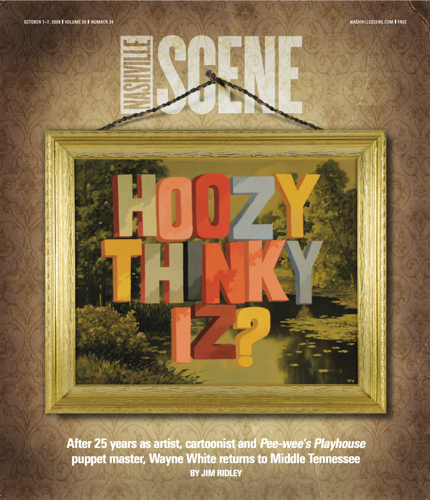
The irony in this is that Wayne White's work, in many ways, is a reaction against the tyranny of the swelled head. He honed his career in a culture snob's idea of the bush leagues: cartoons, puppet shows, children's TV. As an artist, he invokes pomp for purely comic effect, outfitting humble items such as thrift-store paintings with imposingly grandiose text elements. The guy's now the subject of a lavish monograph—the kind of career-capping coffee-table brick most artists lust for—and yet its title mocks just that sort of hubris: Maybe Now I'll Get the Respect I So Richly Deserve.
Maybe. But White is one of those rare figures who's managed to hold onto his cutting-edge cred even while paddling in the mainstream. A kid from a small town outside Chattanooga with a state-university art education, White left Middle Tennessee to become a widely published cartoonist, an Emmy-winning set designer, and in the most recent turn of his career a sought-after artist and sculptor.
But even people who've followed White throughout each of these phases—from the characters he devised for the hugely influential late-1980s children's show Pee-wee's Playhouse to the Georges Melies-influenced sets he designed for the Smashing Pumpkins' blockbuster "Tonight, Tonight" video—may be startled by the range, energy and artistic development they show when placed side by side in Maybe Now I'll Get the Respect I So Richly Deserve. A labor of love assembled by no less a figure than Todd Oldham, the famed designer whose Southern background, brawny work ethic and spirit of play dovetail with his subject's, the almost psychedelically colorful 382-page retrospective makes a case for White (in Oldham's words) as "an artistic shapeshifter" whose oeuvre resembles "an old master from another galaxy."
In some ways, White is "a true Nashville story," says Lambchop lead singer Kurt Wagner, who's tapped White's work for several album covers. That story is a mixed blessing—an enormous talent who can realize his potential only by striking out for somewhere else. "That's just the way Nashville is," Wagner says. "The only way to try to better yourself is to leave. We went through that with Lambchop. Sure enough, it is a bigger world out there."
Local audiences will see the book and White next weekend when he does a string of Tennessee appearances culminating Oct. 10 at the Southern Festival of Books. For the artist, it'll be a homecoming to the site of his college years and the company of friends and fellow artists whom he counts as enormous influences. That they're known to few outside his creative circle matters not at all. In Wayne White's work, there is no hierarchy of high and low art, of celebrity and anonymity. This is, after all, the story of a guy who walked into The Great Escape in 1980, made a single purchase, and changed the course of his life.

That purchase was an issue of RAW, the highbrow comics anthology published by Art Spiegelman before his success with the Maus graphic novels. Since childhood, cartooning had been one of White's passions: He'd been the school cartoonist in his hometown of Hixson, Tenn., just outside Chattanooga. As a kid, he says, he couldn't wait to hit the drugstore each month to get the latest comic books.
"I loved Superman comics, and those were of course all anonymously drawn," White says, singling out "Silver Age" Superman artist Curt Swan as a favorite. "And of course the Mad cartoonists—Jack Davis, Wally Wood, Al Jaffee, Dave Berg, Mort Drucker, Sergio Aragones."
The son of a former DuPont worker, a onetime high school athlete who married his cheerleader sweetheart, White admittedly spent a lot of his own high school years raising hell, in that peculiarly toxic small-town Southern fashion born of testosterone and boredom. He wanted out of Hixson. His sister had gone off to MTSU in Murfreesboro, and White followed her there in the late '70s just as the burgeoning punk and new wave subculture began to percolate in the sleepy college town. The energy surged in MTSU's art department, housed in a dairy barn on the far side of the campus.
"There was a younger faculty, and they were all sparked to go," recalls Mike Quinn, one of White's closest friends from his MTSU days. There was also a constant tension, former students remember, between the ambitions of the instructors and their students, many of whom had come from the small rural towns surrounding Murfreesboro.
"They all wanted to do Norman Rockwell, or maybe Vermeer," says Bill Killebrew, an MTSU art alum who now runs a successful Nashville flooring company, "and the faculty just ripped into them." Nobody cut a more imposing figure than White's instructor, David LeDoux, described by Quinn as a "hardcore abstract expressionist" known for berating students with confrontational directness about their values, beliefs and methods of expression.
Quinn believes that LeDoux's toughness was "just him pressuring [students] to be as good as they could be." But in a transcribed conversation with Oldham in the monograph, White expresses ambivalent feelings about his former professor and his methods of humiliation. His big influences at MTSU, White says, were mostly peers such as Quinn, Killebrew (whom he calls "one of Nashville's undiscovered geniuses—truly an amazing painter") and his former girlfriend Carol Tyler, herself now a cartoonist of considerable repute.
It was Quinn, a leprechaun of a man whose soft eyes twinkle with mischief, who sparked White's interest in puppetry "purely through laziness," he says with a laugh. They were hanging out in Quinn's decrepit Dodge Dart when his pal said he'd managed to avoid writing a term paper in his forestry class by putting on a puppet show instead. White was impressed.
A short time later, Quinn helped White dodge an assignment to write a paper on Jean Dubuffet by staging "Punk and Juicy," a "horribly violent" puppet show that ended with geysers of blood. They started to perform puppet shows in backyards and at parties, using whatever devious methods of staging they could rig. Once, for homemade pyrotechnics, they emptied the powder out of firecrackers into a metal can, and at the crucial moment they set it alight. The resulting explosion not only deafened listeners, Quinn says, it set the staging area on fire.
After graduation, White found himself rootless and unemployed. "There were not a lot of openings for abstract expressionists in Nashville in 1980," he deadpans. The only professional artist he knew at the time, he says, was Bill Killebrew, who had found a home for his work at a forward-thinking Hillsboro Village gallery called Martin-Wiley. Run by longtime Nashville art collector Terry Martin and Gene Sizemore, it became a meeting ground for Middle Tennessee artists working outside the realm of strictly representational art.
White's first job out of school was in social services, driving impoverished seniors to activity centers. But in November that year, he got a job better suited to his talents, as a sign painter at the Cumberland Science Museum. It was there he made the acquaintance of Alison Mork, a fellow employee with a similar interest in puppetry and ties to a bohemian singer-songwriter scene centered at the venerable Vanderbilt-area dive Springwater.
As a job, the museum gig allowed White to indulge his art degree and to experiment with its heaps of junk and discarded wood scraps. But he still felt he hadn't found his focus—until the day he stood in The Great Escape looking at a copy of RAW. He recognized one of the cartoonists instantly: Gary Panter, whose work on a Frank Zappa album cover had caught White's eye at a record store near the MTSU campus when he was in school. Something clicked.
"That was the big life-changing moment for me," White says. "That's why I decided to become a cartoonist, like, within a day or two. It was real strong. I was seriously drifting at that time, and that kinda focused me instantly." Shortly thereafter, White loaded his things into his 1973 Ford Maverick, bade farewell to Nashville, and set a course straight for New York's School of Visual Arts, where Art Spiegelman taught classes.
As it turned out, White tracked down Spiegelman, who agreed to a cup of coffee in the school cafeteria. "He read my crappy comics and sort of suggested if I wanted to sit in on his classes without actually signing up, I could," White remembers. It was as if the heavens had parted.
"I thought, 'This is it! My ticket to stardom! I'm in! I am totally in!' " White says, acting out his enthusiasm with mock bravado. What he found instead was a sublet in the West Village and a deadly graveyard-shift gig as a short-order cook, slinging burgers to hopheads at the Empire Diner. Rather than using the skills he sharpened at MTSU, he was falling back on the tool set he'd acquired in high school at the Chattanooga IHOP.
But on Fridays, he would attend classes at the School of Visual Arts, where White says he got an education in more ways than one. Not only were Spiegelman's students younger and more accomplished, they were already getting published in RAW. His classmates included such rising stars in underground comics as Kaz, Mark Newgarden and Drew Friedman. They challenged White to get better or go home.
"That's where I really learned to draw, mainly because I was surrounded by people who were better than I was," White says. "I was used to being the big fish in a small pond, and all of a sudden I was low man on a pole. That's why I say to students all the time: Go somewhere where everybody's better than you. That'll put your ass in gear."
These years were one long struggle, White recalls, with one big exception. A hero of White's was Red Grooms, the Nashville native who had become a celebrated pop artist by fusing the graphic hyperbole and energy of cartooning with a sculptural sense of space and implied movement. Art was supposed to be stuffy and dry; Grooms' work was loopy, uproarious, a carnival midway barely tethered to canvas or held in one place.
Grooms needed workers to help paint a project—a 30-foot sculpture of a covered wagon and a cowboy shooting an Indian, now housed in Denver. White got the gig.
"That was incredible," White says. After years in cartooning, working with Grooms gave White his first real glimpse into the art world. By the same token, he believes Grooms was interested in him because the world of underground comics was so far removed from his own sphere of influence.
"He even did a watercolor painting of me called 'The Cartoonist,' " White says. Does he have it hanging under track lighting above his mantelpiece? "Aww, no, man!" he says, laughing. "Even back then, it was probably $20,000. I do have a ball-point pen drawing he did of me."

After that, White went back to cartooning while doing puppet shows at galleries around New York. He got his foot in the door at the now-defunct East Village Eye and worked his way up to credits in The New York Times and The Village Voice. The best thing to come out of this period was that he met Mimi Pond, a cartoonist who'd already authored a book and would go on to write the first broadcast episode of The Simpsons. The long-married couple actually have a keepsake from the night they met at a New York gallery: It was commemorated in Stan Mack's long-running "Real-Life Funnies" comic in The Village Voice.
"You can tell my life for the past 30 years in a series of comic strips, both my own and the women in my life," White says wryly. "Comics are always there for me in a weird way." But it was not comics but puppetry—and the company of an extraordinary TV man-child—that wrenched White's career into a wholly unexpected orbit.
A flip through the sections of Maybe Now I'll Get the Respect I So Richly Deserve devoted to Wayne White's early work teems with varied influences. Duchamp butts up against country-music posters, while Grooms and underground comics and '50s commercial art collide and commingle. It turned out that there was a home for all these styles and more, encompassing nearly the whole of modern art: children's television.
With the help of his friend Alison Mork, then working at Nashville's WDCN-Channel 8, White got an assignment to come to Nashville in the summer of 1985 and design the sets and puppets for a kids' music-education program. Called Mrs. Cabobble's Caboose, it fell under the supervision of a young director named Stephen Kopels, now a San Francisco documentary instructor, who saw White's designs and loved them.
The show reunited White with Mork and Mike Quinn, who played a sidekick named P.T. Pickens. For three months, White built model-train tabletops and beetle-browed dog puppets and indulged every stray creative whim he'd been nursing since his School of Visual Arts days. Mrs. Cabobble's Caboose played on various regional public-television stations for at least 15 years, and it got Quinn his own shorter-lived series for older kids, Music Fun Factory. "We had our own little weird kid show empire at Channel 8," White remembers.
Perhaps more importantly, when White returned to New York, it gave him something to hand to the receptionist at Broadcast Media the following February when he heard the production company was planning a hip new Saturday-morning network series. White even remembers the receptionist's name: Rob Zombie. "First white guy I ever saw with dreadlocks," White says, chuckling.
That series, Pee-wee's Playhouse, would go on to win 22 Emmys (including three for White) in its five-season run. But its influence remains as far-flung as the influences that went into it. Densely art-directed shows for children that also cock an eye toward parents? Creepy post-modern adult takes on kiddie TV, from Wonder Showzen to Robot Chicken? The entire Adult Swim lineup of cartoons for curdled hipsters? All can claim Pee-wee's Playhouse to some degree as an antecedent, even if its creator speaks sincerely of it in far less jaded terms.
"Really, I just wanted the show to be visually beautiful," says Paul Reubens, the creator of Pee-wee Herman and his lovingly twee universe. "I just felt like the show could look like no other show has looked before." Toward that end, Reubens, who has an art-school background himself, used the clout he'd won from his HBO special and the success of Pee-wee's Big Adventure to assemble what White calls "a downtown New York art project disguised as a children's show." He signed on Gary Panter, whose work White had long admired, as a set designer and gave him and White and the show's creative team full rein.
"We did it for adults," says White, who designed and portrayed puppet characters such as jazzbo pup Dirty Dog and high-flying Mr. Kite. (He also enlisted his friend Alison Mork, who became the show's beloved Chairy.) "It was sort of the kick-off of postmodern programming like that, if you want to give it a label.
"But I prefer to think it was a generational thing. We were of a generation that had been marinated in kids' TV our whole life. It was a comment and a parody and an homage and a critique and whatever you want to call it on all those weird kiddie shows we all grew up with."
Whatever you want to call it, the show's distinctive look—a riot of German expressionism, cheery kitsch, cubist caricature, MTV clutter and surrealist fiat—made White a hot property as a set designer. For one of the most striking videos of MTV's golden years, Peter Gabriel's "Big Time," White devised an unsettling menagerie of outsized imagery, from talking mountains to the star's own elongated kisser.
After Pee-wee's Playhouse ended in 1991, he worked on a number of children's shows that would not have existed without its trailblazing, among them Shining Time Station, Beakman's World and the Riders in the Sky program. For the video-directing team of Jonathan Dayton and Valerie Faris, who went on to direct Little Miss Sunshine, White turned the Smashing Pumpkins' "Tonight, Tonight" video into a retro-futurist reverie that anticipated the glam-antiquity look of Baz Luhrmann's Moulin Rouge! by five years.
But his success as a set designer and puppeteer left little room for cartooning or painting. Tiring of Hollywood, White says that in the 1990s he began to learn the basics of oil painting. With that came an interest in historical painting and the big, bold all-American landscapes of the Hudson River Valley school.
However much he tried to work in a vein of deliberate Americana, though, he says the resulting paintings just got weirder and weirder. Picture the bold, homespun directness of a Winslow Homer nostalgia piece ruptured by a somewhat out-of-place element—say, a marauding werewolf.
In an effort to try something different, around the end of the decade, White decided to incorporate text into his paintings. On a whim, instead of painting his own landscape background, he dug into a stash of thrift-store paintings he'd bought to salvage the frames. "What if I just paint the words coming out of that?" he recalls thinking.
This ushered in the most recent phase of White's career, a series of "word paintings" that juxtapose innocuous-looking landscapes with phrases painted in giant block letters, as if the 2001 monolith had materialized in a piece of Holiday Inn motel art. Take the most famous of these, which the Nashville band Lambchop made the cover of their 2000 album Nixon. A boy and girl stand poised at the edge of a mill pond. Only one thing comes between them and the millhouse across the lake: the word "Nixon" in enormous white 3-D letters, reflected in the water and interwoven with tree branches.
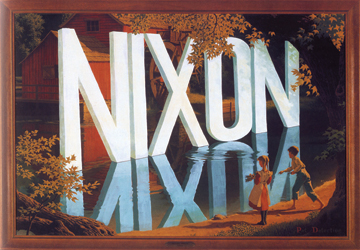
First off, it's funny. The size and sheer incongruity of the word turn it into a kind of Dada punchline to a joke never told. (That "millhouse" is as poker-faced as visual puns get.) It's also weirdly compelling. The text adds a mystery and dynamic element that demolishes the sentimentality of the original painting, while adding bold vertical slashes that grab the eye. It's also unsettling. The word comes loaded with political baggage, but the oddity of the setting whisks away its meaning, making it an enigma.
It also provides a subtle yet barbed critique of the ways words have been devalued by their ubiquity in the American cityscape and roadway. Critics frequently invoke the West Coast painter Ed Ruscha and his "liquid word paintings" to describe White's work. But White insists his word paintings have a more prosaic inspiration: the "See Rock City" mottos painted on barn roofs throughout his Chattanooga childhood. What word or concept isn't rendered abstract when you emblazon it across a 30-foot billboard, or plonk it into a rural landscape?
"We're so surrounded by giant words," White says, warming to a caller's suggestion that he uses text the way kids see words before they've fully developed reading-comprehension skills. "Our whole world is landscapes full of giant words. [The words in the paintings] stand alone as a structure." That the meanings become obscured or tangled adds to their bizarre power, he says.
"That's the hallmark of a compelling image," he explains, "the tension resulting from all these different meanings."
Up next for White is a reunion with Paul Reubens for a live Pee-wee Herman stage show in Los Angeles starting in November. In the meantime, he's still riding the high of the book's publication last May, something he describes as "a gift from the blue." It's the kind of fortunate, well-timed hand-up that has happened throughout a career going on three decades.
"The real important thing in my life has been meeting people in power who will let me do my thing," White says. "Red was one of the first ones, and then Paul Reubens, Peter Gabriel, and most recently Todd Oldham. If you weren't born with power, you've gotta meet people with power, because that's the only way the art is going to get out there."
And maybe now he'll get the respect he so richly deserves.




