
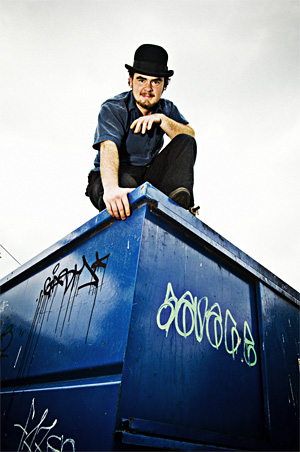
Though he felt strange at first, it didn't take long for Robert LaSalle to lose his shame for foraging through other's people trash. He looted in broad daylight, never donned a disguise, and he always wore gloves. "When you think of people going through Dumpsters, you think of homeless people going through trash, looking for food," says the 23-year-old, with an easy nonchalance and a puff on a cigarette. "There's no way I'd touch food out of a Dumpster."
But if the score is microwaves, refrigerators, laptops, books, furniture and even liquor, and all right there for the taking?
"After the first $400 bucks I made I was like, 'This is easy work and easy money,' " LaSalle says.
So for the past two years, he's racked up thousands of dollars in treasure from the Dumpsters of Vanderbilt, where some 6,500 undergrads—most of whom leave for the summer—find themselves in a hurry to discard undesirables at semester's end. Sometimes it's a printer or scanner, or a dorm refrigerator they won't need next year. Other times it's a nearly brand new Dell laptop that just needs a new version of Windows.
"These Vanderbilt kids don't realize what they're throwing away," says LaSalle, who works freelance as a crew member for Sommet concerts. "They don't throw away any music. They don't throw away anything valuable to an 18 or 19 year old. They don't realize what they're throwing away is extremely valuable to the rest of the world. I don't know if they're just spoiled or what."
Possibly. Vanderbilt ranked this year in the top 50 most expensive private universities in the country, with annual tuition plus room and board topping out around $50,000. Though some 65 percent of students rely on financial aid, it doesn't seem to stop them from ditching perfectly good wares. The university is listed on a few Dumpster-diving sites online for its reputation for primo goods.
LaSalle discovered how good when a neighbor tipped him off to the pay dirt waiting in the university's rustier corners.
"He told me there was all kinds of stuff there," LaSalle recalls. "His main goal wasn't to make money, though. He mainly just stocks up on cleaning supplies and collectibles. He gave me a Picasso print once that he'd found that was framed. So I went with him one day last year and he was showing me all this stuff. I was just blown away."
By the weekend's end, they'd stocked both their apartments. "I pawned a lot of stuff," he says. "I gave away about 10 vacuum cleaners—name brand vacuum cleaners like Oreck. I gave one to my mom. I gave my sister a vacuum cleaner. I gave some friends a vacuum cleaner. And I got to be pretty good friends with some bookstores."
Soon he was going online, looking up when the last classes would let out each semester, lured by the thrill of the next cha-ching. "They're all so anxious to get out of there, and a lot of times their parents will be there helping them throw out a $300 refrigerator," he says. "It's kind of addictive."
The night of the score he'd find himself back at his apartment with roommates, enjoying, among other things, the gin (and conveniently the tonic) he'd retrieved that day. Sometimes he'd find himself in the company of other scavengers—oftentimes well-to-do couples loading up modern sedans with discarded microwaves.
"It's not like you're talking about homeless or lower class people doing this," LaSalle says. "It's young married couples with nice cars and fairly nice clothes, fitting whatever they can in the back of their trucks and cars."
Campus cops routinely drove by on patrol, but they never stopped, never questioned him. "They understand what's going on," he says. "They know people are throwing stuff away and other people are picking it up."
LaSalle figured that silence was acquiescence—until a few weeks ago. In early May, he headed over to campus to make his usual rounds. The merchandise was solid. He found a liter of tequila, blank CDs, laundry detergent and six microwaves. He was in the middle of hauling the sixth refrigerator back to his van when a cop drove by. Only this time, he stopped. LaSalle thought it was an asshole move.
"He walked up to me and said, 'What are you doing?' I said, 'Oh, I'm picking up this refrigerator.' He said, 'Is it your refrigerator?' I said, 'Uh, not yet.' He said, 'What are you doing taking it?' There was another younger guy who did valet across the street and another woman who actually worked for Vanderbilt, also getting railed by this cop. We're all just standing here going, 'What the hell? There's piles of this stuff.' It's the second day after classes are out and it's just this massive pile of books and computers and TVs and refrigerators. It's a jackpot. And I'm not the only one who realizes it."
What's worse, the cop accused him of stealing, something LaSalle considers absurd.
"It's trash," he says. "It's in the Dumpster. No way do I think it's stealing. In no context could you convince me or hopefully most of the logical world that it's stealing."
The officer told LaSalle and the others that if they were ever caught again, that they'd be charged with trespassing. "Basically, I'm banned from campus," he says.
And just like that, his Dumpster-diving days were over. LaSalle isn't too bummed. He's always made enough to eat and pay his bills. And it isn't as if he's part of the freegan movement—young, typically liberal folks who've turned foraging into an anti-consumerist statement. But his actions aren't without an ideological component. Somebody should profit from this waste, he argues, be it him or Goodwill.
"Really, I was pissed off that they're so wasteful and that the Vanderbilt police would not allow people to take it," he says. "All that stuff is going straight to the dump. It just doesn't seem right. It's trash. And I along with other people in the city have made a lot of money from it. And somebody should make some money from it."
But Vanderbilt officials say their concern isn't theft—it's lawsuits. Dumpster diving isn't a big problem for the university—it only comes up a little in December, and mostly at the end of May. They've never arrested anyone for Dumpster diving, and they continue to issue warnings of trespass charges for repeat offenders.
"The problem is it's a safety hazard for them to be crawling around in a Dumpster," says spokesperson Missy Pankake. "Since Vandy is private property, campus police issue criminal trespass warnings and if they catch them a second time they could arrest them. The main concerns are if the person fell in the Dumpster and couldn't get out, or hurt themselves pulling something out of the Dumpster, or heaven forbid were picked up by the trash."
The university does provide drop-off points to donate items in good condition. It also has a move-out program with charities such as the Salvation Army and the Dismas House. "There is an effort to capture and reuse a lot of the materials the students throw away," Pankake says. "But I'm sure there is some stuff that slips through."
And that stuff, LaSalle laments, will no longer be decorating his abode or lining his pockets. "After the cop stopped me, I left like three more refrigerators standing right in front of me," LaSalle says. "More computers. More of everything. It's probably all in the city dump now."
Email tmoore@nashvillescene.com, or call 615-744-3362.



Post a comment as anonymous
Report
Watch this discussion.
(0) comments
Welcome to the discussion.
Log In
Welcome to the discussion.
Keep it clean. Please avoid obscene, vulgar, lewd, racist or otherwise abusive language. Comments featuring hate speech or threatening or violent content will not be tolerated.
PLEASE TURN OFF YOUR CAPS LOCK.
Be truthful. Don't knowingly lie or mislead.
Be proactive. Use the “report” link on any comment that violates our comment policy.
Share with us. We'd love to hear your feedback.