
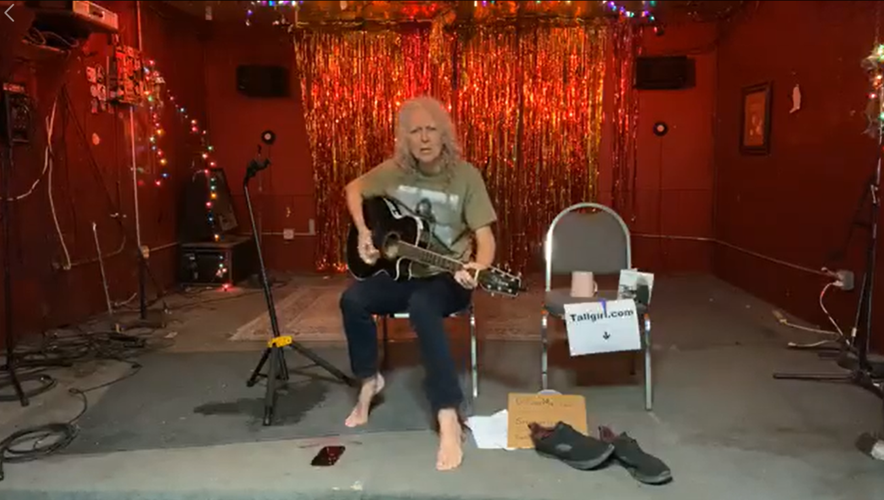
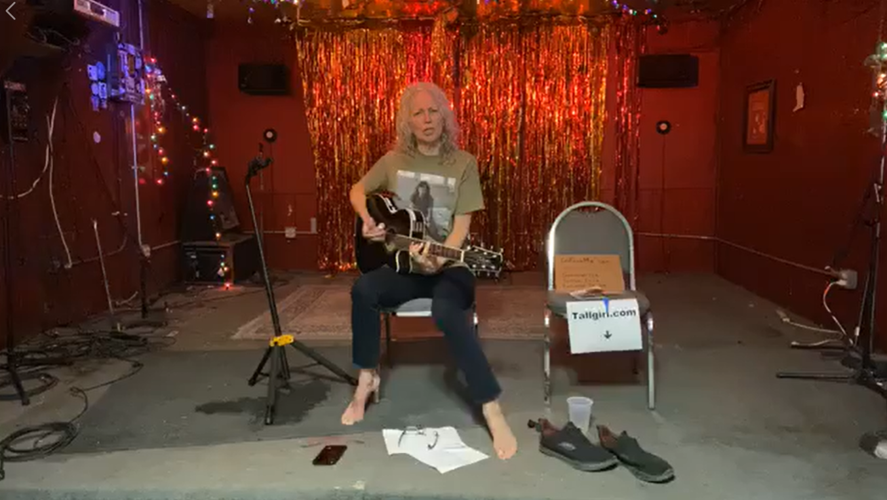
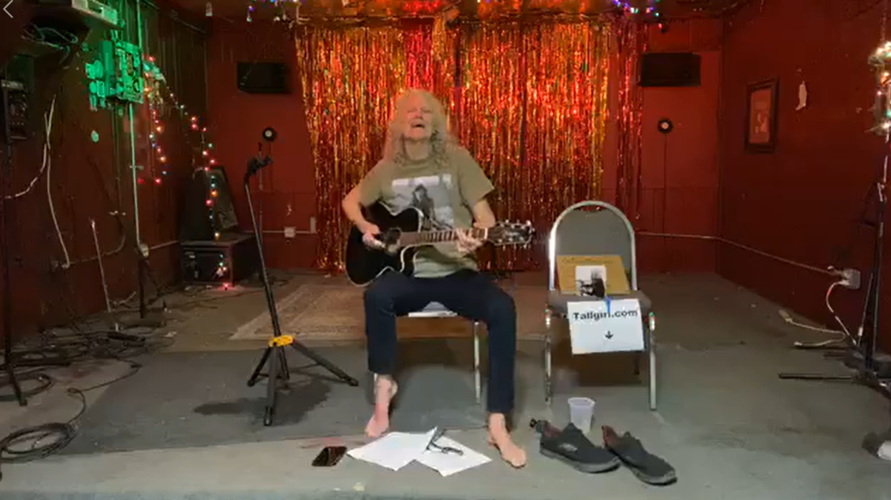


Sitting barefoot on the stage of the temporarily closed Nashville venue Springwater on Saturday afternoon, singer, songwriter, prose writer and rock ’n’ roller Marshall Chapman streamed an hour-long set that exemplified Nashville singer-songwriterdom.
The South Carolina-born musician — who moved to town in 1967 and released her debut LP Me, I'm Feelin Free a decade later — has a new collection of cover tunes, Songs I Can’t Live Without, set for a May 15 release. (See her website or that of your favorite record store for a preorder.) The Music City legend's weekly livestream is a continuation of a residency that she began in December, and she's directing fans to donate to a GoFundMe campaign that's been launched to support the venerable venue's staff during the shutdown. Alone on the stage, in a technological space that is both bracing and a little bit eerie, Chapman sang some of her great songs, told stories and did schtick, accompanying herself on minimalist blues-folk guitar.
What Chapman has, above all, is style as a performer — a built-in ease that makes her the ideal singer of her subtly turned country-pop-rock tunes. As you can hear on her 1995 full-length It’s About Time …, which was recorded live at the Tennessee State Prison for Women, Chapman can navigate a Percy Mayfield-style tune like “Late Date With the Blues,” which she co-wrote with California musician and songwriter Dennis Walker. Chapman isn’t exactly a country vocalist — her gliding vocal presence is an extension of her rich speaking voice. She is, however, a canny singer and songwriter whose work sits in the shared territory of rock ’n’ roll, country and pop.
As Chapman said during the stream, the start of her residency marked the first time she’d visited Springwater since the late ’70s, when she played bass during a set by Townes Van Zandt. She kicked off Saturday's set with one of her odes to rock, “Why Can’t I Be Like Other Girls.” Like, say, Nick Lowe’s “They Called It Rock” and Lou Reed’s “Rock & Roll,” the song tells truths about the music business, as well as idealism and self-assertion.
Chapman nailed “Goodbye Forever,” a song that features the guitar lick from Bill Justis’ foundational 1957 rock instrumental “Raunchy.” She paused to talk about Songs I Can’t Live Without, telling the audience at home about a shelved version of John Phillips and John Stewart’s 1973 song “Chilly Winds” she had recorded for the album.
Songs adds color to Chapman’s readings of tunes by the likes of Leonard Cohen and Bobby Charles. At Springwater, the spare drive of her guitar playing underscored her gift for narrative, and the music hit home — when she sang her 2013 song “Blaze of Glory,” you heard the soundness of its structure. I came away thinking about what Lou Reed, another great songwriter, did on his 1982 album The Blue Mask — and what such honesty means in a time that tests our faith in all things.



