



Lee Ann Womack
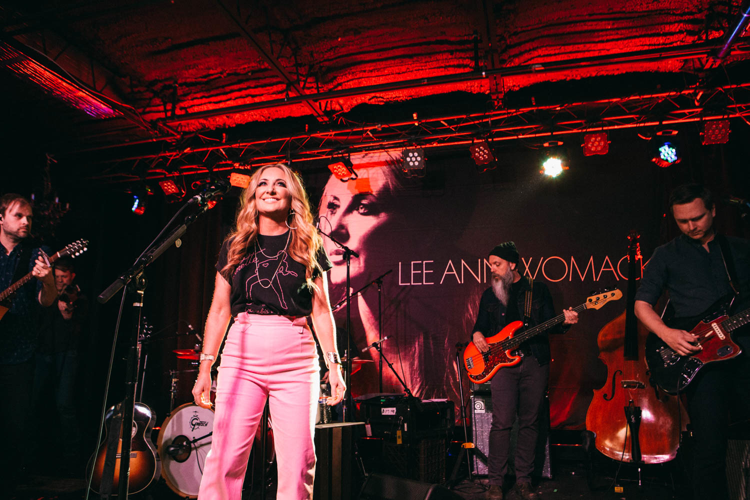
The Spin knows a few things about country music, and we've long believed that the ghost of country contrives to be both everywhere and nowhere in Nashville at the same time. In a mythical city where history resides on every street corner, the cross-currents of revivalism deposit little piles of musical styles that are swept up, cleaned up and curated for the tourist trade. But that wasn't the case during Lee Ann Womack’s show Friday night, the first of two sold-out dates at The Basement East. Womack's set encompassed pop country, Celtic country, Texas country and pure Nashville country, and she held the stage with the casual mastery of a true star. There was no curation on display — what we saw was a great country singer in the classic mold, not to mention a first-rate musical mind at work.
Womack’s high ranking in our 18th Annual Country Music Critics' Poll came on the heels of her brilliant 2017 full-length The Lonely, the Lonesome and the Gone, which marks the latest phase of an interesting career. Twenty years ago, when she was cutting commercial country for a major label, Womack earned street cred among Americana tastemakers. Talking to No Depression's Grant Alden in 2000 about her then-current full-length I Hope You Dance, Womack said, “I'd rather be Ricky Skaggs than Garth Brooks.” After a decade-long string of hit singles and albums, Womack went on hiatus, returning in 2014 with the excellent The Way I'm Livin’, which established her as a quasi-Americana artist. However you tag her, Womack chooses material with unerring intelligence, sings in an ornamented, rhythmically savvy style and leads a crack band that follows her stylistic shifts with supreme ease.

Lee Ann Womack
Womack showed off her vocal chops in a rendition of Marijohn Wilkin and Danny Dill's country-folk song “Long Black Veil” that left us speechless with admiration. It was one of many similarly transcendent moments in her set. Nothing could be more likely to inspire pointless cover versions than “Long Black Veil,” which has been in the folk-country repertoire for more than 50 years. Womack and her band approached it with what you could call a flexible tempo — they played the song in wide meter, and Womack subtly abstracted the melody.
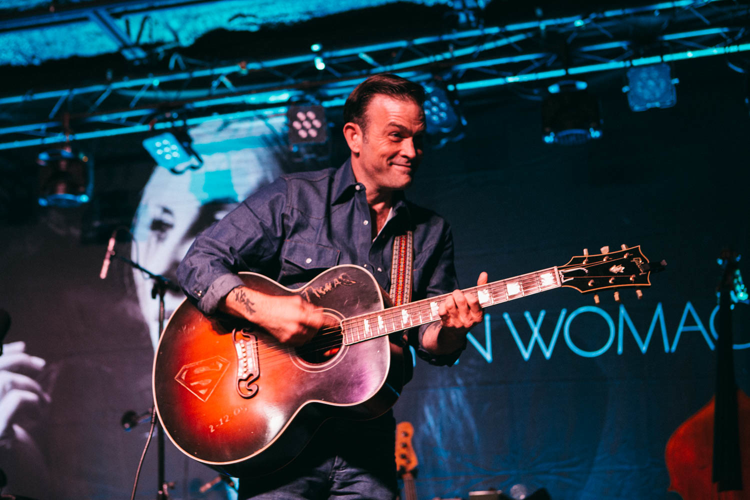
Womack also played her pop-country hits, including the blithe “Never Again, Again,” a smash single from her self-titled 1997 debut LP. We got off on her rendition of Rodney Crowell's “Ashes by Now,” which became a riff-driven power-pop number with help from guitarist Jonathan Trebing. We missed out on opener Waylon Payne’s set, but the songwriter, actor and singer joined Womack to sing “Solitary Thinkin',” a track he wrote for her 2007 full-length Call Me Crazy. Payne also co-wrote some of the material on The Lonely, the Lonesome & the Gone.

Waylon Payne
Although the Texas-born Womack isn't exactly a blues singer, she uses many of the same melismatic techniques that some blues vocalists favor. A George Jones acolyte (as she told the crowd, “My mom worried about me because I loved George Jones and his drinkin’ songs”), she’s a worthy successor to the infinitely subtle Possum. Womack phrases flawlessly and belts when necessary, and her bluesy explorations of Celtic rock got us stomping along. Womack & Co.'s rendition of Julie and Buddy Miller's “Does My Ring Burn Your Finger” rocked out, and Womack picked up a guitar for “The Way I'm Livin',” another Richard Thompson-in-Nashville, Celtic-Appalachian rocker.
If Womack is, as she told No Depression, more Ricky Skaggs than Garth Brooks, she's also more Gail Davies than Shania Twain. We think these are all great artists (The Spin hearts Shania, naturally), and it seemed to us that Womack was trying to explain how her relationship to the music business functions in terms of her considerable artistic ambition. The very sharp Womack serves as a model for anyone serious about remaking country by using old-school techniques. She doesn’t seem to differentiate among, say, Lightnin’ Hopkins (whom she mentioned, along with Janis Joplin and Lefty Frizzell, during an aside about Texas music), Jones, Dusty Springfield and Linda Thompson, all of whom we hear in Womack’s work. She sounds comfortable with the concept of country-as-pop, and it comes through in her music.

Lee Ann Womack
The packed house at The Basement East ate it up, and Womack gave a fine vocal performance despite complaining about what she called a touch of “that Nashville funk.” She did an acoustic rendition of folk standard “The Wayfaring Stranger,” and sang Hayes Carll’s “Chances Are” as soulfully as she delivered everything else. For her encore, Womack made a pass at Elton John and Bernie Taupin’s “Honky Cat,” a tune she recorded for the new full-length multi-artist release Restoration, a collection of cover versions of John-and-Taupin songs. She laid into a straight Texas shuffle for Luke McDaniel’s “You’re Still on My Mind,” sang like Jones on Don Chapel’s “I’ll Be Over You (When the Grass Grows Over Me)” and ended the show with a suitably humble version of “Lord, I Hope This Day Is Good,” a Dave Hanner song recorded by Don Williams.
Because Lee Ann Womack is comfortable in history, we left feeling good about our place in it, and that’s not a sensation that comes along every day.
See our slideshow for more photos.
In The Spin — the Scene's live review column — staffers and freelance contributors review concerts under a collective byline.



