
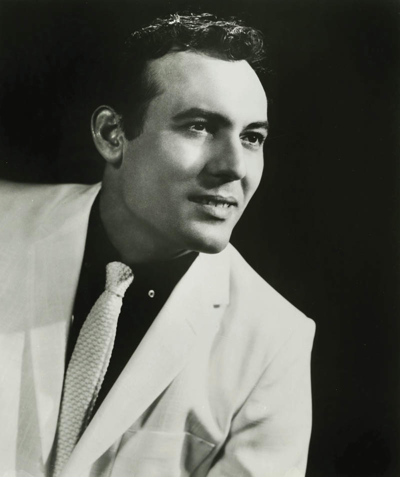
On a cool October evening in 1955, Carl Perkins couldn't sleep. His friend and fellow musician, Johnny Cash, had told him about an old army buddy whose proudest possession was a pair of blue suede shoes. The image stuck in Perkins' mind, and a few weeks later he and his band were playing a show when he spotted a young buck who kept chastising his dancing partner — "Don't step on my suedes, baby!"
It was the kind of synchronicity most people would ignore, but Perkins saw it as a sign. The universe clearly wanted him to write a song about natty blue slippers. With dawn approaching and his wife and children asleep, Perkins sat down at his kitchen table and scribbled the lyrics on a brown paper bag. Writing quickly, he finished the song and went to bed, not realizing that he had just created an anthem that would endure for six decades and beyond.
The Country Music Hall of Fame and Museum is honoring the 60th anniversary of the quintessential rockabilly classic, "Blue Suede Shoes" this Saturday. A tie-in to the museum's ongoing exhibit, Flyin' Saucers Rock & Roll: The Cosmic Genius of Sam Phillips, the panel discussion will focus on the song's impact and legacy, along with a performance by Perkins acolyte Chuck Mead.
"Blue Suede Shoes" was much more than just a catchy tune about flashy footwear. Rockabilly had been simmering as a musical style long before Elvis Presley captured it on tape at Sun Studios in the summer of 1954. The postwar industrial boom brought young white Southerners out of the fields and into factories, and country music began a transformation from its down-home front-porch roots to the sound of rough and rowdy honky-tonks. At the same time, radio stations like WDIA in Memphis and WLAC in Nashville brought the hot sounds of R&B to radios across the South. Honky-tonkers wanted music they could dance to, so grafting the beat of R&B onto hillbilly music was inevitable.
Carl Perkins was at ground zero of this musical fusion for years as he played and fought his way through the nightclubs and honky-tonks of West Tennessee. The moment he heard Elvis Presley's supercharged version of "Blue Moon of Kentucky" on the radio, he realized he wasn't the only one with an equation for reconciling Hank Williams with Wynonie Harris. He soon learned that Sam Phillips was the mastermind who could help him capture that sound on record.
After Perkins recorded two singles at Sun in 1955, his musical style and the piss-and-vinegar attitude of his generation found full expression in "Blue Suede Shoes." Released just in time for New Year's 1956, and just weeks after Presley had left Sun for the greener pastures of RCA Victor, "Blue Suede Shoes" shot to the top of the country, R&B and pop charts. While a few pop artists had scored chart trifectas, it was unprecedented for a "hillbilly" record. Jaws dropped even further in just a few weeks when Elvis Presley's first RCA release, "Heartbreak Hotel," accomplished the same feat.
Throughout the spring and summer of 1956, Perkins and Presley continued to duke it out for the top spots on all three charts. A devastating car accident in March 1956, just as Perkins was about to appear on national television, kept him from touring for four weeks, but did little to blunt the sales of "Blue Suede Shoes." The single became one of the biggest hits of the year — Presley released his version of the song in September — and launched a gold rush of hillbilly rockers all seeking to duplicate the success Perkins and Presley achieved.
But rockabilly's moment on the charts was fleeting. Repeating the success of "Blue Suede Shoes" proved impossible for Perkins, as the primary audience for rock 'n' roll in all its varieties shifted from 20-somethings to the teen crowd. Presley easily shed the more overtly country aspects of his sound, but the honky-tonks were hard-coded into Perkins' musical DNA. He continued to record amazing rockabilly records, but pop radio and the teen crowd were looking elsewhere.
Perkins spent almost a decade in the musical wilderness before his achievements were recognized and hailed by British rockabilly fans like The Beatles. In the late 1960s, Perkins returned to the country charts with a string of minor hits and became a prominent feature of Johnny Cash's road company. Before his death in 1998, he came to be revered as one of the founding fathers of rock 'n' roll — an achievement that began when he sat down at a kitchen table in a Jackson, Tenn., housing project and created one of the primary gospels of rockabilly.
Email Music@nashvillescene.com



